

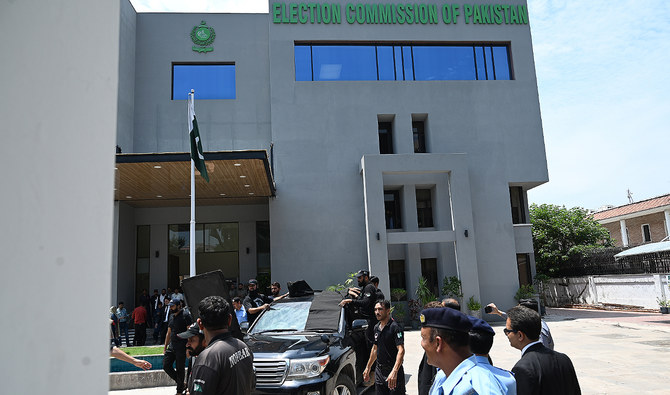

ISLAMABAD: The Election Commission of Pakistan (ECP) this week initiated the process of consulting political parties on general elections, which are due in November but are widely expected to be delayed as the regulator must first draw new constituency boundaries based on the results of a fresh census.
As the ECP begins the consultations, all eyes will be on the Pakistan Tehreek-e-Insaf (PTI) party of former Prime Minister Imran Khan who has been at loggerheads with the election regulator for months, and is currently in prison after being convicted in a case involving the illegal sale of state gifts. Khan was accused last year of not declaring assets earned through the sale of the gifts he got from foreign dignitaries while he was in office from 2013-2022 and was subsequently barred by the election commission from holding public office over that non-disclosure. Earlier this month, a trial court upheld the ECP’s decision, handing Khan a three-year prison term. He is barred from holding public office for five years and, unless he wins an appeal in the case, is effectively out of the next election.
Even before his conviction, Khan has repeatedly publicly accused the ECP of bias against his party and is facing a case relating to the contempt of the electoral body and the chief election commissioner (CEC).
“As you are aware that the Election Commission of Pakistan is charged with the constitutional duty to organize and conduct elections in terms of Article 218 (3) of the Constitution of the Islamic Republic of Pakistan and to make such arrangements as are necessary to ensure that the election is conducted honestly, justly, fairly and in accordance with the law and that corrupt practices are guarded against,” the ECP said in in a letter to the PTI on Wednesday, inviting it to discuss issues surrounding the upcoming national polls.
The ECP said it wanted the party’s feedback on the delimitation of constituencies, preparation of electoral rolls, and the schedule of general election.
“You are requested to make it convenient to attend this important meeting in person or through authorized representatives with the Election Commission on Thursday 24th August, 2023 at 02:00 PM at ECP Secretariat Islamabad,” the regulator added.
Similar letters were also sent to representatives of other major parties, including the Pakistan Peoples Party, Pakistan Muslim League-Nawaz and Jamiat Ulema-e-Islam (F).
The ECP’s invitation to political parties also comes as President Dr. Arif Alvi on Wednesday invited the chief election commissioner, Sikandar Sultan Raja, to meet him to discuss an election date.
Under the constitution, general elections must be held within 90 days after the National Assembly’s dissolution. However, the outgoing Sharif government’s decision to approve the results of the 2023 digital census before it dissolved the Assembly on Aug. 9 meant the election regulator would be required to redraw hundreds of constituencies as per those results.
Last week, the Election Commission of Pakistan (ECP) issued a notification outlining its plan to finalize the delimitation of federal and provincial constituencies by December 14, meaning polls would not take place within the customary 90-day period and could be delayed until February.
Political analysts say if the caretaker set-up stretches beyond its constitutional tenure, a prolonged period without an elected government would allow the military — which already has an outsized role in Pakistani politics and security, economic and foreign policy — to consolidate control.
Two major Pakistani political parties, the Pakistan Peoples Party and Khan’s PTI, have rejected the timeline for redrawing of national and provincial constituencies announced by the election regulator, but the ECP says it is constitutionally bound to “delimit constituencies after every census [is] officially published.”


