

Two Palestinians arrested, one teenager shot dead after Israeli settlers killed: army

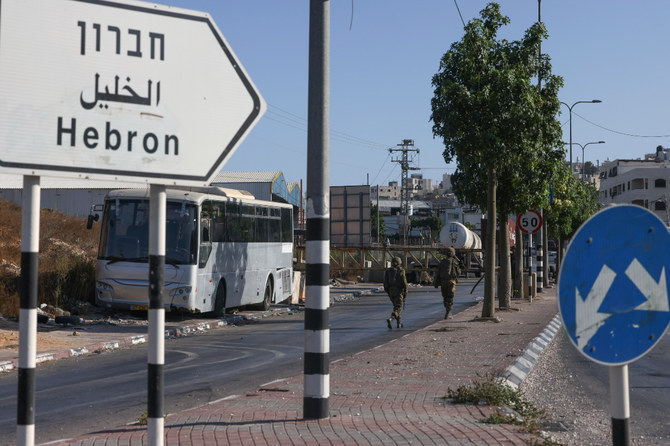
Israeli security forces man checkpoint at closed-off southern entrance of Hebron city in West Bank, near Israeli settlement where settler was killed a day earlier. (AFP)
Short Url
Updated 22 August 2023
Follow

Two Palestinians arrested, one teenager shot dead after Israeli settlers killed: army

  • Another raid came as Israeli security forces were still searching for Palestinian gunman that carried out shooting in Hawara

JERUSALEM: Israeli forces on Tuesday arrested two Palestinians suspected of shooting dead an Israeli settler near Hebron in the occupied West Bank, where violence has surged since early last year. Batsheva Nigri, 40, was killed on Monday in a drive-by shooting while traveling in a car with her daughter and a man near Hebron, in the second attack targeting Israelis in the territory within days.
Her daughter was unhurt but the man was wounded and was in serious condition, the Israeli army and medics said.
Two Palestinian residents of Hebron suspected of being the perpetrators of the shooting were arrested, the army said, after roads in the vicinity of the attack were blocked and a large manhunt was conducted.

On Tuesday also Israeli security forces stormed into a town the northern West Bank, leading to fighting that killed a 17-year-old Palestinian, according to Palestinian health officials, the latest violence to grip the occupied territory.
The Israeli military conducted an arrest raid before dawn in the town of Zababdeh south of Jenin, local medics said. The Palestinian Health Ministry reported that 17-year-old Othman Abu Kharj was fatally shot in the head. The raid came as Israeli security forces were still searching for the Palestinian gunman that carried out a shooting in the northern Palestinian city of Hawara that killed an Israeli father and son on Saturday.
The Israeli military did not immediately respond to a request for comment on the raid in Zababdeh.
Hebron shooting
The two Palestinians arrested on Tuesday related the the women killing were questioned according to the army this morning, “During their initial questioning, the two linked themselves to carrying out the attack,” the army said in a statement, adding they had turned in the weapon allegedly used in the attack.
Nigri was a teacher and resident of Beit Hagai, an Israeli settlement south of Hebron.
The Palestinian militant group Hamas, which controls the Gaza Strip, had called her killing a “heroic act” and a “normal response” to settlement projects.
The attack came two days after an Israeli father and son were shot dead at a car wash in the town of Hawara in the West Bank.
Israel has yet to make any arrests in that case despite a search operation that has seen troops raid villages and carry out house-to-house searches.
There has been a surge in violence in the West Bank since early last year, with a string of attacks by Palestinians on Israeli targets, repeated deadly Israeli army raids and violence by Jewish settlers against Palestinian communities.
Israel has occupied the West Bank since the 1967 Six-Day War, when it also seized the Gaza Strip but withdrew from it in 2005.
Excluding annexed east Jerusalem, the West Bank is home to nearly three million Palestinians and around 490,000 Israelis who live in settlements considered illegal under international law.
At least 218 Palestinians have been killed so far this year in violence linked to the Israeli-Palestinian conflict.
Some 31 Israelis, one Ukrainian and one Italian have also been killed, according to an AFP tally compiled from official sources on both sides.
They include, on the Palestinian side, combatants as well as civilians and, on the Israeli side, three members of the Arab minority.


Aoun reassures Lebanon that risk of war is ‘fading’ in year-end message

Lebanese President Joseph Aoun. (File/AFP)
Updated 46 min 55 sec ago
Follow

Aoun reassures Lebanon that risk of war is ‘fading’ in year-end message

  • Israeli military spokesperson said it targeted 380 armed operatives, 950 military sites in Lebanon in past year
  • Beirut’s southern suburb residents pledge to avoid celebratory gunfire on New Year’s Eve

BEIRUT: Lebanese President Joseph Aoun on Wednesday sought to reassure citizens in his year-end address, saying “the overall atmosphere remains positive and the risk of war is fading,” amid widespread concern over a possible Israeli escalation against Hezbollah.

Fear of renewed attacks followed Israeli criticism of a Lebanese Army weapons-confiscation operation that is set to enter its second phase at the start of the 2026. The plan include the expansion from areas north of the Litani River to the Awali River, after the first phase was completed south of the Litani.

President Aoun cautioned that this does not mean “completely eliminating the risk of war,” stressing that “work is underway with various friendly and brotherly countries to completely neutralize the threat of war.”

Addressing Internal Security officials, Aoun said that the “situation is among the best,” noting that this assessment has been echoed by foreign visitors to Lebanon, despite the strain caused by large numbers of Syrian and Palestinian refugees.

He added that security forces were fully carrying out their duties and solving crimes with notable speed, pointing to the successful visit of Pope Leo XIV earlier this year as further evidence of progress.

On Monday, Egyptian Ambassador to Lebanon Alaa Moussa stressed during a Beirut press conference that implementing “international agreements and resolutions, foremost among them the Nov. 27, 2014 agreement and Resolution 1701, constitutes the fundamental approach to sparing Lebanon further security tensions,” speaking of “dire consequences that could result from continued escalation.”

The Egyptian diplomat indicated that “there are no hidden warnings or threats directed at Lebanon, but rather a clear commitment to the agreements signed by the concerned parties, which must be fully implemented by everyone.”

The ambassador stated that his country, under the directives of President Abdel Fattah El-Sisi, is “exerting intensive efforts to reduce tensions in southern Lebanon and the region in general, through active diplomatic contacts led by the Minister of Foreign Affairs Badr Abdelatty with relevant regional and international parties.”

Israeli military spokesman Avichai Adraee published on Wednesday a summary of Israeli attacks on Hezbollah in Lebanon in 2025.

“The Army targeted approximately 380 armed operatives, including Ali Tabatabai (chief of staff), Hassan Kamal (responsible for anti-tank missiles on the southern front), Abbas Hassan Karky (logistics officer in the southern command), and Khodr Saeed Hashem (commander of the naval force in the Radwan Unit),” he said.

“It also attacked approximately 950 military targets, including 210 launch sites and weapons depots, 140 military buildings, and about 60 tunnel entrances,” Adraee added.

In the statement, he accused Hezbollah of committing about 1,920 ceasefire violations and said the military would continue its raids and targeting operations in the new year.

UNIFIL Com. Gen. Diodato Abagnara said in his end-of-the-year message that “UNIFIL will continue to support Lebanon and Israel in implementing their obligations under Resolution 1701, building on the stability achieved in 2025 and strengthening efforts toward a lasting peace.”

As part of the weapons restriction plan, on Tuesday, the Fatah movement — the Palestinian National Security Forces in Lebanon — handed over a new batch of heavy and medium weapons from the Ain Al-Hilweh Palestinian refugee camp to the Lebanese Army in four trucks, away from the media.

This is the second batch of weapons to be handed over from the camp, which is the largest Palestinian refugee camp in Lebanon. It represents the fifth phase of the Palestinian weapons handover process in the camps, four of which were completed between Aug. 21 and Sept. 13, 2025, encompassing nine camps, including Ain Al-Hilweh.

The handover follows and implements an agreement reached between Aoun and Palestinian President Mahmoud Abbas after the latter’s visit to Lebanon in May.

Abbas had announced “the Palestinian Authority’s support for the Lebanese state’s plan to extend its authority over all Lebanese territory, including the Palestinian camps.”

Hamas continues to refuse to hand over its weapons to the Lebanese Army, while Hezbollah maintains its weapons north of the Litani River.

The Lebanese Army implemented “exceptional security measures in various Lebanese regions on New Year’s Eve, with the aim of maintaining security.”

It called on citizens to “cooperate with the security measures taken to maintain public safety and prevent incidents,” warning of the consequences of firing weapons, which will be prosecuted as it poses a threat to public safety.

In another measure, authorities announced that gun licenses and traffic permits will be suspended until Jan. 2, 2026.

In Beirut’s southern suburbs, residents signed a pledge as part of an Internal Security Forces campaign against celebratory gunfire on New Year’s Eve, committing not to fire weapons in public and to report violations with photos or videos.