

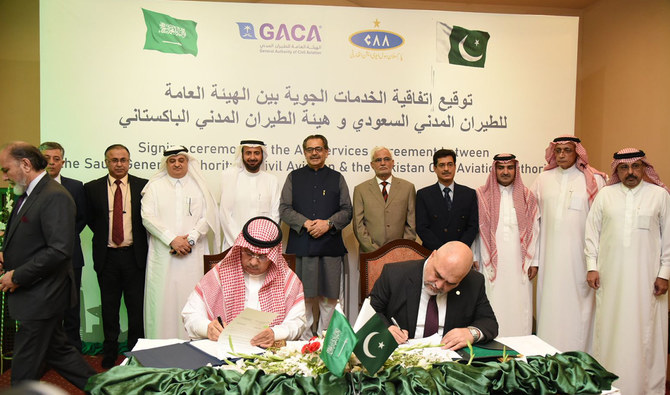
Pakistan, Saudi Arabia sign ‘Air Services Agreement’ to increase number of flights

1 / 2
Pakistani and Saudi civil aviation representatives sign a memorandum of understanding in Islamabad, Pakistan, on August 21, 2023. (Photo Courtesy: Ministry of Religious Affairs)
2 / 2
Pakistani and Saudi civil aviation representatives sign a memorandum of understanding in Islamabad, Pakistan, on August 21, 2023. (Photo Courtesy: Ministry of Religious Affairs)
Short Url
Updated 22 August 2023
Follow

Pakistan, Saudi Arabia sign ‘Air Services Agreement’ to increase number of flights

  • Saudi Hajj Minister Dr. Tawfiq Al-Rabiah is in Pakistan on a four-day visit
  • Will inaugurate Nasuk exhibition tomorrow, meet Umrah tour companies

ISLAMABAD: Saudi Hajj Minister Dr. Tawfiq Al-Rabiah said on Monday the Kingdom and Pakistan had signed a memorandum of understanding (MOU) titled the ‘Air Services Agreement’ to increase the number of flights between the two countries.

Al-Rabiah, who is also chairman of the administrative board of the Two Holy Mosques, is in Pakistan on a four-day visit. He is leading a large delegation comprising the deputy ministers of Hajj and Umrah, tourism and international cooperation, the president of Saudi Airlines, the general authority of civil aviation, and representatives from Saudi Aviation.

“During this visit, we signed an MOU with the help of Allah, the Air Services Agreement,” Al-Rabiah said at a joint press conference with Pakistan’s Caretaker Minister of Religious Affairs, Aneeq Ahmed.

“Under this agreement, the number of flights between Pakistan and Saudi Arabia will increase due to which the cost of travel will also be reduced.”
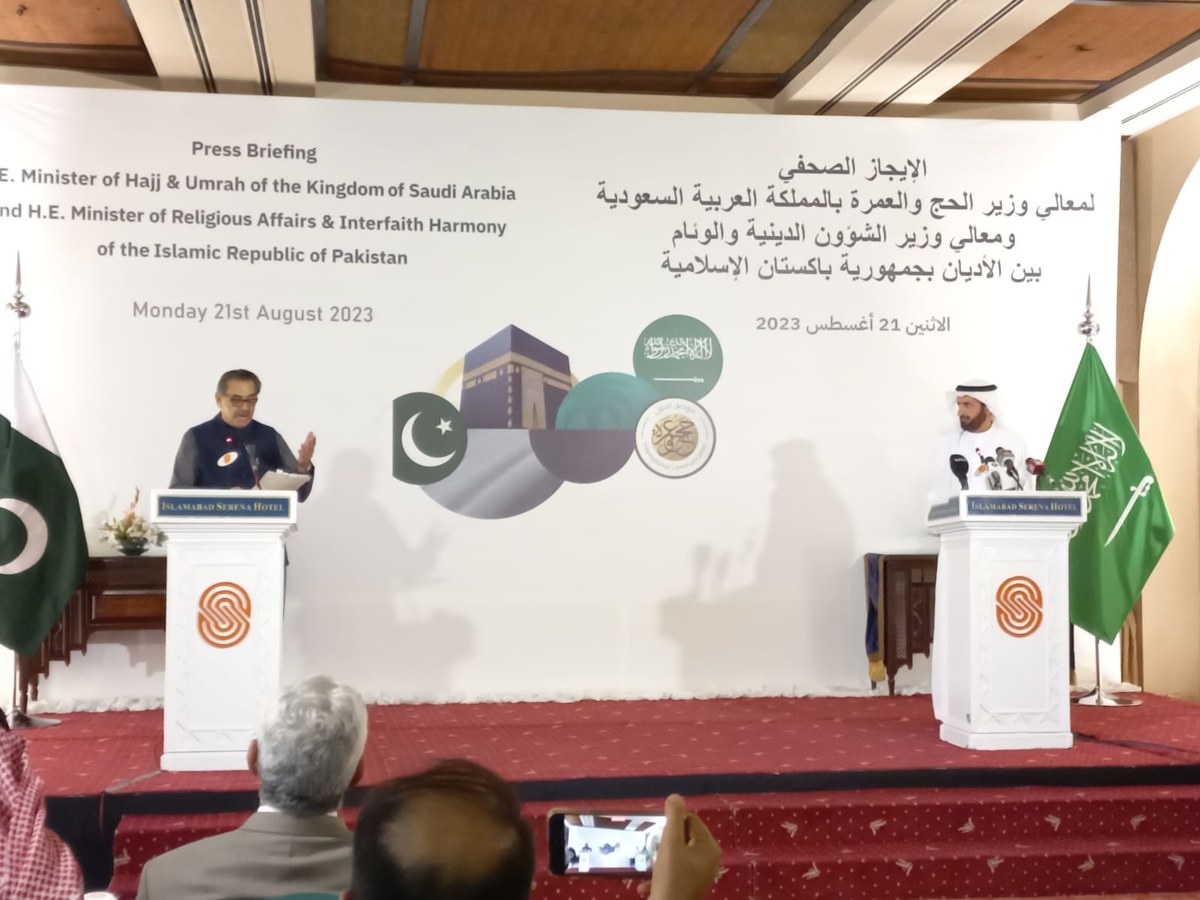


Saudi Hajj Minister Dr. Tawfig Al-Rabiah (right) addresses joint press conference with Pakistani caretaker religious affairs minister Aneeq Ahmed in Islamabad, Pakistan on August 21, 2023. (AN Photo)

Al-Rabiah said his delegation had held a meeting with Pakistan’s Minister of Religious Affairs and discussed “opportunities and challenges to ensure maximum facilities for Pakistani visitors.”

The minister said a substantial number of Pakistanis had visited Saudi Arabia last year and the Kingdom anticipated an even greater number this year.

“In efforts to enhance the pilgrimage experience, we’ve renovated and opened eight historical sites in Madinah,” he said, and approximately 100 more sites would open soon in Makkah and Madinah.

Saudi Arabia aimed to enhance pilgrim services by opening up competition among companies, thereby improving services and reducing costs, the minister added.

“As part of these initiatives, we will inaugurate a Nasuk exhibition in Karachi tomorrow and meet with Umrah tour operators and companies, aiming to simplify the process further,” Al-Rabiah said.

Nusuk is the first-ever official planning, booking and experience platform to create Hajj or Umrah itineraries to Makkah, Madina, and beyond. With Nusuk, travelers from all over the world can easily organize their entire visit, from applying for an eVisa to booking hotels and flights.
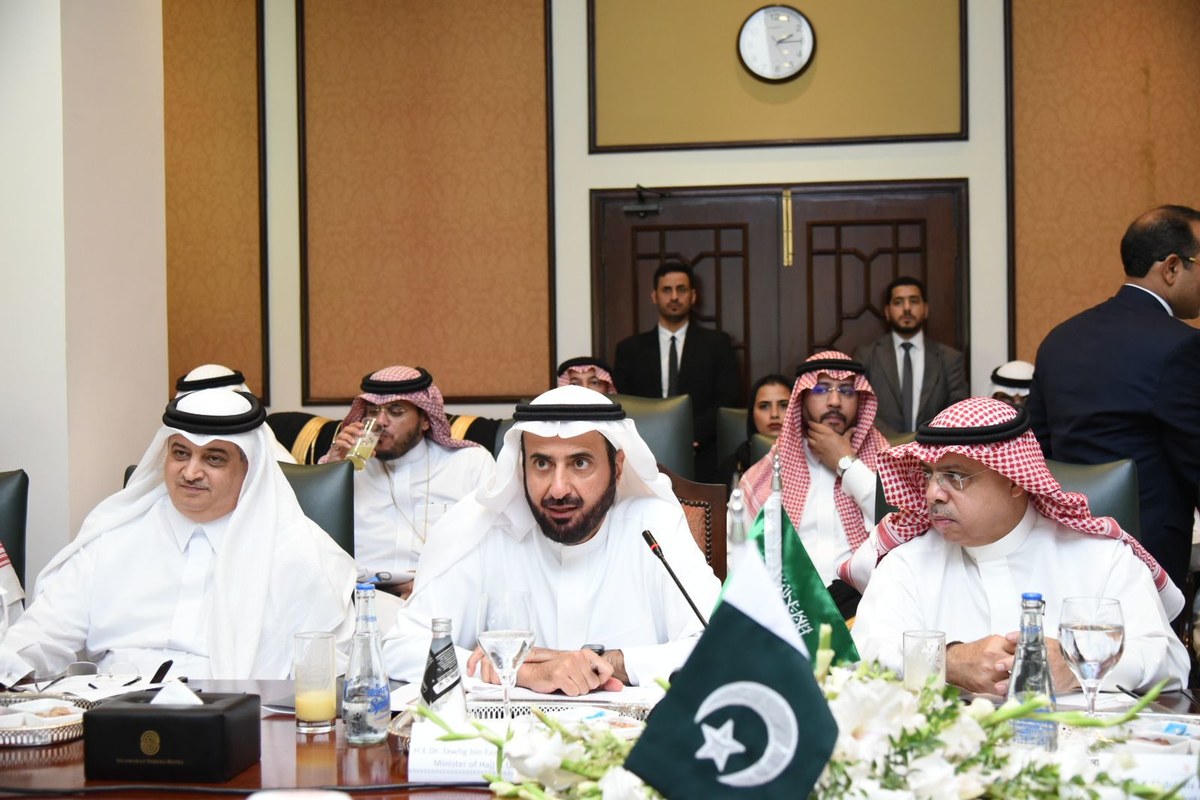


Pakistani and Saudi delegations hold talks in Islamabad, Pakistan on August 21, 2023. (Photo Courtesy: Ministry of Religious Affairs)

Pakistani minister Ahmed expressed gratitude to the Kingdom for restoring Pakistan’s pre-pandemic Hajj quota of 179,210 and requested the visiting minister to increase the figure as Pakistan’s population had increased by at least 20 million as per a new census.

“We have requested the Excellency [Saudi Hajj Minister] that our census shows a population of around 240 million, so, please increase the quota and he has promised that the quota will increase,” he added.

Ahmed said he also requested the visiting minister to expand the Makkah Route Initiative in Pakistan. The project was launched in 2019 in Pakistan and four other Muslim countries, streamlining Hajj visas, customs and health requirements at departure airports. This year, over 26,000 Pakistani pilgrims benefited from the project at Islamabad airport where the facility has been introduced.

“We want this facility to move forward, by including Karachi, Lahore, Quetta, and Peshawar and his excellency promised us that he will work on it,” Ahmed said.

Pakistan has also requested a fingerprinting exemption for Pakistani pilgrims above the age of 65, the minister added. 


Pakistan calls for new global cricket body, says ICC ‘hostage to Indian politics’

Updated 5 sec ago
Follow

Pakistan calls for new global cricket body, says ICC ‘hostage to Indian politics’

  • Pakistan’s government has barred its team from playing against India in World Cup fixture on Feb.15
  • India generates largest share of cricket’s commercial revenue, enjoying overarching influence in the sport

ISLAMABAD: Pakistan’s Defense Minister Khawaja Asif called for a new global cricket governing body on Tuesday, saying that the International Cricket Council (ICC) has become hostage to Indian political interests amid a fresh row between the neighbors ahead of the T20 World Cup 2026. 

Pakistan’s government announced earlier this week that it has cleared its national men’s team to play the upcoming World Cup, scheduled to be held in India and Sri Lanka from Feb. 7. However, Islamabad said the national team will boycott its upcoming fixture against India on Feb. 15 without mentioning a reason. The ICC responded by saying that Pakistan’s decision was “not in the interest of the global game or the welfare of fans worldwide, including millions in Pakistan.”

Pakistan’s dispute with the ICC can be traced back to it expressing displeasure recently at the cricket body’s decision to replace Bangladesh with Scotland for the World Cup. Bangladesh had requested the global governing body shift its matches to any another venue outside India owing to security concerns, as political tensions surge Delhi and Dhaka surge. 

“A new international organization of cricket is needed to keep the spirit of the gentleman’s game alive,” Asif wrote on social media platform X. “ICC has become hostage to Indian political interests in South Asia.”

India generates the largest share of cricket’s commercial revenue and hence enjoys overarching influence over the sport. Critics argue that this financial contribution translates into decisive leverage within the ICC. 

A large part of that revenue comes from the Indian Premier League (IPL), the sport’s most lucrative T20 cricket competition, which is run by the Board of Control for Cricket in India (BCCI). Between 2024 and 2027, the IPL is projected to earn $1.15 billion, nearly 39 percent of the ICC’s total annual revenue, according to international media reports. 

The ICC is headed by Jay Shah, the son of Indian Home Minister Amit Shah. The ICC chair is expected to be independent from any cricket board and hence take impartial decisions.

India and Pakistan engaged in a military confrontation that lasted for four days in May last year before Washington brokered a ceasefire. Militaries of the two countries pounded each other with drones, missiles, fighter jets and exchanged artillery fire in what was the worst fighting between them since 1999. 

These bilateral tensions have made their way to cricket, with India refusing to shake hands with Pakistani cricketers during the September 2025 Asia Cup tournament between both sides. The two teams met for three matches, all of which India won, and did not shake hands before or after the fixtures. 

The two countries have not played a full bilateral series since 2012–13 due to political tensions. They meet largely at neutral venues.