

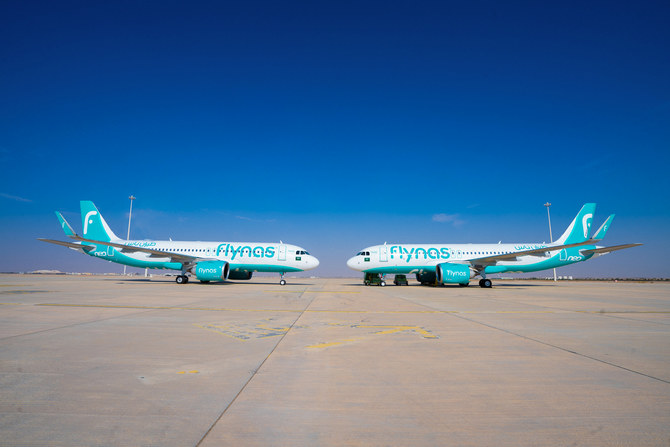
flynas launches direct flights linking Jeddah and Osh in Kyrgyzstan

The newly established route, operating from King Abdulaziz International Airport in Jeddah to Osh International Airport, encompasses three weekly flights each on Monday, Wednesday and Friday. (Supplied)
Short Url
Updated 23 August 2023
Follow

flynas launches direct flights linking Jeddah and Osh in Kyrgyzstan

RIYADH: In a bid to further advance Saudi Arabia’s aviation sector, the Kingdom’s budget airline flynas has inaugurated direct flights connecting Jeddah and Osh, the second largest city in Kyrgyzstan.

The newly established route, operating from King Abdulaziz International Airport in Jeddah to Osh International Airport, encompasses three weekly flights each on Monday, Wednesday and Friday, as outlined in an official statement.

This strategic route was launched in collaboration with Saudi Arabia’s Air Connectivity Program and flynas’ expansion plans, noted the statement.

The Air Connectivity Program, introduced in 2021, aims to bolster the Kingdom’s tourism sector growth by enhancing air connectivity and developing existing and potential air routes.

Concurrently, flynas intends to expand its reach by serving a total of 165 domestic and international destinations, aligning with the objectives of Vision 2030, a blueprint aiming to establish Saudi Arabia as a global tourism destination.

Presently, flynas operates more than 70 domestic and international routes, encompassing 1,500 weekly flights.

The press statement further disclosed that flynas intends to broaden its operations from Jeddah to Kyrgyzstan, with plans to introduce flights to the capital city, Bishkek, by October.

The collaborative effort between flynas and the Air Connectivity Program is expected to contribute to Saudi Arabia’s National Tourism Strategy, targeting 100 million visitors by 2030 and increasing the tourism sector’s contribution to the Kingdom’s gross domestic product to over 10 percent.

Earlier in August, flynas introduced direct weekly flights linking Jeddah and Casablanca, Morocco.

In June, flynas inked a $3.73 billion deal with Airbus to purchase 30 aircraft during the Paris Air Show, with plans to expand its long-haul destinations across its route network. This agreement included 10 A321XLRs, aimed at expanding flynas’ long-haul destinations, in addition to its existing fleet of 21 A320neos, 13 A320ceos, and four A330-300s.

Furthermore, flynas inked a memorandum of understanding with Saudi Investment Recycling Co. this month to promote integrated waste management practices. This partnership is poised to facilitate sustainability-driven collaboration for an advanced circular economy.

Founded in 2007, flynas has transported over 60 million passengers to date, according to the airline’s data.


OPEC+ approves gradual output increase from April amid market uncertainty 

Updated 7 sec ago
Follow

OPEC+ approves gradual output increase from April amid market uncertainty 

RIYADH: Eight OPEC+ producers agreed to raise oil output gradually from April, citing healthy market fundamentals and a stable global economic outlook, after ministers met virtually to assess market conditions and determine future supply policy. 

Saudi Arabia, Russia, Iraq, the UAE, Kuwait, Kazakhstan, Algeria and Oman approved a production increase of 206,000 barrels per day for April, according to a statement. 

The increase marks the start of a gradual unwinding of 1.65 million barrels per day in voluntary reductions introduced in April 2023 to shore up prices.  

The move comes as the US-Israeli conflict with OPEC+ member Iran and Tehran’s retaliation have disrupted shipments in the Middle East. Oil, gas and other cargoes moving through the Strait of Hormuz have faced interruptions since Feb. 28 after shipowners received warnings from Iran that the area was closed to navigation, Reuters reported. 

In a statement released after the talks, the eight nations cited a “steady global economic outlook and current healthy market fundamentals, as reflected in the low oil inventories,” as the rationale for the measured production increase. 

The statement stressed that the full 1.65 million bpd “may be returned in part or in full subject to evolving market conditions and in a gradual manner.” 

They also stressed they retain flexibility to increase, pause or reverse the supply hike if needed. That includes the option of reinstating cuts announced in November 2023, when several members pledged additional voluntary reductions totaling 2.2 million barrels per day. 

The producers reiterated their commitment to the broader Declaration of Cooperation and said compliance with output targets, including voluntary adjustments, will continue to be monitored by the Joint Ministerial Monitoring Committee. 

The group also reaffirmed plans to compensate for any overproduction recorded since January 2024, saying the phased increase would allow participating countries to accelerate those efforts. 

Brent crude futures jumped on Feb. 27 to $73 per barrel, the highest level since July, amid fears of a wider Middle East conflict and potential supply disruptions through Hormuz, which accounts for more than 20 percent of global oil transit, Reuters reported. 

Oil prices are expected to rise, with Barclays lifting its Brent crude forecast to around $100 a barrel from $80 a day earlier, while analysts said prices could jump by as much as $20 per barrel when trading resumes on March 2 if tensions escalate further.

The eight countries will continue holding monthly reviews of market conditions, conformity and compensation levels, with the next meeting scheduled for April 5.