

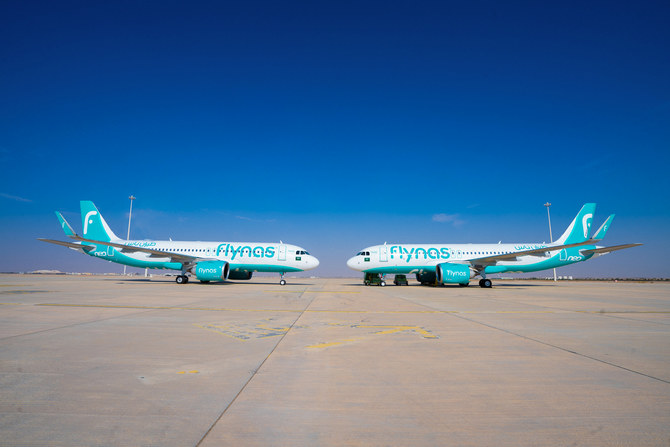
flynas launches direct flights linking Jeddah and Osh in Kyrgyzstan

The newly established route, operating from King Abdulaziz International Airport in Jeddah to Osh International Airport, encompasses three weekly flights each on Monday, Wednesday and Friday. (Supplied)
Short Url
Updated 23 August 2023
Follow

flynas launches direct flights linking Jeddah and Osh in Kyrgyzstan

RIYADH: In a bid to further advance Saudi Arabia’s aviation sector, the Kingdom’s budget airline flynas has inaugurated direct flights connecting Jeddah and Osh, the second largest city in Kyrgyzstan.

The newly established route, operating from King Abdulaziz International Airport in Jeddah to Osh International Airport, encompasses three weekly flights each on Monday, Wednesday and Friday, as outlined in an official statement.

This strategic route was launched in collaboration with Saudi Arabia’s Air Connectivity Program and flynas’ expansion plans, noted the statement.

The Air Connectivity Program, introduced in 2021, aims to bolster the Kingdom’s tourism sector growth by enhancing air connectivity and developing existing and potential air routes.

Concurrently, flynas intends to expand its reach by serving a total of 165 domestic and international destinations, aligning with the objectives of Vision 2030, a blueprint aiming to establish Saudi Arabia as a global tourism destination.

Presently, flynas operates more than 70 domestic and international routes, encompassing 1,500 weekly flights.

The press statement further disclosed that flynas intends to broaden its operations from Jeddah to Kyrgyzstan, with plans to introduce flights to the capital city, Bishkek, by October.

The collaborative effort between flynas and the Air Connectivity Program is expected to contribute to Saudi Arabia’s National Tourism Strategy, targeting 100 million visitors by 2030 and increasing the tourism sector’s contribution to the Kingdom’s gross domestic product to over 10 percent.

Earlier in August, flynas introduced direct weekly flights linking Jeddah and Casablanca, Morocco.

In June, flynas inked a $3.73 billion deal with Airbus to purchase 30 aircraft during the Paris Air Show, with plans to expand its long-haul destinations across its route network. This agreement included 10 A321XLRs, aimed at expanding flynas’ long-haul destinations, in addition to its existing fleet of 21 A320neos, 13 A320ceos, and four A330-300s.

Furthermore, flynas inked a memorandum of understanding with Saudi Investment Recycling Co. this month to promote integrated waste management practices. This partnership is poised to facilitate sustainability-driven collaboration for an advanced circular economy.

Founded in 2007, flynas has transported over 60 million passengers to date, according to the airline’s data.


US imposes preliminary 126% tariffs on solar imports from India

Updated 12 sec ago
Follow

US imposes preliminary 126% tariffs on solar imports from India

RIYADH: The administration of US President Donald Trump has imposed preliminary tariffs of up to 146 percent on solar panels imported from India, Indonesia, and Laos, after concluding that these countries provided unfair support to their manufacturing sectors.

The move is expected to benefit US producers, but in turn, could raise costs for consumers, according to Bloomberg.

The US Department of Commerce said on Feb. 24 that the tariff rates reflect the level of support provided, at 126 percent on imports from India, between 86 percent and 143 percent on Indonesia, and 81 percent on Laos.

The US claims that this support allows foreign producers to sell their exports in the US market at prices below production costs, harming the competitiveness of domestic manufacturers.

While these tariffs are expected to favor domestic manufacturers, they will negatively affect US renewable energy project developers, who have long relied on low-cost foreign supplies, exacerbating uncertainty in a sector already influenced by fluctuating policies and regulatory decisions in Washington.

A different customs path for solar tariffs

These duties are separate from the broader global tariffs previously imposed by Trump, which the US Supreme Court overturned last week. Following the ruling, Trump introduced new tariffs of 10 percent, with a warning that they could rise to 15 percent.

Earlier this month, the president reached a bilateral trade agreement with India aimed at easing economic tensions between the two countries.

According to Bloomberg NEF data, India, Indonesia, and Laos accounted for 57 percent of US solar panel imports in the first half of 2025, with some project developers shifting to importing panels from these countries after Washington imposed high tariffs on four Southeast Asian countries that had once represented the largest share of imports.

Pressure on Indian manufacturers

Vikram Bagri, an analyst at Citi, wrote in a research note on Feb. 24 that the relatively high tariff levels will make the US market almost closed to solar panel manufacturers in India.

The US solar industry group, the Alliance for American Solar Manufacturing and Trade, had requested the Department of Commerce to open an investigation into the support, arguing that the step was necessary to protect the domestic industry.

Tim Brightbill, co-chair of the international trade practice at Wiley Rein and the alliance’s lead attorney, said: “The results announced today represent a pivotal step toward restoring fair competition in the US solar market.”

He added: “US manufacturers are investing billions of dollars to rebuild production capacity domestically and create well-paying jobs. These investments cannot succeed if unfairly traded imports continue to distort the market.”

The Department of Commerce is expected to issue a final decision on the investigation on July 6, while a parallel probe is underway to impose anti-dumping duties on solar cell imports from India, Indonesia, and Laos.