Afrin: Syrians in the country’s rebel-held north on Monday marked the 10-year anniversary of chemical attacks that killed over 1,400 people near Damascus, one of the conflict’s many horrors that went unpunished.
“I was in such shock. I smelt death,” said paramedic Mohammed Sleiman from Zamalka in Eastern Ghouta, who lost five members of his family that day.
On August 21, 2013, regime forces attacked Eastern Ghouta and Moadamiyet Al-Sham, rebel-held areas outside the capital.
The opposition accused the regime of using toxic gas in the attacks, which killed around 1,400 people, including more than 400 children.
The government denied the allegations.
Speaking from the northern city of Afrin, held by pro-Turkish rebels, Sleiman recalled rushing to the scene after hearing news of the attack.
He wrapped his face with a piece of cloth to protect himself from the gas.
“I found a large number of people hurt or dead. It was like the apocalypse. The scene was indescribable,” the 40-year-old told AFP ahead of the anniversary.
When he went back to his family home, he found it empty. With his brother, he went to look for them at a nearby medical facility.
“I found my father and all the neighbors, all of them just with numbers, no names. I remember my father was number 95. I identified the bodies of the people I knew,” he said.
Syria’s civil war broke out in 2011 after the government’s repression of peaceful demonstrations escalated into a deadly conflict that pulled in foreign powers and global jihadists.
The war has killed more than half a million people and forced around half of the country’s pre-war population from their homes.
Sleiman later learned that his other brother, his sister-in-law and their two children had also been killed in the attack.
“We dug a communal grave for hundreds of people and buried them close together,” he said.
“When I tell the story, I can see it all in front of me as if it was now,” he said, adding that he was receiving psychological counselling because of the trauma.
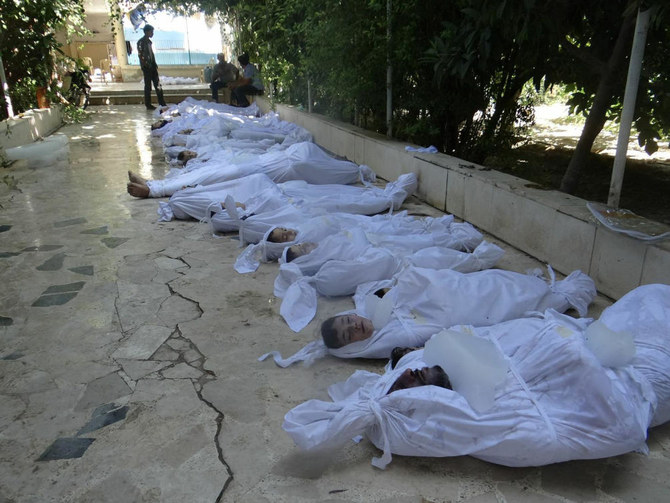
Activists in 2013 posted dozens of amateur videos on YouTube said to show the effects of the attack, including footage of dozens of corpses, many of them children, outstretched on the ground.
Other images showed unconscious children, people foaming at the mouth and doctors apparently giving them oxygen to help them breathe.
The scenes provoked revulsion and condemnation around the globe.
A UN report later said there was clear evidence sarin gas was used.
Despite insisting the use of chemical weapons was a red line, then US president Barack Obama held back on retaliatory strikes, instead reaching a deal with Russia on the dismantlement of Syria’s chemical arsenal under UN supervision.
Eastern Ghouta returned to regime control in 2018.
Survivors and activist gathered at several sites in Syria’s opposition-held north and northwest Syria on Sunday to mark the anniversary.
At a commemoration in Afrin, survivors shared their stories while young children put on a small performance, re-enacting the horror.
The regime of Syrian President Bashar Assad agreed in 2013 to join the Organization for the Prohibition of Chemical Weapons (OPCW) global watchdog and give up all chemical weapons.
The OPCW has since blamed Assad’s regime for a series of chemical attacks during Syria’s civil war.
Syria’s OPCW voting rights were suspended in 2021, in an unprecedented rebuke following poison gas attacks on civilians in 2017.
“We are not organizing this event in order to remember the massacre, as it is always on our minds,” said Mohammed Dahleh, a survivor from Zamalka who helped organize the Afrin commemoration.
“We are reminding the world... of its failure to support justice and rights,” he said.
“We will continue to insist on the need to hold Bashar Assad accountable.”


![]()

‘Apocalypse’: 10 years on, Syrians recall chemical attack
Short Url
https://arab.news/b9nt3
‘Apocalypse’: 10 years on, Syrians recall chemical attack
- The opposition accused the regime of using toxic gas in the attacks, which killed around 1,400 people, including more than 400 children
- Survivors and activists gathered at several sites in Syria’s opposition-held north and northwest Syria on Sunday to mark the anniversary


Latest updates





© 2026 SAUDI RESEARCH & PUBLISHING COMPANY, All Rights Reserved And subject to Terms of Use Agreement.