

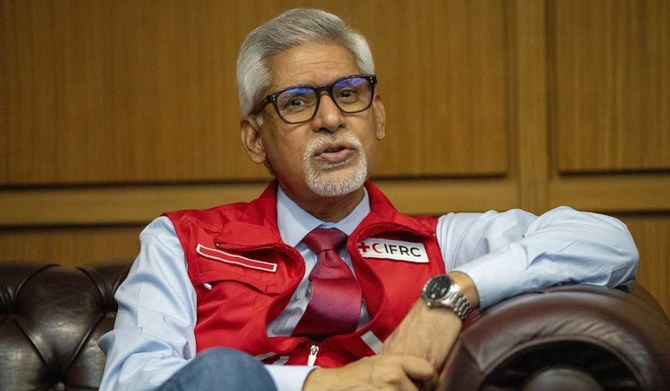

CAIRO: A global aid official urged the international community Sunday to provide more funds to help Sudanese citizens trapped by a monthslong military conflict between rival generals in the African nation.
Jagan Chapagain, the secretary-general of the International Federation of Red Cross and Red Crescent Societies, said his organizations have received only 7 percent of the $45 million they appealed for to help those inside Sudan. The war pits the military against the powerful paramilitary Rapid Support Forces.
“The needs are real,” he told The Associated Press in an interview in Cairo. “Sudanese people need urgent support, urgent solidarity and urgent interest.”
Sudan was plunged into chaos in April when simmering tensions between the military, led by Abdel Fattah Burhan, and the RSF, commanded by Mohammed Hamdan Dagalo, exploded into open fighting in the capital, Khartoum, and elsewhere.
The conflict has turned Khartoum and other urban areas into battlefields. Many residents live without water and electricity, and the country’s health care system has nearly collapsed. The sprawling region of Darfur saw some of the worst bouts of violence in the conflict, and the fighting there has morphed into ethnic clashes with RSF and allied Arab militia targeting ethnic African communities.
Clashes also intensified earlier this month in the provinces of South Kordofan and West Kordofan. A rebel group attacked Kadugli, the provincial capital of South Kordofan and clashed with the military, killing and displacing civilians, according to the UN mission in Sudan.
In Al-Fula, the provincial capital of West Kordofan, fighting erupted for days between the military and the RSF before local officials helped stop the clashes, the UN mission, known as UNITAMS, said Sunday. But government offices, banks and the offices of the UN and other aid agencies were looted, it said
More than 3.4 million people were forced to flee their homes to safer areas inside Sudan, according to the United Nations’ migration agency. Over a million crossed into neighboring countries, including Egypt, Chad, South Sudan, Ethiopia and Central African Republic, the agency added.
Chapagain called for the international community to show the same solidarity with Sudanese people they showed last year when they rushed to help those who fled Russia’s invasion of Ukraine.
“I see the humanitarian side of the Ukraine is a good example. That’s how the world community can come together. We need a similar solidarity for Sudan now,” he said.
Along with the $45 million needed to help those inside Sudan, Chapagain said another $35 million is needed to provide assistance to those who fled the fighting to Sudan’s neighboring countries.
His comments came following a trip to the Egyptian border with Sudan, where he met with customs officials and Sudanese refugees who fled the fighting in Khartoum. Egypt received more than 272,000 Sudanese as of Aug. 1, according to official figures.
Although the operations at the Egyptian side of the border were organized, he said, there were long lines for people on the Sudanese side waiting to be allowed into Egypt. He said between 400 and 600 people are crossing daily into Egypt compared to thousands in the first weeks of the war.
The Egyptian government had allowed women and children to cross without visas in the first weeks of the war, but in June it began requiring visas for all Sudanese citizens despite objections from activists and rights groups.
Chapagain said the Egyptian government is under economic pressure as they are hosting more than 9 million migrants, including Sudanese, Syrians and others, as well as the country’s growing population of over 105 million.
“They want to be generous. They want to be welcoming,” he said. “But at the same time, they do have concern in the sense that ... they are still a developing country.”


