

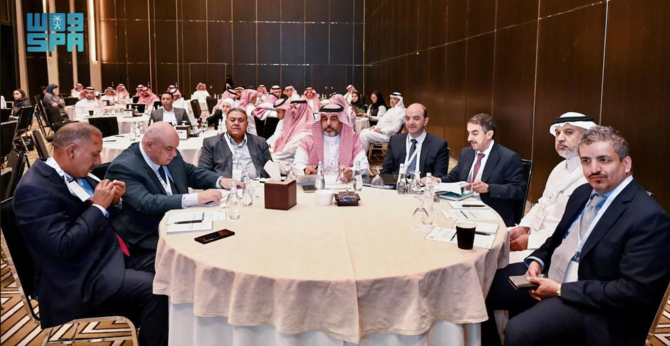
Saudi-Jordanian Joint Committee meets in Riyadh to promote trade ties  

The 18th session of the Saudi-Jordanian Joint Committee in Riyadh. (SPA)
Short Url
Updated 25 December 2023
Follow

Saudi-Jordanian Joint Committee meets in Riyadh to promote trade ties  

  • Meeting in line with the bilateral economic agreement signed between the two countries in 1962

RIYADH: The Saudi-Jordanian Joint Committee held its 18th session on Sunday in Riyadh in the presence of government officials from both sides, the Saudi Press Agency reported. 

Saif bin Saad Al-Faqar, assistant undersecretary for sector development at Saudi Arabia’s Ministry of Transport and Logistics Services, said that the meeting was held under the directives of the Kingdom’s leadership and was in line with the bilateral economic agreement signed between the two countries in 1962. 

The official emphasized the countries’ ambitions to expand cooperation in various fields and implement recommendations made at past committee sessions. 

Dana Al-Zoubi, secretary-general of the Jordanian Ministry of Industry, Trade and Supply, affirmed the countries’ strong relationship in various fields, adding that the session built on the efforts of meetings last year in Amman to improve trade and economic exchange. 

HIGHLIGHTS

• The meeting was held under the directives of the Kingdom’s leadership and was in line with the bilateral economic agreement signed between the two countries in 1962. 

• Saudi Arabia has been among the major investors in Jordan as it pumped in $14 billion worth of investment spread over 900 projects.

The meeting resulted in the drawing up agreements and discussions on the best ways to increase cooperation between the countries. 

Saudi Arabia and Jordan’s bilateral economic relations have been rapidly growing, with the latter aiming to boost cross-border investments in the Kingdom. 

According to the SPA, the trade between the two countries amounted to roughly $4.4 billion in 2021, up from around $3.1 billion in 2020.  

In June, the Jordanian Investment Council indicated it would roll out new projects in Saudi Arabia and other Gulf countries valued at $2.5 billion between 2023 and 2026. 

Additionally, Jordanian Investment Minister Kholoud Saqqaf invited entrepreneurs and investors from Saudi Arabia to take advantage of the country’s attractive investment environment.    

During a virtual meeting organized by the Ministry of Investment and Jordan Chamber of Commerce with the Saudi-Jordanian Business Council, Saqqaf said that economic relations between Jordan and Saudi Arabia had reached an “advanced” level in many areas, especially investment and trade.   

According to state-run news agency Petra, Jordan benefited from free trade agreements it had signed with many countries, allowing exports to numerous markets. 

The minister added that Saudi investments are among the most significant made by Jordan and are spread across many high-value sectors, such as infrastructure, banking, trade, tourism, real estate development, agriculture and healthcare. 


European gas prices soar almost 50% as Iran conflict halts Qatar LNG output

Updated 02 March 2026
Follow

European gas prices soar almost 50% as Iran conflict halts Qatar LNG output

  • Analysts warn prolonged disruption could push prices higher
  • Some shipments of oil, LNG through Strait of Hormuz suspended
  • Benchmark Asian LNG price up almost 39 percent

LONDON: ​Benchmark Dutch and British wholesale gas prices soared by almost 50 percent on Monday, after major liquefied natural gas exporter Qatar Energy said it had halted production due to attacks in the Middle East.

Qatar, soon to cement its role as the world’s second largest LNG exporter after the US, plays a major role in balancing both Asian and European markets’ demand of LNG.

Most tanker owners, oil majors and ‌trading houses ‌have suspended crude oil, fuel and liquefied natural ​gas shipments ‌via ⁠the ​Strait of ⁠Hormuz, trade sources said, after Tehran warned ships against moving through the waterway.

Europe has increased imports of LNG over the past few years as it seeks to phase out Russian gas following Russia’s invasion of Ukraine.

Around 20 percent of the world’s LNG transits through the Strait of Hormuz and a prolonged suspension or full closure would increase global competition for other ⁠sources of the gas, driving up prices internationally.

“Disruptions to ‌LNG flows would reignite competition between ‌Asia and Europe for available cargoes,” said ​Massimo Di Odoardo, vice president, gas ‌and LNG research at Wood Mackenzie.

The Dutch front-month contract at the ‌TTF hub, seen as a benchmark price for Europe, was up €14.56 at €46.52 per megawatt hour, or around $15.92/mmBtu, by 12:55 p.m. GMT, ICE data showed.

Prices were already some 25 percent higher earlier in the day but extended gains ‌after QatarEnergy’s production halt.

Benchmark Asian LNG prices jumped almost 39 percent on Monday morning with the S&P Global ⁠Energy Japan-Korea-Marker, widely used ⁠as an Asian LNG benchmark, at $15.068 per million British thermal units, Platts data showed.

“If LNG/gas markets start to price in an extended period of losses to Qatari LNG supply, TTF could potentially spike to 80-100 euros/MWh ($28-35/mmBtu),” Warren Patterson, head of commodities strategy at ING, said. The British April contract was up 40.83 pence at 119.40 pence per therm, ICE data showed.

Europe is also relying on LNG imports to help fill its gas storage sites which have been depleted over the winter and are currently around 30 percent full, the latest data from Gas Infrastructure ​Europe showed. In the European carbon ​market, the benchmark contract was down €1.10 at €69.17 a tonne