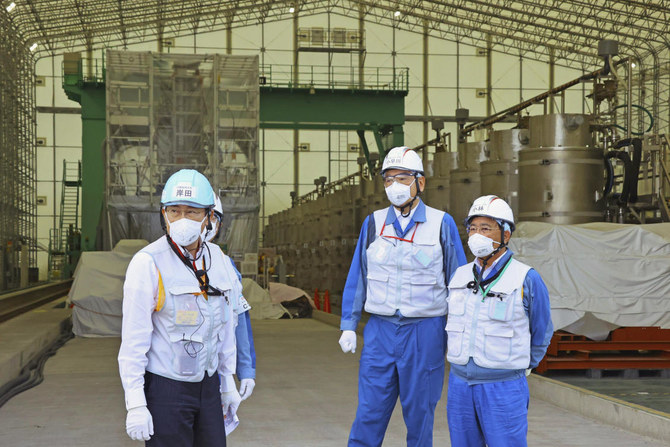
TOKYO: Japanese Prime Minister Fumio Kishida made a brief visit to the tsunami-wrecked Fukushima nuclear plant on Sunday to highlight the safety of an impending release of treated radioactive wastewater into the Pacific Ocean, a divisive plan that his government wants to start soon despite protests at home and abroad.
His trip comes hours after he returned home Saturday from a summit with US and South Korean leaders at the American presidential retreat of Camp David. Before leaving Washington on Friday, Kishida said it is time to make a decision on the treated water’s release date, which has not been set due to the controversy surrounding the plan.
Since the government announced the release plan two years ago, it has faced strong opposition from Japanese fishing organizations, which worry about further damage to the reputation of their seafood as they struggle to recover from the accident. Groups in South Korea and China have also raised concerns, turning it into a political and diplomatic issue.
The government and the plant operator, Tokyo Electric Power Co., say the water must be removed to make room for the plant’s decommissioning and to prevent accidental leaks from the tanks because much of the water is still contaminated and needs further treatment.
Japan has obtained support from the International Atomic Energy Agency to improve transparency and credibility and to ensure the plan by TEPCO meets international safety standards. The government has also stepped up a campaign promoting the plan’s safety at home and through diplomatic channels.
IAEA, in a final report in July, concluded that the TEPCO plan, if conducted strictly as designed, will cause negligible impact on the environment and human health, encouraging Japan to proceed.
Kishida told reporters after Sunday’s plant visit that he hoped to meet with the head of the national fisheries organization on Monday before his ministers decide the date at a meeting next week, Kyodo News agency reported. Kishida did not mention a starting date for the water release, which is widely expected to be at the end of August.
During his visit on Sunday, Kishida saw wastewater filtering and dilution facilities and met with TEPCO president Tomoaki Kobayakawa and other top officials. He urged the officials to prioritize safety in the release and help prevent reputational damage to local fisheries, Kyodo said.
While seeking understanding from the fishing community, the government has also worked to explain the plan to South Korea to keep the issue from interfering with their relationship-building. Japan, South Korea and the US are working to bolster trilateral ties in the face of growing Chinese and North Korean threats.
South Korean President Yoon Suk Yeol’s government recently showed support for the Japanese plan, but he faces criticism at home. During a joint news conference at Camp David, Yoon said he backs the IAEA’s safety evaluation of the plan but stressed the need for transparent inspection by the international community.
Kishida said Friday the outreach efforts have made progress, and that the decision will factor in safety preparations and measures for possible reputation damage on the fisheries.
A massive March 11, 2011, earthquake and tsunami destroyed the Fukushima Daiichi plant’s cooling systems, causing three reactors to melt and contaminating their cooling water. The water is collected, filtered and stored in around 1,000 tanks, which will reach their capacity in early 2024.
The water is being treated with what’s called an Advanced Liquid Processing System, which can reduce the amounts of more than 60 selected radionuclides to government-set releasable levels, except for tritium, which the government and TEPCO say is safe for humans if consumed in small amounts.
Scientists generally agree that the environmental impact of the treated wastewater would be negligible, but some call for more attention to dozens of low-dose radionuclides that remain in it.

Japan’s Kishida visits Fukushima plant to highlight safety before start of treated water release
Short Url
https://arab.news/2deus
Japan’s Kishida visits Fukushima plant to highlight safety before start of treated water release
- Since the government announced the release plan two years ago, it has faced strong opposition
Missiles pound Ukraine capital ahead of Russian invasion anniversary
- Kyiv has faced waves of overnight strikes in recent weeks as Moscow has intensified its winter assaults
- The strikes also prompted heightened vigilance across Ukraine’s western border
KYIV: Explosions rocked Kyiv before dawn on Sunday after officials warned of a ballistic missile attack, just two days before the fourth anniversary of Russia’s invasion.
AFP journalists in the capital heard a series of loud blasts beginning around 4:00 a.m. (0200 GMT), shortly after an air raid alert was issued.
“The enemy is attacking the capital with ballistic weapons,” the head of Kyiv’s military administration Tymur Tkachenko said on Telegram, urging people to remain in shelters.
The air force later extended the alert nationwide, warning of a broader missile threat.
Kyiv, regularly targeted by Russian missile and drone attacks since the start of the invasion on Feb. 24, 2022, has faced waves of overnight strikes in recent weeks as Moscow has intensified its winter assaults on energy and military infrastructure.
Temperatures had plunged to nearly minus 10C when the capital was struck again, with emergency services deployed across the city.
Tkachenko later said the attacks had caused a fire on the roof of a residential building.
The strikes also prompted heightened vigilance across Ukraine’s western border.
Poland’s Operational Command said early Sunday it was scrambling jets after detecting “long-range aviation of the Russian federation conducting strikes on the territory of Ukraine.”
It also came hours after blasts in Lviv, a western city near the Polish border that rarely sees deadly attacks.
Explosions ripped through a central shopping street around 12:30 am (2230 GMT Saturday), killing a policewoman and injuring 15 people after officers responded to a reported break-in.
“This is clearly an act of terrorism,” mayor Andriy Sadovyi said, offering no details on perpetrators.
Such attacks far from the front line have become more frequent over the past two years.
Four years of war
Ukraine will mark four years since Russia’s assault on Feb. 24, 2022, a withering war that has shattered towns, uprooted millions and killed large numbers on both sides.
Moscow occupies close to a fifth of Ukrainian territory and continues to grind forward in places, especially in the eastern Donbas region, despite heavy losses and repeated Ukrainian strikes on logistics.
Ukrainian President Volodymyr Zelensky said on Friday that Ukraine “is definitely not losing” the war and that victory remains the goal.
He said Ukrainian forces had clawed back about 300 square kilometers (116 square miles) of territory in recent counterattacks, gains AFP could not immediately verify.
If confirmed, they would be Kyiv’s most significant advances since 2023.
Sweeping outages of Starlink Internet terminals across the Ukraine front, shut down by owner Elon Musk following a plea from Kyiv, have enabled the push, according to Zelensky.
The bombardment also came amid a diplomatic push by Washington to end the four-year war.
Ukrainian, Russian and US envoys have met several times since January, but without a breakthrough.
Zelensky, under mounting pressure from Washington to consider concessions, plans consultations with European leaders in the coming days and wants deeper involvement from Middle Eastern states and Turkiye.
AFP journalists in the capital heard a series of loud blasts beginning around 4:00 a.m. (0200 GMT), shortly after an air raid alert was issued.
“The enemy is attacking the capital with ballistic weapons,” the head of Kyiv’s military administration Tymur Tkachenko said on Telegram, urging people to remain in shelters.
The air force later extended the alert nationwide, warning of a broader missile threat.
Kyiv, regularly targeted by Russian missile and drone attacks since the start of the invasion on Feb. 24, 2022, has faced waves of overnight strikes in recent weeks as Moscow has intensified its winter assaults on energy and military infrastructure.
Temperatures had plunged to nearly minus 10C when the capital was struck again, with emergency services deployed across the city.
Tkachenko later said the attacks had caused a fire on the roof of a residential building.
The strikes also prompted heightened vigilance across Ukraine’s western border.
Poland’s Operational Command said early Sunday it was scrambling jets after detecting “long-range aviation of the Russian federation conducting strikes on the territory of Ukraine.”
It also came hours after blasts in Lviv, a western city near the Polish border that rarely sees deadly attacks.
Explosions ripped through a central shopping street around 12:30 am (2230 GMT Saturday), killing a policewoman and injuring 15 people after officers responded to a reported break-in.
“This is clearly an act of terrorism,” mayor Andriy Sadovyi said, offering no details on perpetrators.
Such attacks far from the front line have become more frequent over the past two years.
Four years of war
Ukraine will mark four years since Russia’s assault on Feb. 24, 2022, a withering war that has shattered towns, uprooted millions and killed large numbers on both sides.
Moscow occupies close to a fifth of Ukrainian territory and continues to grind forward in places, especially in the eastern Donbas region, despite heavy losses and repeated Ukrainian strikes on logistics.
Ukrainian President Volodymyr Zelensky said on Friday that Ukraine “is definitely not losing” the war and that victory remains the goal.
He said Ukrainian forces had clawed back about 300 square kilometers (116 square miles) of territory in recent counterattacks, gains AFP could not immediately verify.
If confirmed, they would be Kyiv’s most significant advances since 2023.
Sweeping outages of Starlink Internet terminals across the Ukraine front, shut down by owner Elon Musk following a plea from Kyiv, have enabled the push, according to Zelensky.
The bombardment also came amid a diplomatic push by Washington to end the four-year war.
Ukrainian, Russian and US envoys have met several times since January, but without a breakthrough.
Zelensky, under mounting pressure from Washington to consider concessions, plans consultations with European leaders in the coming days and wants deeper involvement from Middle Eastern states and Turkiye.
© 2026 SAUDI RESEARCH & PUBLISHING COMPANY, All Rights Reserved And subject to Terms of Use Agreement.


