

Neonatal nurse in a British hospital guilty of killing 7 babies

1 / 2
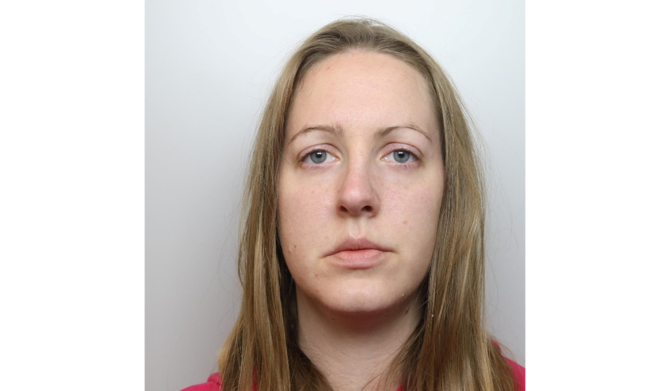
Lucy Letby been found guilty of killing seven babies and trying to kill six others. (REUTERS)
2 / 2
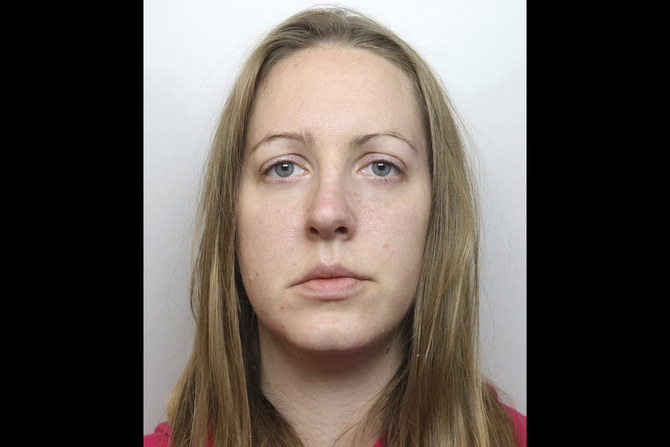
Lucy Letby been found guilty of killing seven babies and trying to kill six others. (File/AP)
Short Url
Updated 19 August 2023
Follow

Neonatal nurse in a British hospital guilty of killing 7 babies

  • Lucy Letby, 33, was convicted of killing five baby boys and two baby girls at the Countess of Chester hospital and attacking other newborns
  • Jury had been told she poisoned some of her infant victims by injecting them with insulin and others were injected with air or force fed milk

LONDON: A neonatal nurse in a British hospital was found guilty Friday of murdering seven babies and trying to kill six others during a yearlong campaign of deception that saw her prey on the vulnerabilities of sick newborns and their anxious parents.
Following 22 days of deliberation, the jury at Manchester Crown Court convicted 33-year-old Lucy Letby of killing the babies, including two triplet boys, in the neonatal unit at the Countess of Chester Hospital in northwest England between June 2015 and June 2016. She will be sentenced on Monday.
“Parents were exposed to her morbid curiosity and her fake compassion,” said senior prosecutor Pascale Jones. “Too many of them returned home to empty baby rooms. Many surviving children live with permanent consequences of her assaults upon their lives.”
Her attacks, Jones said, were “a complete betrayal of the trust placed in her.”

FASTFACT

Lucy Letby was accused of injecting air into their bloodstreams and administering air or milk into their stomachs via nasogastric tubes.

Families of the victims said they will “forever be grateful” to jurors who since last October had to sit through 145 days of “grueling” evidence.
In a joint statement read outside court, they also expressed their gratitude to all those who came to give evidence during the trial, which they described as “extremely harrowing and distressing” to listen to.
“To lose a baby is a heart-breaking experience that no parent should ever have to go through, but to lose a baby or to have a baby harmed in these particular circumstances is unimaginable,” they said.
Letby’s motives remain unclear, but the scale of her crimes points to intricate planning.
She was accused of deliberately harming the babies in various ways, including by injecting air into their bloodstreams and administering air or milk into their stomachs via nasogastric tubes. She was also accused of poisoning infants by adding insulin to intravenous feeds and interfering with breathing tubes.
The British government launched an independent inquiry soon after the verdicts that will look into the wider circumstances around what happened at the hospital, including the handling of concerns raised by staff.
“This inquiry will seek to ensure the parents and families impacted get the answers they need,” Health Secretary Steve Barclay said. “I am determined their voices are heard, and they are involved in shaping the scope of the inquiry should they wish to do so.”
One of the senior doctors at the Countess of Chester Hospital told the BBC he had repeatedly tried to raise the alarm about Letby but hospital executives failed to investigate the allegations.
Dr Stephen Brearley, the lead doctor in the neonatal unit, said the hospital tried to silence doctors who complained about Letby and delayed calling the police.
The jury of seven women and four men deliberated for 22 days before reaching the verdict. One juror was excused well into deliberations for personal reasons, and the judge later gave the remaining 11 jurors the option of reaching a verdict with 10 people in agreement instead of a unanimous decision.
Letby was found guilty of the seven murders and of seven charges of attempted murder relating to six children. She was cleared of two charges of attempted murder and the jury could not reach a verdict on several others.


Israel defends Somaliland move at UN amid concerns over Gaza motives

Women walk in front of a gas station, in the city of Hargeisa, Somaliland. (AFP file photo)
Updated 7 sec ago
Follow

Israel defends Somaliland move at UN amid concerns over Gaza motives

  • Some states question if recognition part of a bid to relocate Palestinians or establish military bases
  • US President Donald Trump's peace plan for Gaza states: "No one will be forced to leave Gaza, and ⁠those who wish to leave will be free to do so and free to return"
  • US accuses Security Council of double standards after Western countries recognized Palestinian state

UNITED NATIONS: Israel defended on Monday its formal recognition of the self-declared Republic of Somaliland, but several countries at the ​United Nations questioned whether the move aimed to relocate Palestinians from Gaza or to establish military bases.
Israel became the first country to recognize Somaliland as an independent and sovereign state on Friday.
The 22-member Arab League, a regional organization of Arab states in the Middle East and parts of Africa, rejects “any measures arising from this illegitimate recognition aimed at facilitating forced displacement of the Palestinian people or exploiting northern Somali ports to establish military bases,” Arab League UN Ambassador Maged Abdelfattah Abdelaziz told the UN Security Council.
“Against the backdrop of Israel’s previous references to Somaliland of the ‌Federal Republic of ‌Somalia as a destination for the deportation of Palestinian people, ‌especially ⁠from ​Gaza, its unlawful ‌recognition of Somaliland region of Somalia is deeply troubling,” Pakistan’s Deputy UN Ambassador Muhammad Usman Iqbal Jadoon told the council.
Israel’s UN mission did not immediately respond to a request for comment on the remarks or address any of them in its statement at the council meeting. In March, the foreign ministers of Somalia and Somaliland said they had not received any proposal to resettle Palestinians from Gaza.
US President Donald Trump’s peace plan for Gaza states: “No one will be forced to leave Gaza, and ⁠those who wish to leave will be free to do so and free to return.”
Israel’s coalition government, the most right-wing ‌and religiously conservative in its history, includes far-right politicians who advocate the ‍annexation of both Gaza and the West ‍Bank and encouraging Palestinians to leave their homeland.
Somalia’s UN Ambassador Abukar Dahir Osman said ‍council members Algeria, Guyana, Sierra Leone and Somalia “unequivocally reject any steps aimed at advancing this objective, including any attempt by Israel to relocate the Palestinian population from Gaza to the northwestern region of Somalia.”

SOMALILAND VS PALESTINIAN STATE
Somaliland has enjoyed effective autonomy — and relative peace and stability — since 1991 when Somalia descended into civil war, but ​the breakaway region has failed to receive recognition from any other country.
“It is not a hostile step toward Somalia, nor does it preclude future dialogue between ⁠the parties. Recognition is not an act of defiance. It is an opportunity,” Israel’s Deputy UN Ambassador Jonathan Miller told the council.
In September, several Western states, including France, Britain, Canada and Australia announced they would recognize a Palestinian state, joining more than three-quarters of the 193 UN members who already do so.
Deputy US Ambassador to the UN Tammy Bruce said: “This council’s persistent double standards and misdirection of focus distract from its mission of maintaining international peace and security.”
Slovenia’s UN Ambassador Samuel Zbogar disputed her argument, saying: “Palestine is not part of any state. It is illegally occupied territory ... Palestine is also an observer state in this organization.”
He added: “Somaliland, on the other hand, is a part of a UN member state and recognizing it goes against ... the UN Charter.”
Israel said last week that it would seek immediate cooperation with ‌Somaliland in agriculture, health, technology and the economy. The former British protectorate hopes Israeli recognition will encourage other nations to follow suit, increasing its diplomatic heft and access to global markets.