Why is blasphemy such a sensitive issue in Pakistan?

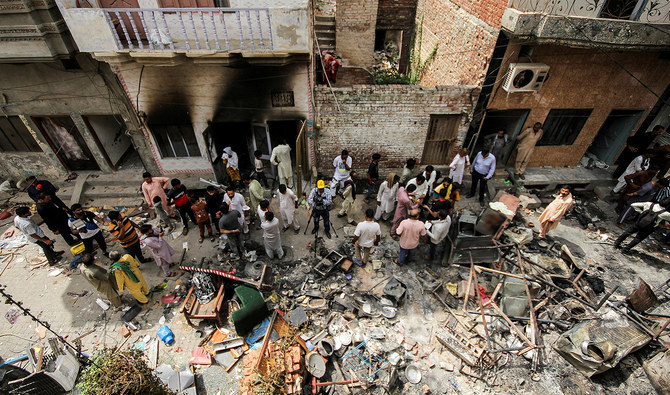
People and members of the media gather along a street in a Christian neighbourhood, a day after the church buildings and houses were vandalised by protesters in Jaranwala, Pakistan August 17, 2023. (REUTERS)
Short Url
Updated 18 August 2023
Follow

Why is blasphemy such a sensitive issue in Pakistan?

  • Since 1990, at least 85 people have been murdered in relation to blasphemy allegations, local media and researchers say
  • They have included individuals accused of blasphemy, their children, lawyers, judges hearing their cases, and others

ISLAMABAD: Blasphemy is an incendiary charge in Muslim-majority Pakistan, where even unproven allegations of insulting Islam and its Prophet Muhammad can provoke death at the hands of vigilantes.

How common is violence in Pakistan over blasphemy, and why is it such a sensitive issue?

Since 1990, at least 85 people have been murdered in relation to blasphemy allegations, according to local media and researchers.

They have included individuals accused of blasphemy, their children, lawyers, judges hearing their cases, and others.

Those killed include members of religious minorities, prominent politicians, students, clerics and the mentally ill.

They have been burned to death, hanged by mobs, shot dead in courtrooms and hacked to death on the side of the road, among other forms of attack.

Since 2011, when Punjab Governor Salmaan Taseer was shot dead by his bodyguard over a call for the blasphemy laws to be reformed, mainstream debate over the issue has been all but impossible.

Today, spurious blasphemy allegations are often levelled as a way to pressure opponents in disputes — including by top political leaders.

Taseer’s killer was lauded by many, and the murder was followed by the rise of the Tehreek-e-Labbaik Pakistan (TLP), a far-right party with widespread support that calls for blasphemers to be beheaded.

The rise of the TLP has seen an increase in blasphemy cases filed on ideological grounds.

The majority of those accused of blasphemy in Pakistan are Muslims, but members of religious minorities face an especially acute threat, according to rights groups.

Christians — who form about 1.3 percent of Pakistan’s 250 million population — have been at particular risk, with neighborhoods in the cities of Lahore, Gojra, Jaranwala and the capital Islamabad burned down or attacked following blasphemy allegations in recent years.

When anti-blasphemy violence breaks out, local police have been seen standing aside and allowing mobs to carry out their attacks — often out of fear that they might be branded as “blasphemers” themselves for not allowing lynchings.

Pakistan’s blasphemy laws — some inherited from its British former colonial rulers — were little-used until the 1970s and ‘80s, when they were strengthened and expanded to include several clauses specific to insulting Islam.

As of 2023, there are at least 53 people in custody across Pakistan on blasphemy charges, according to the US Commission on International Religious Freedom.

Judges hearing blasphemy cases have reported facing pressure to hand down convictions, regardless of the evidence, fearing being targeted by physical violence if they don’t.

According to current laws — which were strengthened once more this year — the offense of insulting the Prophet Muhammad carries a mandatory death sentence, while “defiling” the Qur’an carries life imprisonment.


Pakistan, global crypto exchange discuss modernizing digital payments, creating job prospects 

Updated 05 December 2025
Follow

Pakistan, global crypto exchange discuss modernizing digital payments, creating job prospects 

  • Pakistani officials, Binance team discuss coordination between Islamabad, local banks and global exchanges
  • Pakistan has attempted to tap into growing crypto market to curb illicit transactions, improve oversight

ISLAMABAD: Pakistan’s finance officials and the team of a global cryptocurrency exchange on Friday held discussions aimed at modernizing the country’s digital payments system and building local talent pipelines to meet rising demand for blockchain and Web3 skills, the finance ministry said.

The development took place during a high-level meeting between Finance Minister Muhammad Aurangzeb, Pakistan Virtual Assets Regulatory Authority (PVARA) Chairman Bilal bin Saqib, domestic bank presidents and a Binance team led by Global CEO Richard Teng. The meeting was held to advance work on Pakistan’s National Digital Asset Framework, a regulatory setup to govern Pakistan’s digital assets.

Pakistan has been moving to regulate its fast-growing crypto and digital assets market by bringing virtual asset service providers (VASPs) under a formal licensing regime. Officials say the push is aimed at curbing illicit transactions, improving oversight, and encouraging innovation in blockchain-based financial services.

“Participants reviewed opportunities to modernize Pakistan’s digital payments landscape, noting that blockchain-based systems could significantly reduce costs from the country’s $38 billion annual remittance flows,” the finance ministry said in a statement. 

“Discussions also emphasized building local talent pipelines to meet rising global demand for blockchain and Web3 skills, creating high-value employment prospects for Pakistani youth.”

Blockchain is a type of digital database that is shared, transparent and tamper-resistant. Instead of being stored on one computer, the data is kept on a distributed network of computers, making it very hard to alter or hack.

Web3 refers to the next generation of the Internet built using blockchain, focusing on giving users more control over their data, identity and digital assets rather than big tech companies controlling it.

Participants of the meeting also discussed sovereign debt tokenization, which is the process of converting a country’s debt such as government bonds, into digital tokens on a blockchain, the ministry said. 

Aurangzeb called for close coordination between the government, domestic banks and global exchanges to modernize Pakistan’s payment landscape.

Participants of the meeting also discussed considering a “time-bound amnesty” to encourage users to move assets onto regulated platforms, stressing the need for stronger verifications and a risk-mitigation system.

Pakistan has attempted in recent months to tap into the country’s growing crypto market, crack down on money laundering and terror financing, and promote responsible innovation — a move analysts say could bring an estimated $25 billion in virtual assets into the tax net.

In September, Islamabad invited international crypto exchanges and other VASPs to apply for licenses to operate in the country, a step aimed at formalizing and regulating its fast-growing digital market.