

UAE’s Sultan Al-Neyadi, first Arab astronaut deployed on a long-term space mission, to return home

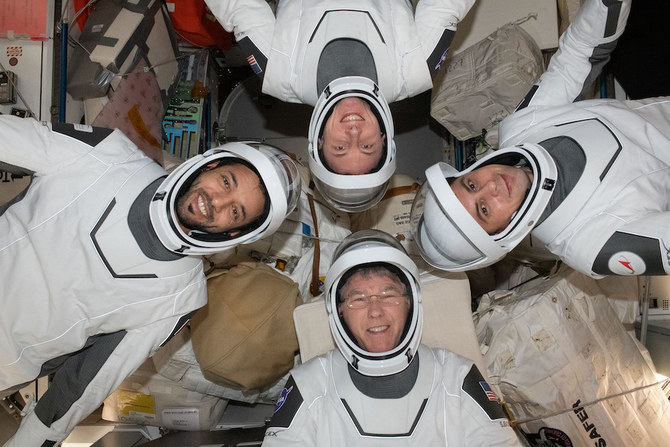
Sultan Al-Neyadi, left, with NASA astronauts Stephen Bowen, top, Woody Hoburg, bottom, and Roscosmos cosmonaut Andrey Fedyaev, were part of NASA’s SpaceX Crew-6 that lifted off on March 2, 2023. (Twitter: NASA)
Short Url
Updated 18 August 2023
Follow

UAE’s Sultan Al-Neyadi, first Arab astronaut deployed on a long-term space mission, to return home

DUBAI: UAE astronaut Sultan Al-Neyadi, the first Arab astronaut deployed on a long-term space mission, is scheduled to return to Earth on September 1 after spending six months aboard the International Space Station.

Al-Neyadi, together with NASA astronauts Stephen Bowen and Woody Hoburg and Roscosmos cosmonaut Andrey Fedyaev, were part of NASA’s SpaceX Crew-6 that lifted off on March 2, 2023 at the Kennedy Space Center in Florida.

The crew conducted more than 200 science experiments and technology demonstrations during their stay at the space station.

A SpaceX Dragon spacecraft – named Endeavour – that is docked at the orbiting outpost will return the four to Earth after undocking no earlier than Sept. 1, splashing down off the coast of Florida.

“During the mission, the crew contributed to hundreds of experiments and technology demonstrations, including student robotic challenges, plant genetics, and human health in microgravity to prepare for exploration beyond low Earth orbit and to benefit life on Earth,” NASA said in a statement.

“Crew-6 is the sixth crew rotation mission with SpaceX for the agency’s Commercial Crew Program. Regular commercial crew rotation missions enable NASA to continue the important research and technology investigations taking place aboard the station.

“Such research benefits people on Earth and lays the groundwork for future human exploration through the agency’s Artemis missions, which will send astronauts to the Moon to prepare for future expeditions to Mars,” it added.


Lebanon central bank seeks to recuperate embezzled funds to bolster liquidity, governor says

Updated 6 sec ago
Follow

Lebanon central bank seeks to recuperate embezzled funds to bolster liquidity, governor says

  • The central bank had filed a criminal complaint against an unnamed former official of the central bank
  • Souaid said the bank would become a primary plaintiff in the state’s investigation against Forry Associates

BEIRUT: Lebanon’s central bank will seek the repayment of public funds embezzled by at least one former central bank official and by lawyers and commercial bankers, to help guarantee its liquidity, Central Bank Governor Karim Souaid said on Thursday.
Souaid did not name Riad Salameh, the former central bank governor whose 30-year term ended in disgrace amid investigations into whether he embezzled more than $300 million between 2002 and 2015.
Instead Souaid told reporters that the central bank had filed a criminal complaint against an unnamed former official of the central bank, a former banker and a lawyer over alleged illicit enrichment through misuse of public funds.
He ⁠said the operations were carried out through four offshore shell companies in the Cayman Islands that he did not name.

COORDINATING WITH FRENCH INVESTIGATORS
Souaid said the bank would become a primary plaintiff in the state’s investigation against Forry Associates, suspected of receiving commissions from commercial banks and transferring them out of the country.
Forry is controlled by Salameh’s brother, Raja. Both ⁠Raja and Riad Salameh deny wrongdoing.
The pair are under investigation in France, Germany, Switzerland and other countries over the alleged embezzlement. Souaid said he would travel to France to meet with the investigators this month “to exchange highly sensitive information held by the French authorities.”
Souaid would not say how many people in total were suspected of involvement in the scheme or the full sum now thought to have been embezzled.
“Our mission is to pursue these individuals and entities, seek their conviction, and seize their movable and immovable assets and the proceeds of ⁠their illicit activities to ensure liquidity for the rightful owners, first and foremost the depositors,” he said.
A Lebanese source familiar with the central bank’s new measures said they were prompted by lots of evidence — both new material uncovered in the central bank’s records and other evidence made available from external investigators.
The source said the bank’s leadership suspected Salameh was aided in his scheme by other members of the institution.
Salameh was detained for nearly 13 months over the alleged financial crimes committed during his tenure, and was released last September after posting a record bail of more than $14 million.
He remains in Lebanon under a travel ban.