



ISLAMABAD: Pakistan’s caretaker government faces daunting challenges in maintaining law and order, neutrality, and ensuring economic stability before the country heads to the polls, political analysts said on Wednesday.
Since Caretaker Prime Minister Anwaar-ul-Haq Kakar took an oath of office on August 14, Pakistan’s government has jacked up petrol prices by Rs20 per liter, raising fears of further inflation while the Pakistani rupee has depreciated against the greenback by over six rupees.
Kakar takes over the country’s reins at a time when militants have stepped up attacks in Pakistan’s northwestern Khyber Pakhtunkhwa (KP) province as the South Asian country grapples with an economic crisis amid deepening political instability, with popular opposition politician Imran Khan behind bars on graft charges.
Dr. Khaqan Hassan Najeeb, a former economic adviser to the government, said the caretaker administration would have to work on four “key areas” which include implementing the International Monetary Fund’s (IMF) program, multilateral agreements, privatization of state-owned entities, and intergovernmental transactions.
“Pakistan’s new caretaker setup must show the ability, the competence, and [select] the set of people who can carry the IMF program,” Najeeb told Arab News.
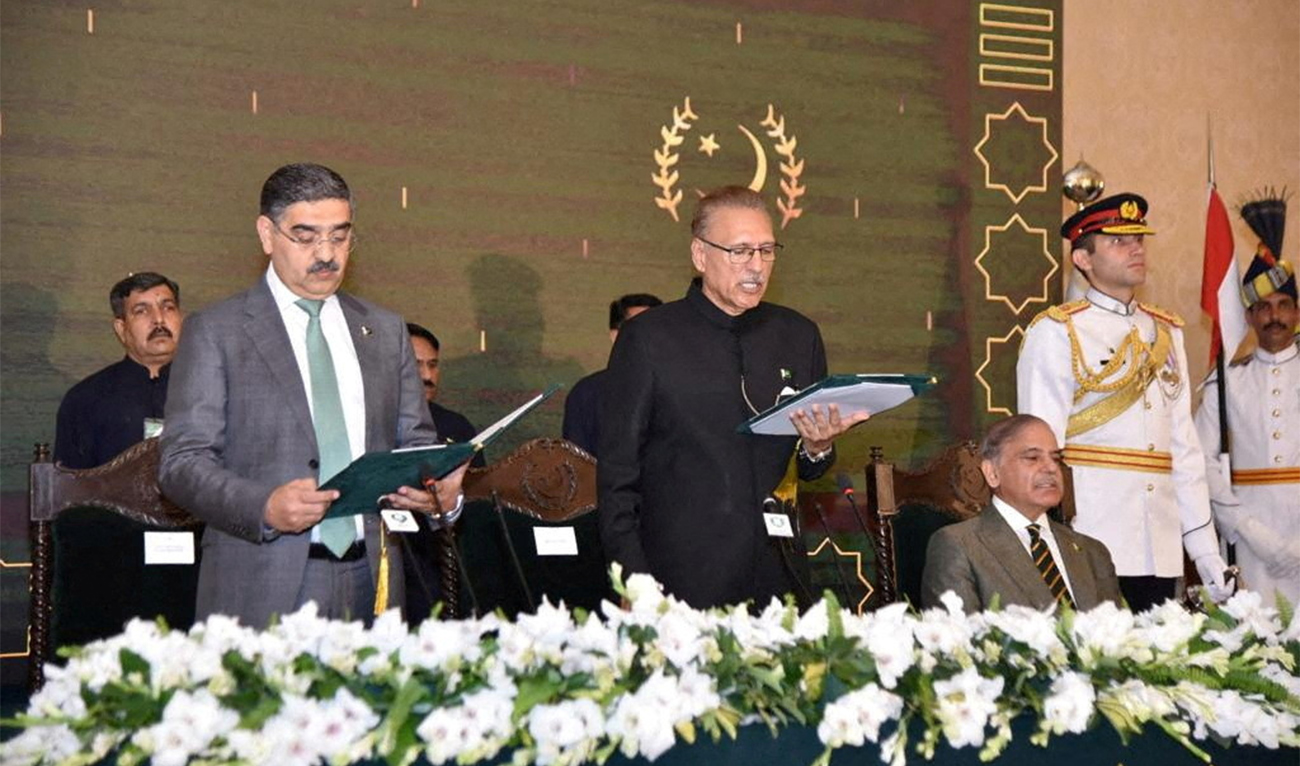
Pakistan's caretaker Prime Minister Anwaar-ul-Haq Kakar takes oath from Pakistan's President Arif Alvi, in Islamabad, Pakistan August, on 14, 2023. (Photo courtesy: REUTERS via PID)
In July, Pakistan secured a last-gasp $3 billion IMF bailout package that helped it narrowly escape a sovereign default. The benchmarks and quantitative performance criteria agreed with the IMF must be met so that the November review goes through, Najeeb said.
He said Pakistan would also have to work on handling its energy crisis to ensure its circular debt “doesn’t rise further.”
Gharidah Farooqi, a prominent TV host and political analyst, said the biggest challenge for the caretaker prime minister would be to establish his “neutrality” as the general impression was that he was close to Pakistan’s powerful military.
“It is a big challenge for him to move forward positively with that impression and how he maintains his neutrality instead of becoming a pawn prime minister,” she told Arab News.
Farooqi said another challenge for the caretaker government would be to take decisions with every political entity on board, especially Khan’s Pakistan Tehreek-e-Insaf (PTI) party. “How long the caretaker setup extends [its tenure] and consequentially how much elections are delayed, this would be a big challenge for him,” she said.
She said though it was the Election Commission of Pakistan’s (ECP) responsibility to hold polls, all eyes were on the caretaker government to see whether polls would be held within a constitutional timeframe or on a date decided by consensus among all political parties.
“To maintain neutrality on transfer and postings, releasing funds will be a challenge for him to fix the economy, and provide relief to the public during his tenure,” Farooqi said.
Journalist and security analyst Hassan Khan said the security situation in KP and Pakistan’s southwestern Balochistan province was “deteriorating with every passing day” adding that the caretaker government would not be able to handle it.
“The caretaker government would not have the required capacity and decision-making space to handle the issue of terrorism in both provinces,” Khan told Arab News, adding that security forces were routinely being targeted in Pakistan’s northwestern cities of Peshawar, Bannu, Dera Ismail Khan, Orakzai, Kurram, Khyber, Swat, and Bajaur districts.
He said the state’s action was “largely limited” to issuing condemnations.
“Tehreek-e-Taliban Pakistan and Daesh were quite active in all these regions and involved in target killings of politicians and religious leaders,” Khan said. “But the state was trying to externalize this issue by blaming it on Afghanistan.”
He said it would be challenging for the government to maintain a conducive environment for polls in KP and Balochistan.
“Some forces might use the recent wave of terrorism in these two provinces to postpone the elections in these regions,” Khan said.
“If the government and election commission go ahead with elections in these provinces, political parties and candidates may not be able to hold public gatherings and corner meetings to mobilize voters,” he added.


