

Saudi culture minister signs deal with MBC to operate and manage new TV channel

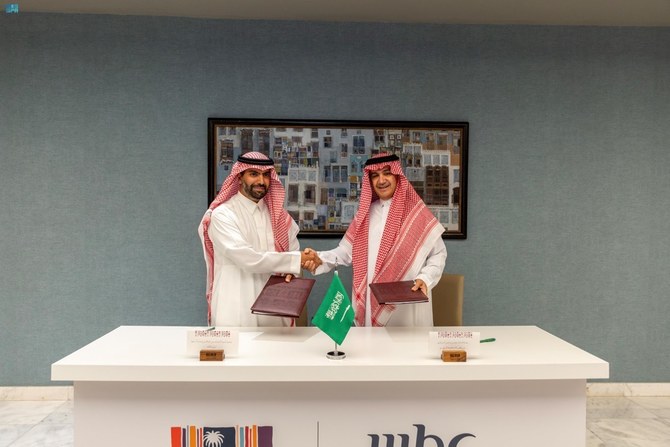
Prince Badr bin Abdullah and Waleed Al-Ibrahim. (SPA)
Short Url
Updated 17 August 2023
Follow

Saudi culture minister signs deal with MBC to operate and manage new TV channel

  • Sources said the channel will showcase and celebrate the Kingdom’s culture in a way that reflects the views of the Saudi people and the heritage, civilization and cultural history of the country
  • The agreement aims to help ‘consolidate the Kingdom’s position as a regional cultural center of gravity and to achieve the goals of Saudi Vision 2030 in its cultural aspects’

JEDDAH: Prince Badr bin Abdullah, the Saudi minister of culture, on Wednesday signed an agreement with the chairman of the board of directors of media organization MBC Group, Waleed Al-Ibrahim, for the launch and operation of a TV channel that showcases and celebrates Saudi culture.

The deal aims to help “consolidate the Kingdom’s position as a regional cultural center of gravity and to achieve the goals of Saudi Vision 2030 in its cultural aspects,” the Saudi Press Agency reported.

Sources said the channel, which will be available as part of MBC’s package of satellite and digital channels and on the Arabic-language streaming application Shahid from September, will aim to engage the general public in a modern and lively manner through content that reflects the views of the Saudi people and the heritage, civilization and cultural history of their country.

It will celebrate the richness of Saudi culture by offering unique perspectives on art, literature, heritage, poetry, theater, cinema, design, fashion and the culinary arts, they added, in ways that reflect rapid developments in technology and the ever-changing needs of local and global audiences.

In addition, it aims to help boost skills among the Saudi population, the sources said, while also providing extensive coverage of cultural events, producing documentaries about prominent Saudi figures, building a major archive of Saudi cultural works, and hosting discussions with cultural figures.

In addition to the main TV channel, the agreement includes plans for a digital media platform specializing in producing videos for online platforms, as well as articles, podcasts and documentary content that reflect the interests and tastes of the new generation, while expanding the scope, aspirations and capabilities of local content producers and connecting them with a network of leading international counterparts, the sources added.


A look back at how Arab News marked its 50th anniversary

Updated 31 December 2025
Follow

A look back at how Arab News marked its 50th anniversary

  • In a year crowded with news, the paper still managed to innovate and leverage AI to become available in 50 languages
  • Golden Jubilee Gala, held at the Diplomatic Quarter in Riyadh, now available to watch on YouTube

RIYADH: In 2025, the global news agenda was crowded with headlines concerning wars, elections and rapid technological change.

Inside the newsroom of Arab News, the year carried additional weight: Saudi Arabia’s first English-language daily marked its 50th anniversary.

And with an industry going through turmoil worldwide, the challenge inside the newsroom was how to turn a midlife crisis into a midlife opportunity. 

For the newspaper’s team members, the milestone was less about nostalgia than about ensuring the publication could thrive in a rapidly changing and evolving media landscape.

“We did not want just to celebrate our past,” said Faisal J. Abbas, editor-in-chief of Arab News. “But more importantly, we were constantly thinking of how we can keep Arab News relevant for the next five decades.”

Faisal J. Abbas, editor-in-chief of Arab News. (Supplied)

The solution, he added, came down to two words: “Artificial intelligence.”

For the Arab News newsroom, AI was not a replacement for journalism but as a tool to extend it.

“It was like having three eyes at once: one on the past, one on the present, and one on the future,” said Noor Nugali, the newspaper’s deputy editor-in-chief.

Noor Nugali, deputy editor-in-chief of Arab News. (Supplied)

One of the first initiatives was the 50th anniversary commemorative edition, designed as a compact historical record of the region told through Arab News’ own reporting.

“It was meant to be like a mini history book, telling the history of the region using Arab News’ archive with a story from each year,” said Siraj Wahab, acting executive editor of the newspaper.

The issue, he added, traced events ranging from the outbreak of the Lebanese civil war in 1975 to the swearing-in of Donald Trump, while also paying homage to former editors-in-chief who shaped the newspaper’s direction over five decades.

The anniversary edition, however, was only one part of a broader strategy to signal Arab News’ focus on the future.

To that end, the paper partnered with Google to launch the region’s first AI-produced podcast using NotebookLM, an experimental tool that synthesizes reporting and archival material into audio storytelling.

The project marked a regional first in newsroom-led AI audio production.

The podcast was unveiled during a special 50th anniversary ceremony in mid-November, held on the sidelines of the Arab Media Forum, hosted by the Dubai Future Foundation. The event in the UAE’s commercial hub drew regional media leaders and officials.

Remarks at the event highlighted the project as an example of innovation in legacy media, positioning Arab News as a case study in digital reinvention rather than preservation alone.

“This is a great initiative, and I’m happy that it came from Arab News as a leading media platform, and I hope to see more such initiatives in the Arab world especially,” said Mona Al-Marri, director-general of the Government of Dubai Media Office, on the sidelines of the event.

“AI is the future, and no one should deny this. It will take over so many sectors. We have to be ready for it and be part of it and be ahead of anyone else in this interesting field.”

Behind the scenes, another long-form project was taking shape: a documentary chronicling Arab News’ origins and its transformation into a global, digital-first newsroom.

“While all this was happening, we were also working in-house on a documentary telling the origin story of Arab News and how it transformed under the current editor into a more global, more digital operation,” said Nugali.

The result was “Rewriting Arab News,” a documentary examining the paper’s digital transformation and its navigation of Saudi Arabia’s reforms between 2016 and 2018. The film charted editorial shifts, newsroom restructuring and the challenges of reporting during a period of rapid national change.

The documentary was screened at the Frontline Club in London, the European Union Embassy, Westminster University, and the World Media Congress in Bahrain. It later became available on the streaming platform Shahid and onboard Saudi Arabian Airlines.

The grand slam of the anniversary year was the Golden Jubilee of Arab News gala, held in late September in Riyadh’s Diplomatic Quarter. (AN photo)

It was also nominated for an Association for International Broadcasting award.

In early July, a special screening of the documentary took place at the EU Embassy in Riyadh. During the event, EU Ambassador to Saudi Arabia Christophe Farnaud described the film as an “embodiment” of the “incredible changes” that the Kingdom is undergoing.

“I particularly appreciate … the historical dimension, when (Arab News) was created in 1975 — that was also a project corresponding to the new role of the Kingdom,” Farnaud said. “Now the Kingdom has entered a new phase, a spectacular phase of transformation.”

Part of the documentary is narrated by Prince Turki Al-Faisal, the former Saudi ambassador to the US, who in the film delves into the paper’s origins.

Prince Turki Al-Faisal, the former Saudi ambassador to the US. (AN photo)

The grand slam of the anniversary year was the Golden Jubilee of Arab News gala, held in late September in Riyadh’s Diplomatic Quarter.

Hosted by the Dean of Diplomatic Corps in Saudi Arabia and Ambassador of Djibouti to Riyadh Dya-Eddine Said Bamakhrama, the evening featured a keynote address by Prince Turki, who spoke about Arab News’ founding under his father, the late King Faisal, and its original mission to present the Kingdom to the English-speaking world.

The Dean of Diplomatic Corps in Saudi Arabia and Ambassador of Djibouti to Riyadh Dya-Eddine Said Bamakhrama (far left). (AN photo)

Arab News was established in Jeddah in 1975 by brothers Hisham and Mohammed Ali Hafiz under the slogan to give Arabs a voice in English while documenting the major transformations taking place across the Middle East.

The two founders were honored with a special trophy presented by Prince Turki, Assistant Media Minister Abdullah Maghlouth, Editor-in-Chief Abbas, and family member and renowned columnist Talat Hafiz on behalf of the founders. 

During the gala, Abbas announced Arab News’ most ambitious expansion yet: the launch of the publication in 50 languages, unveiled later at the World Media Congress in Madrid in cooperation with Camb.AI.

The grand slam of the anniversary year was the Golden Jubilee of Arab News gala, held in late September in Riyadh’s Diplomatic Quarter. (AN photo)

The Madrid launch in October underscored Arab News’ aim to reposition itself not simply as a regional paper, but as a global platform for Saudi and Middle Eastern perspectives.

The event was attended by Princess Haifa bint Abdulaziz Al-Mogrin, the Saudi ambassador to Spain; Arab and Spanish diplomats; and senior editors and executives.

As the anniversary year concluded, Arab News released the full video of the Golden Jubilee Gala to the public for the first time, making the event accessible beyond the room in which it was held.

For a newspaper founded in an era of typewriters and wire copy, the message of its 50th year was clear: longevity alone is not enough. Relevance, the newsroom concluded, now depends on how well journalism adapts without losing sight of its past.