

Pakistan’s ousted PM’s petition challenging three-year jail term fixed for hearing next week

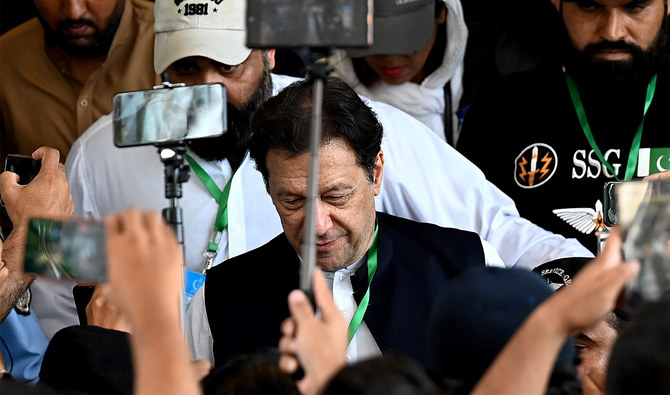
Pakistan's former Prime Minister Imran Khan (C) leaves after appearing in the Supreme Court in Islamabad, Pakistan, on July 26, 2023. (Photo courtesy: AFP/File)
Short Url
Updated 16 August 2023
Follow

Pakistan’s ousted PM’s petition challenging three-year jail term fixed for hearing next week

  • The PTI party says its leader has been deliberately denied his legal and constitutional rights since his arrest
  • Khan’s lawyers maintain they are not getting proper access to their client, though there was no legal obstacle

ISLAMABAD: Former prime minister Imran Khan’s Pakistan Tehreek-e-Insaf (PTI) party said on Wednesday the country’s higher judiciary had fixed a petition challenging his three-year imprisonment on graft charges for hearing next week.

Khan, who was ousted from power in a parliamentary no-trust vote last year in April, was convicted by a local court for illegally selling state gifts which he received during his term in the country’s top political office.

His party reiterated earlier in the day he was not getting all his legal and constitutional rights after being arrested from his Lahore residence in what has come to be known as the Toshakhana – or state repository – case more than 10 days ago.

“Chairman PTI Imran Khan’s application for suspension of lower court decision against Toshakhana judgment fixed for hearing on August 22, 2023,” the party circulated a brief message among the media community on Wednesday.

“While being in solidarity confinement, Chairman PTI has not yet been given proper access, legal team wasn’t allowed to meet even today & they’re filing another petition in Islamabad High Court,” it added.

The PTI noted there were no legal obstacles preventing Khan’s lawyers from meet him, adding they were perfectly within their right to interact with their client under the prison manual and the constitution.

However, in a social media post, it maintained the former PM had been deprived of his rights deliberately despite being the founding leader of the country’s largest political party.

Khan developed significant differences with the country’s military since his ouster from power which he attributed to a “foreign conspiracy.”

The former prime minister’s political faction faced a crackdown after resorting to violent protests and targeting government and military installations earlier this year in May when he was briefly arrested from a court in Islamabad on corruption allegations.


Pakistan, UK discuss regional security, cross-border attacks as senior official visits Islamabad

Updated 7 sec ago
Follow

Pakistan, UK discuss regional security, cross-border attacks as senior official visits Islamabad

  • British envoy for Afghanistan Richard Lindsay’s visit comes at a time of a surge in militancy in Pakistan’s border regions
  • Pakistani diplomat says both sides reviewed broader security challenges, emphasized coordination to address ‘shared concerns’

ISLAMABAD: Pakistani and British officials have discussed regional security challenges and cross-border attacks during talks in Islamabad, a Pakistani diplomat said on Tuesday, during a visit of the United Kingdom’s Afghanistan envoy, Richard Lindsay, to the Pakistani capital.

Pakistan and the UK regularly cooperate on counterterrorism and security, with a focus on intelligence-sharing to combat militant activity. Lindsay’s visit comes at a time of a rise in militancy in Pakistan’s western provinces, which border Afghanistan.

Mohammad Sadiq, Pakistan’s special representative for Afghanistan, said the discussions in Islamabad focused on the regional security situation, particularly the urgent challenge posed by cross-border attacks.

“We also exchanged views on the latest regional security developments and broader security challenges,” he said on X. “We emphasized the importance of continued cooperation and coordination to address shared concerns and promote regional stability.”

Islamabad frequently accuses Afghanistan of allowing its soil and India of backing militant groups, such as the Tehreek-e-Taliban Pakistan (TTP) and the Balochistan Liberation Army (BLA), for attacks against Pakistan. Kabul and New Delhi deny this.

In recent years, Pakistan and the UK have engaged with each other on counterterrorism and cross-border crimes as part of bilateral cooperation.

Both sides held the second round of the Pakistan-UK Counter Terrorism Dialogue in London in February last year, reviewing global and regional threats and exchanging best practices. Over the years, armed forces of both countries have also maintained close cooperation, particularly in counterterrorism efforts and professional military training.