

Pakistani scholars, diplomats commend Saudi Arabia for global dialogue on Muslim unity

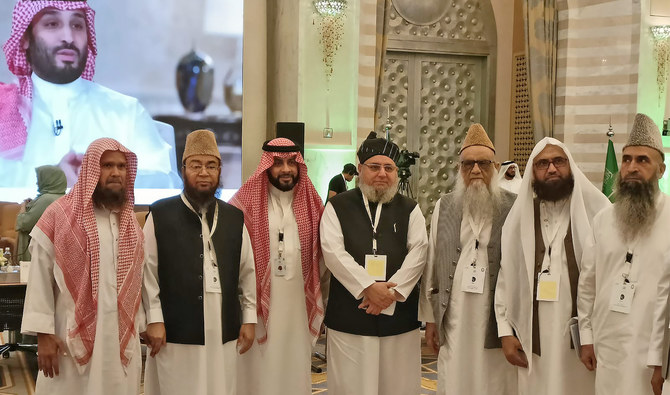
Pakistani religious scholars pose for a picture at a two-day international conference themed “Communication and Integration” in Makkah, Saudi Arabia, on August 14, 2023. (Photo courtesy: Senator Hafiz Abdul Karim)
Short Url
Updated 16 August 2023
Follow

Pakistani scholars, diplomats commend Saudi Arabia for global dialogue on Muslim unity

  • The Kingdom hosted an international conference, themed as ‘Communication and Integration,’ in Makkah on August 13-14 
  • The sessions encompassed efforts to serve Islam, promote tolerance and coexistence, and counter extremism and terrorism

ISLAMABAD: Pakistani religious scholars and diplomats on Tuesday commended Saudi Arabia’s efforts for a global dialogue in Makkah and collaboration among Islamic scholars and leaders from different nations to effectively convey the authentic message of Islam and foster stronger connections among the Muslim world. 

The Kingdom hosted a two-day international conference, themed as “Communication and Integration,” in Makkah on August 13-14 along with global religious entities. The event was attended by 150 prominent scholars, thinkers, heads of Islamic associations and academics from 85 nations. The conference, organized by the Saudi Ministry of Islamic Affairs, Dawah and Guidance, featured seven sessions where participants presented research on diverse topics. 

The sessions encompassed efforts to serve Islam, promote tolerance and coexistence, moderation and tolerance in the Qur’an and Prophet’s Sunnah, countering extremism and terrorism, and safeguarding society from atheism and dissolution. A final communique issued at the conference vehemently denounced the recurring acts of burning copies of the Holy Qur’an and recognized them as actions that incited hatred, encouraged exclusion and opposed universally shared human values. 

Senator Hafiz Abdul Karim, a Pakistani religious scholar who participated in the conference, said the discussions centered on contemporary challenges faced by Muslims globally, such as incidents like the burning of the Qur’an and the rising cases of Islamophobia. Karim was among eight Pakistani scholars who attended the conference. 

“During the conference, scholars from all over the world shared their insights on the topic, highlighting that educated religious figures with experience should be responsible for issuing fatwas (decrees),” he told Arab News from Makkah. 
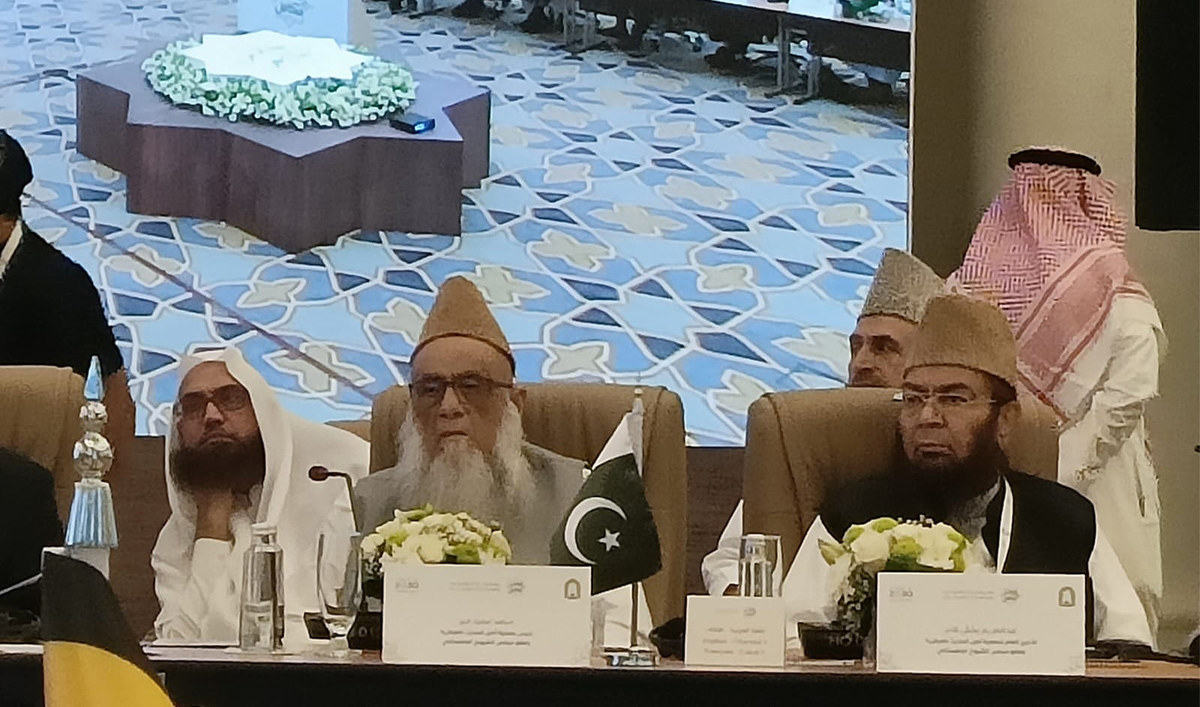


Pakistani religious scholars are pictured at a two-day international conference themed “Communication and Integration” in Makkah, Saudi Arabia, on August 14, 2023. (Photo courtesy: Senator Hafiz Abdul Karim)

The consensus was that Islam promotes a balanced approach rather than a hard-line stance and that extreme approaches have harmed Islam’s image, according to Karim. 

“Therefore, embracing a moderate method was advised, urging Muslims to avoid harshness, intolerance and sectarianism,” he said. 

Hamzah Gilani, a spokesperson for the Pakistani mission in Jeddah, said the international conference stood as a significant platform for effectively conveying the authentic message of Islam and fostering stronger connections among Muslim communities worldwide. 

“The remarkable efforts of Saudi Arabia in promoting dialogue and collaboration among Islamic scholars and leaders from diverse nations are truly praiseworthy,” Gilani told Arab News. 

“It serves as a testament to the Kingdom’s unwavering commitment to supporting and serving Islam, while actively promoting a culture of moderation that counters extremism.” 

Through these commendable initiatives, Gilani said, Saudi Arabia had played a vital role in fostering unity, understanding and harmony within the Muslim ummah. 

Karim said religious edicts must be rooted in the Qur’an and true Hadith, reflect moderate approach and be devoid of intolerance. 

“Those who espouse intolerance in their religious beliefs were criticized [at the conference], emphasizing the importance of adopting moderation instead,” he added. 

The Pakistani scholar said Saudi Arabia had consistently upheld the Qur’an and Sunnah as its legal and systemic foundation even as it progresses toward modernization. 

“This indicates that Saudi Arabia’s core principles, based on the Qur’an and Sunnah, persist while accommodating new advancements and modern technology,” he added. 


Sindh assembly passes resolution rejecting move to separate Karachi

Updated 21 February 2026
Follow

Sindh assembly passes resolution rejecting move to separate Karachi

  • Chief Minister Shah cites constitutional safeguards against altering provincial boundaries
  • Calls to separate Karachi intensified amid governance concerns after a mall fire last month

ISLAMABAD: The provincial assembly of Pakistan’s southern Sindh province on Saturday passed a resolution rejecting any move to separate Karachi, declaring its territorial integrity “non-negotiable” amid political calls to carve the city out as a separate administrative unit.

The resolution comes after fresh demands by the Muttahida Qaumi Movement (MQM) and other voices to grant Karachi provincial or federal status following governance challenges highlighted by the deadly Gul Plaza fire earlier this year that killed 80 people.

Karachi, Pakistan’s largest and most densely populated city, is the country’s main commercial hub and contributes a significant share to the national economy.

Chief Minister Syed Murad Ali Shah tabled the resolution in the assembly, condemning what he described as “divisive statements” about breaking up Sindh or detaching Karachi.

“The province that played a foundational role in the creation of Pakistan cannot allow the fragmentation of its own historic homeland,” Shah told lawmakers, adding that any attempt to divide Sindh or separate Karachi was contrary to the constitution and democratic norms.

Citing Article 239 of Pakistan’s 1973 Constitution, which requires the consent of not less than two-thirds of a provincial assembly to alter provincial boundaries, Shah said any such move could not proceed without the assembly’s approval.

“If any such move is attempted, it is this Assembly — by a two-thirds majority — that will decide,” he said.

The resolution reaffirmed that Karachi would “forever remain” an integral part of Sindh and directed the provincial government to forward the motion to the president, prime minister and parliamentary leadership for record.

Shah said the resolution was not aimed at anyone but referred to the shifting stance of MQM in the debate while warning that opposing the resolution would amount to supporting the division of Sindh.

The party has been a major political force in Karachi with a significant vote bank in the city and has frequently criticized Shah’s provincial administration over its governance of Pakistan’s largest metropolis.

Taha Ahmed Khan, a senior MQM leader, acknowledged that his party had “presented its demand openly on television channels with clear and logical arguments” to separate Karachi from Sindh.

“It is a purely constitutional debate,” he told Arab News by phone. “We are aware that the Pakistan Peoples Party, which rules the province, holds a two-thirds majority and that a new province cannot be created at this stage. But that does not mean new provinces can never be formed.”

Calls to alter Karachi’s status have periodically surfaced amid longstanding complaints over governance, infrastructure and administrative control in the megacity, though no formal proposal to redraw provincial boundaries has been introduced at the federal level.