

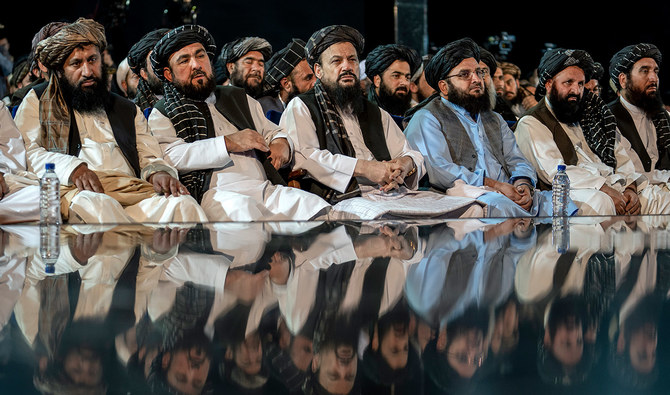

KABUL: Afghanistan’s Taliban government was set Tuesday to mark the second anniversary of their takeover of the country with a military parade in the movement’s birthplace, as well as other celebrations of their surge back to power.
Flags of the Islamic Emirate of Afghanistan — the name given to the country by its new rulers — fluttered at security checkpoints across the capital, which fell on August 15, 2021, when the US-backed government collapsed and its leaders fled into exile.
In the two years since, Taliban authorities have imposed their strict interpretation of Islam on the country, with women bearing the brunt of laws the United Nations has termed “gender apartheid.”
The parade, including scores of military vehicles and weapons left behind by international forces after a weeks-long chaotic withdrawal, was to be held in Kandahar, the cradle of the Taliban movement and from where reclusive Supreme Leader Hibatullah Akhundzada rules by decree.
Elsewhere, convoys of Taliban members are due to drive through the streets of Herat in the west, while in Kabul, the education ministry will host a celebration at a school in a part of the city once stacked with diplomats who are now thin on the ground — the Taliban government still unrecognized formally by any other country.
The international community continues to grapple with how, and if, to engage with the Taliban authorities, with restrictions on women’s rights — squeezed from public spaces and avenues to work and education — a key obstacle in negotiations over aid and recognition.
A group of UN experts on Monday hit out at pledges by Taliban authorities of a softer rule than during their first stint in power from 1996 until 2001.
“Despite reassurances by the Taliban de facto authorities that any restrictions, particularly in terms of access to education would be temporary, the facts on the ground have demonstrated an accelerated, systematic, and all engulfing system of segregation, marginalization and persecution,” the experts said in a statement.
Afghan women ahead of the anniversary have expressed fear and despair over the loss of rights — a handful holding small demonstrations, many of their faces covered with masks.
But Afghans also pointed to worry over an economic and humanitarian crisis in motion since the Taliban takeover, as aid dried up and sanctions were imposed.
Farmer Rahatullah Azizi told AFP he used to earn a living off his crops but now has “just enough to eat.”
He expressed relief, however, that the security situation was better, noting he could now travel freely at night without fear of being mugged.
But while security has drastically improved in the past two years, the Daesh group remains a threat, and tensions have risen with Pakistan over an increase of attacks in the countries’ shared border areas.
Taliban authorities have pledged that Afghan territory won’t be used by foreign militants to stage attacks abroad, but it remains a sticking point.
But while some Afghans celebrate the end of fighting and Taliban rule, others see it as a grim anniversary.
“All the girls and women of Afghanistan want their freedom back,” said former student Hamasah Bawar.


