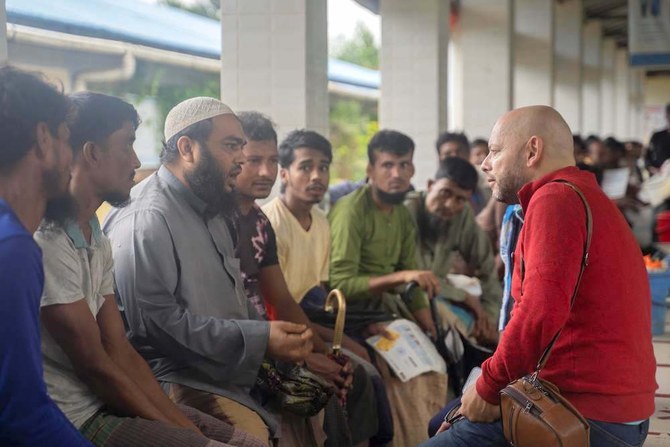

DHAKA: Rohingya refugees in Cox’s Bazar have sought support from the Organization of Islamic Cooperation as they continue to face uncertainties about their future compounded by a massive cut in UN food rations this year.
Aid for the Rohingya in Bangladesh was cut to $8 per person per month, or 27 cents a day, at the beginning of June. The World Food Programme said a lack of funding had forced it to reduce the rations, first slashed in March from $12 to $10.
The aid cuts are affecting more than 1 million Rohingya people, most of whom had escaped deadly violence and persecution in Myanmar to neighboring Bangladesh during a military crackdown in 2017.
After a recent visit of a joint delegation from the OIC and UN High Commissioner for Refugees, the Rohingya community in Bangladesh believed the OIC could provide them with the support they need.
“We request the OIC and UNHCR to create more funds to ensure enough food for our children until there is a sustainable and dignified repatriation,” Mohammad Zubair, chairman of Arakan Rohingya Society for Peace and Human Rights, told Arab News.
Based in Cox’s Bazar, ARSPH works for the rights and justice of the Rohingya.
“No one can give any guarantee for our future though we have been witnessing frequent visits by international delegations. In this context, as the largest platform of the Muslim ummah, the OIC can help us more since those who are suffering here are the Rohingya Muslims,” Zubair said.
“We are fully dependent on the food aid provided by the World Food Programme. But how could a person survive with only $8 per month?”
Refugees in the camps face a multitude of problems, including malnutrition and domestic violence, which Zubair noted had “significantly increased” in recent weeks.
Mohammed Rezuwan Khan, another Rohingya refugee in Cox’s Bazar, hoped that there would be some changes after the visit of the OIC-UNHCR delegation.
“I hope there should be some changes in our fate, at least it may help to reduce the ongoing funding crisis,” Khan told Arab News.
He also highlighted the issue of repatriation for Rohingya refugees, a process that had made little practical progress despite being on the UN agenda for years.
“I think the Myanmar government will not repatriate all of us,” Khan said. “In this context, third country resettlement can be another sustainable solution to our crisis. The OIC is a big platform and can play a vital role in this process. Third country resettlement will offer us education and livelihood scopes with dignity.”
The visit of the joint delegation was also welcomed by former Bangladesh ambassador to the US, Humayun Kabir, who told Arab News that the trip had helped to keep the Rohingya issue at the top of the global agenda.
“The OIC is already playing a significant role in the diplomatic field for resolving the Rohingya crisis,” Kabir said. “Amid the funding crisis for the Rohingya, there are some potentials that some OIC members can come up with to mitigate the crisis. Here, we can expect more support from Saudi Arabia.
“I think this joint delegation visit is a positive approach as they witnessed the situation on the ground, and it’s a positive contribution to keep the issue vibrant in the global agenda.”
In a statement on Sunday, OIC Assistant Secretary-General Tariq Ali Bakheet called on the international community to show solidarity for the Rohingya.
“The diplomatic track must advance hand in hand with humanitarian efforts to deal with the root causes of the problem and reach a permanent solution to the Rohingya crisis,” he said.