WARSAW: Poland’s ruling party wants to ask voters in a referendum whether they support accepting “thousands of illegal immigrants from the Middle East and Africa” as part of a European Union relocation plan, the prime minister said Sunday, as his conservative party seeks to hold onto power in an October parliamentary election.
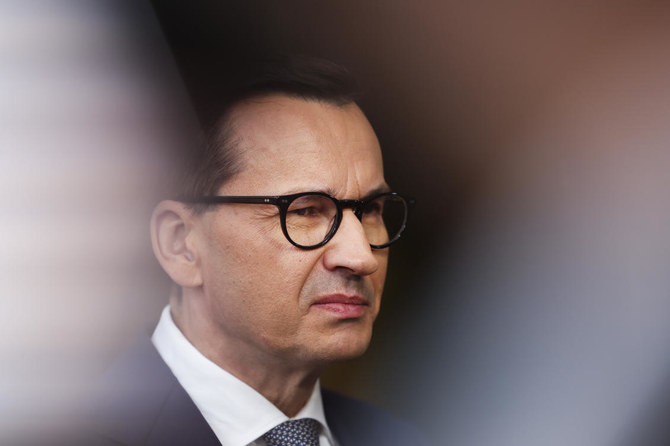
Mateusz Morawiecki announced the referendum question in a new video published on social media. It indicated that his party, Law and Justice, is seeking to use migration in its election campaign, a tactic that helped it take power in 2015.
Poland is hosting more than a million Ukrainian refugees, who are primarily white and Christian, but officials have long made clear that they consider Muslims and others from different cultures to be a threat to the nation’s cultural identity and security.
EU interior ministers in June endorsed a plan to share out responsibility for migrants entering Europe without authorization, the root of one of the bloc’s longest-running political crises.
The Polish government wants to hold the referendum alongside the parliamentary election, scheduled for Oct. 15. Morawiecki said that the question would say: “Do you support the admission of thousands of illegal immigrants from the Middle East and Africa under the forced relocation mechanism imposed by the European bureaucracy?”
The video announcing the question includes scenes of burning cars and other street violence in Western Europe. A Black man licks a huge knife in apparent anticipation of committing a crime. Party leader Jaroslaw Kaczynski then says: “Do you want this to happen in Poland as well? Do you want to cease being masters of your own country?”
Leaders have announced two other questions in recent days. One will ask voters for their views on privatizing state-owned enterprises and the other will ask if they support raising the retirement age, which Law and Justice lowered to 60 for women and 65 for men.
The questions are set up to depict the opposition party, Civic Platform, as a threat to the interests of Poles. The pro-business and pro-EU party, which governed from 2007 to 2015, raised the retirement age during its time in power, favored some privatization and signaled a willingness to accept a few thousand refugees before it lost power.
The video takes aim directly at Civic Platform leader Donald Tusk, a former president of the European Council. “Tusk is the greatest threat to our security, he is the greatest threat to Poland’s security,” Morawiecki says. “Let’s not let Tusk — as an envoy of the Brussels elites — demolish security in Poland.”
Europe’s asylum system collapsed eight years ago after well over a million people entered the bloc — most of them fleeing conflict in Syria — and overwhelmed reception capacities in Greece and Italy, in the process sparking one of the EU’s biggest political crises.
The 27 EU nations have bickered ever since over which countries should take responsibility for people arriving without authorization, and whether other members should be obliged to help them cope.
Initially Poland was neither an entry country nor a destination country for migrants and refugees. It became a front-line state two years ago when migrants began crossing from Belarus, something European authorities view as an effort by the Russian ally to generate turmoil in Poland and other European countries.
Poland responded by building a large wall on its border. It has recently increased its military presence on the border fearing an uptick in migration and other possible instability.
As well as disagreements over migration, Law and Justice has long been in conflict with the EU over a perception by the bloc that the Warsaw government has been eroding democratic norms.


![]()

Polish government plans referendum asking if voters want ‘thousands of illegal immigrants’
Short Url
https://arab.news/993zd
Polish government plans referendum asking if voters want ‘thousands of illegal immigrants’
- Officials have long made clear that they consider Muslims and others from different cultures to be a threat to the nation’s cultural identity and security.
- The prime minister announced the referendum question Sunday in a new video published on social media


Latest updates



© 2026 SAUDI RESEARCH & PUBLISHING COMPANY, All Rights Reserved And subject to Terms of Use Agreement.