

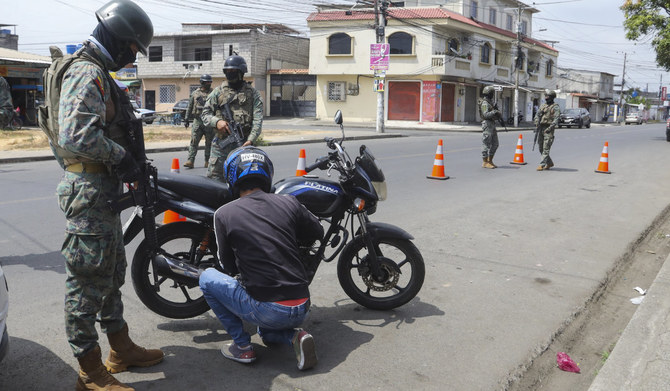

QUITO: Ecuador declared a state of emergency Thursday and asked the FBI to help probe the assassination of a popular presidential candidate, whose death has highlighted the once-peaceful nation’s decline into a violent hotbed of drug trafficking and organized crime.
Police said six Colombians have been arrested in the murder of Fernando Villavicencio, a 59-year-old journalist and anti-corruption crusader who was gunned down as he left a campaign rally in the capital Quito on Wednesday night.
Another attacker, also Colombian, was shot dead by security agents, authorities said.
Interior Minister Juan Zapata said the assailants belonged to “organized crime groups,” without specifying which ones.
Shocked citizens expressed their frustration with the burgeoning violence in the South American country, which has seen its murder rate soar as drug gangs wage bloody turf wars.
Housewife Ruth Flores, 65, told AFP people were “outraged” by the murder of a man she saw as “the hope for honesty in our country. A candidate who denounced the corruption of narcopolitics.”
She described the situation in the country as “very worrying. You can’t walk peacefully ... there is no security.”
HIGHLIGHT
Fernando Villavicencio, a 59-year-old journalist and anti-corruption crusader who was gunned down as he left a campaign rally in the capital Quito on Wednesday night.
President Guillermo Lasso declared a two-month state of emergency, and said the US Federal Bureau of Investigation had accepted the country’s request for help, with a delegation arriving soon.
Villavicencio had complained of receiving threats from Los Choneros, one of the country’s most powerful drug gangs.
“They told me to wear a (bulletproof) vest. I don’t need it. Let the hitmen come! They may bend me but they will never break me,” the politician told a rally earlier this week in Chone, the gang’s birthplace.
Electoral officials have also reported threats against them ahead of the snap election on Aug. 20. A popular mayor and aspiring lawmaker have also been assassinated in recent weeks.
Villavicencio was targeted with a hail of gunfire, with the country’s main newspaper, El Universo, reporting he was assassinated “hitman-style and with three shots to the head.”
His family wept and held each other as his body was transported from a forensic lab to a funeral home for a private wake.
The attack came a little over a week before the snap election, called by Lasso after he dissolved the opposition-dominated Congress in May to avoid an impeachment trial over alleged corruption.
He is not seeking reelection.
Earlier, Lasso blamed the killing on “organized crime.” “This is a political crime ... and we do not doubt that this murder is an attempt to sabotage the electoral process,” said Lasso, who also declared three days of national mourning.
Villavicencio was the second most popular of eight candidates in the presidential race, according to recent opinion polls.
His journalistic investigations exposed a vast graft network which led to former president Rafael Correa being sentenced to eight years in prison.
Correa now lives in exile in Belgium after fleeing to escape the prison term.
Giant posters of Villavicencio were still plastered on the walls of the sports complex where the rally was held, as passersby placed candles and bouquets of white roses outside.
A cyclist, who was too afraid to give her name, put up a banner reading: “The damn narcopoliticians will pay.”
Nine other people were injured in the attack, including a candidate running for the national legislature and three policemen, prosecutors and police officials said.
US Secretary of State Antony Blinken offered to “support local authorities to bring the perpetrators of this heinous act to justice.”
The European Union’s foreign policy chief Josep Borrell said the bloc “stands with Ecuador in its fight against the worsening violence by organized crime.”
United Nations Secretary-General Antonio Guterres said via a spokesman that such attacks represented “a grave threat to democracy,” while UN human rights chief Volker Turk said it underscored “the challenges the country and its people face amid the violence.”
Ecuador is not known to have large plantations of drug crops or laboratories, but its location — between major cocaine producers Colombia and Peru — and laxer controls have made it a new nerve center for the global drug trade.
Most drugs are shipped abroad via the major port of Guayaquil.
Hundreds have been killed — some dismembered or burned to death — in a gang war that largely played out in the country’s prisons, mainly in Guayaquil, in the battle for control of drug routes.
Guayaquil has also been hit by car bombs and shocking scenes of bodies dangling from bridges.
Highlighting Ecuador’s growing influence in the trade, Dutch authorities said Thursday they had seized over eight tons of cocaine discovered in a container carrying bananas from Ecuador, its largest ever seizure of the drug.
In 2022, Ecuador’s murder rate almost doubled compared to the previous year to 25 per 100,000.


