Death toll rises to 80 in Hawaii wildfires

1 / 3
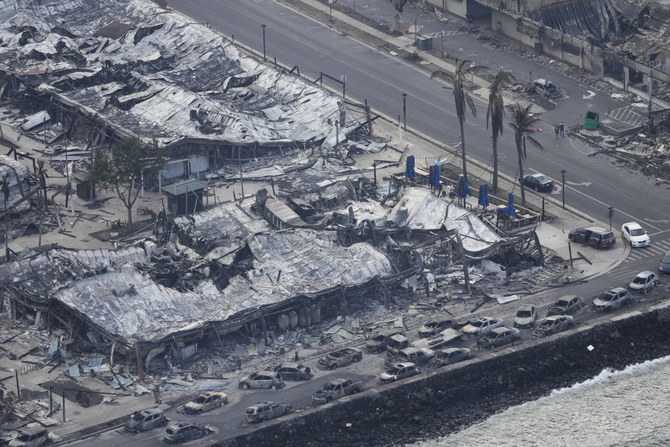
A wasteland of burned out homes and obliterated communities is left on Aug. 10, 2023, in Lahaina, Hawaii, following a stubborn blaze, one of the deadliest in the US in recent years. (AP)
2 / 3
A man stands in a street amidst wildfire wreckage on Aug. 10, 2023, in Lahaina, Hawaii. (AP)
3 / 3
A wildfire burns in Kihei, Hawaii late on Aug. 9, 2023, destroying parts of a centuries-old town in one of the deadliest US wildfires in recent years. (AP)
Short Url
Updated 12 August 2023
Follow

Death toll rises to 80 in Hawaii wildfires

  • Fueled by a dry summer and strong winds from a passing hurricane, the fire started Tuesday and took Maui by surprise, racing through parched growth covering the island and then feasting on homes and anything else that lay in its path

LAHAINA, Hawaii: Hawaii’s chief legal officer said she was opening a probe into the handling of devastating wildfires that killed at least 80 people in the state this week, as criticism grows of the official response.
The announcement and increased death toll came as residents of Lahaina were allowed back into the town for the first time — with most finding their homes reduced to ashes, and even the lucky few angry at a sense of abandonment.
“Where is the government? Where are they?” said a man who did not want to be named.
“We can’t move freely, we don’t get the support, now we’ve heard about looting.”
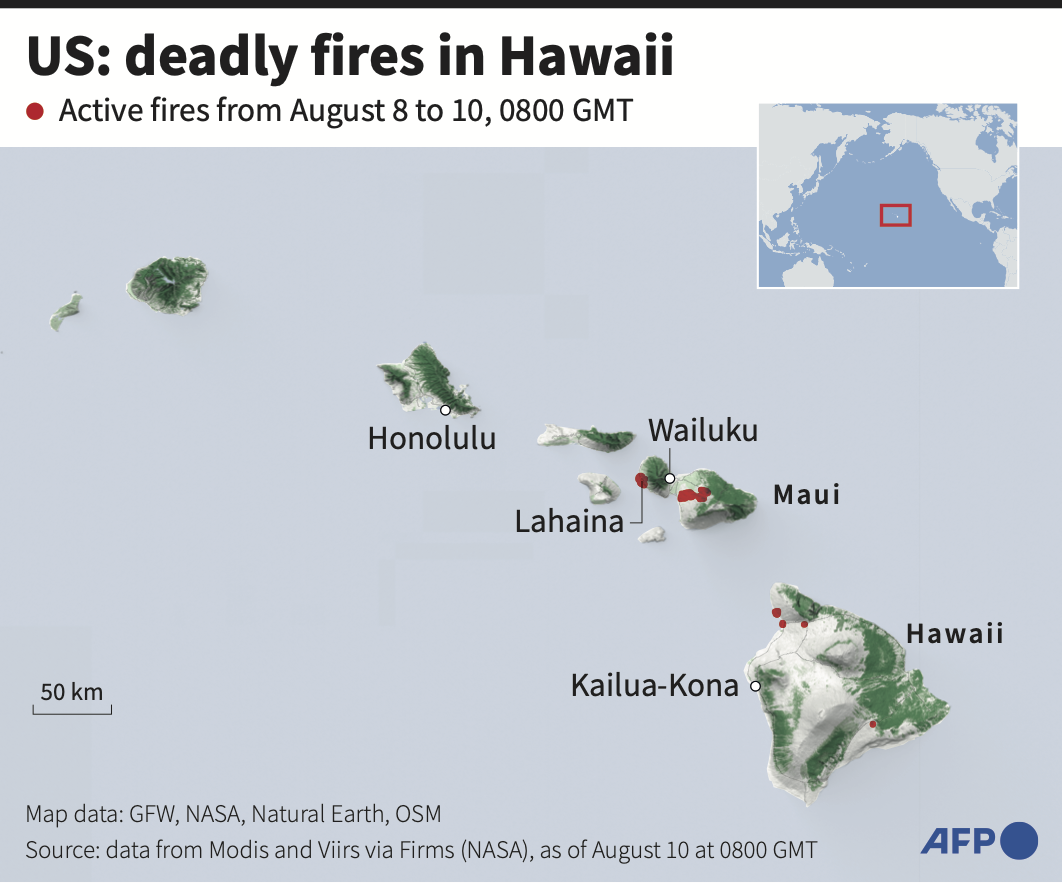
Hawaii’s Attorney General Anne Lopez said her office would examine “critical decision-making and standing policies leading up to, during and after the wildfires on Maui and Hawai’i islands this week.”
She added that her department would make the findings public.
Late Friday, Maui County officials revised the death toll to 80, adding that 1,418 people were in emergency evacuation shelters.
The fires follow other extreme weather events in North America this summer, with record-breaking wildfires still burning across Canada and a major heat wave baking the US southwest.
Europe and parts of Asia have also endured soaring temperatures, with major fires and floods wreaking havoc. Scientists have said global warming caused by carbon emissions is contributing to the extreme weather.
For some of those who made it back into Lahaina, there was elation as they tearfully reconnected with neighbors they feared might not have gotten out alive.
“You made it!” cried Chyna Cho, as she embraced Amber Langdon amid the ruins. “I was trying to find you.”
For some of the luckiest, there was joy — albeit tempered by the scale of the tragedy that counts among the worst natural disasters to hit the state of Hawaii.
“I just couldn’t believe it,” Keith Todd said after finding his home intact.
“I’m so grateful, but at the same time it’s so devastating.”
Todd, 64, discovered his house and his neighbor’s house untouched, and his solar panels providing electricity to the fridge, which was still dispensing ice on demand.
But even those few whose homes still appeared habitable were being warned they might not be safe.
“Some structures in the Lahaina water system were destroyed by the fire ... These conditions may have caused harmful contaminants, including benzene and other volatile organic chemicals, to enter the water system,” said Maui’s water department.
“As a precaution...(we) are advising residents to not use the tap water for drinking and cooking until further notice.”
Fears of looting were also on residents’ minds.


Old Delhi iftars revive Mughal heritage, one course at a time

Updated 4 sec ago
Follow

Old Delhi iftars revive Mughal heritage, one course at a time

  • Dastarkhwan-e-Jahaanuma iftars have been held in Old Delhi since 2017
  • Muslim and non-Muslim participants arrive from across India and abroad

NEW DELHI: On a rooftop in Delhi’s historic walled city, guests from across India sit on cushions around a low table overlooking Jama Masjid, waiting for its sunset call to prayer — the signal to start a special iftar that will take them back four centuries, to the Mughal era, if only for a while.

Mughals ruled the Indian subcontinent between the 16th and 19th centuries. Originally from Central Asia, they carried traditions borrowed from Arabs, Persians and Ottomans, which they merged with the various local Indian styles — a fusion that marked the global revival of Islamic architecture and culture.

Jama Masjid is one of the most iconic examples of the Mughal style — a scenic background to the curated iftars that bring 40 to 50 people from across India to share a meal, knowledge and experience.

“People getting together from different walks of life, different parts of the country, different religions, different cultures coming together — it was absolutely and completely amazing,” said Arvind Sirohi, who took part in the event with his wife.

“Lovely storytelling, amazing food, and end of the day, right next to Jama Masjid in Old Delhi. The ambience, the environment, the atmosphere came together so beautifully.”

The community-led iftar experience is called Dastarkhwan-e-Jahaanuma — from Urdu words meaning a “spread of food” and “showing the world.”

For Veena Sirohi, it did exactly what the name promised by bringing together people from different communities, different parts of India, and abroad.

“I think that’s a great way of synthesizing different cultures, bringing people together, bringing the human aspect of what we all are ... we are actually all one,” she told Arab News.

“And we had some wonderful comperes who told us about … the history of Ramadan, what goes behind it, how the food is curated, and how each and every item has a specific place in the menu.”

Served in gilded bowls and plates from traditional Indian crockery, with rose petals dotting the dastarkhwan cloth, the dishes were some of the festive Ramadan delicacies, offering a taste of Mughal culinary heritage.

Among them was mutanjan, or fragrant rice cooked with ghee, sugar, saffron, cardamom, and studded with nuts, which for many Indian Muslims is traditionally the first dish to break the fast.

It was followed by shabde, a rich, slow-cooked aromatic meat stew or the Delhi biryani — a fragrant, mildly spiced saffron rice and meat dish, where marinated chicken or mutton is layered with basmati rice and cooked slowly.

The hearty feast closed with nihari, a hearty stew simmered overnight with spices and bone marrow, which emerged in the 18th century and was originally eaten by Mughal royals for breakfast.

“These are the traditional dishes which are not usually available in the market, but are specially prepared by the bawarchees (cooks) of Old Delhi. Some of the dishes are occasional dishes,” said Abu Sufiyan Khan, the founder of Tales of City, the cultural experience company that has been curating Dastarkhwan-e-Jahaanuma since 2017.

The special iftars are hosted once a week throughout the fasting month, usually on weekends. There are variations in dishes served as they come from different kitchens, as Tales of City collaborates with various local artisans and cooks.

“We are curating this with different experts and every time the menu changes,” Khan said.

“We bring all these dishes onto a single dastarkhwan, and we share this meal with the people coming from all over India to break bread together in the holy month of Ramadan, know each other, learn about each other’s culture, and create a dialogue space where we can have more meaningful conversations and an opportunity to get to know each other.”

Those who take part, like Ayandrali Dutta, a food critic, appreciate everything about the experience, especially as it takes place in Old Delhi, where the vibe is always “jovial, lively, in all positive ways” during Ramadan.

“You get to meet interesting people, you get to hear interesting stories ... It’s a great initiative to show what Ramadan is, what kind of food is eaten, talk about the cultures between Lucknow and Delhi and other parts of the country. And it just brings a lot of happiness,” she said.

“I loved it. My heart is happy, my belly is full. Nothing else I can ask for.”