

India PM Modi’s government defeats no-confidence motion

1 / 2
In this screen grab India's Prime Minister Narendra Modi (R) is seen on a television screen as he addresses the lower house Lok Sabha in New Delhi on August 10, 2023, in response to the Opposition's no-confidence motion against the NDA government. (AFP)
2 / 2
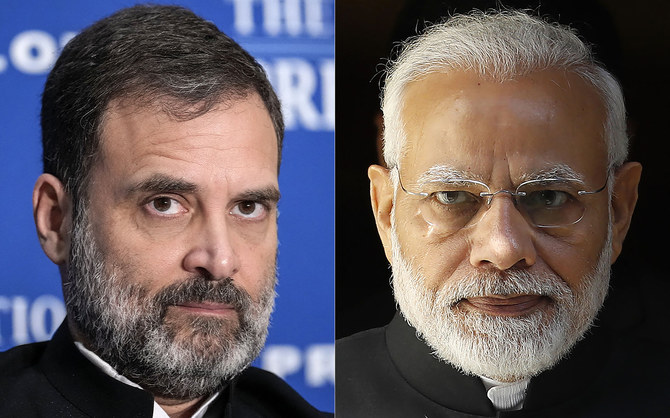
This combination of pictures created on August 9, 2023 shows India's opposition leader Rahul Gandhi (L) speaking at the National Press Club in Washington, DC, on June 1, 2023 and India's Prime Minister Narendra Modi leaving from 10 Downing Street in central London on April 18, 2018. (AFP)
Short Url
Updated 10 August 2023
Follow

India PM Modi’s government defeats no-confidence motion

  • Opposition lawmakers brought the motion over months of ethnic violence in Manipur state 
  • No-confidence vote was dismissed by the government ahead of a general election next year

The government of Indian Prime Minister Narendra Modi defeated a no-confidence motion in parliament on Thursday after a fiery speech by the premier at the climax of a three-day debate.

Opposition lawmakers — who had brought the motion over months of ethnic violence in Manipur state — walked out of the chamber, prompting a furious rebuke from the premier, with the government then winning the vote.

The walkouts, according to broadcasters, included Congress party leader Rahul Gandhi, who on Wednesday said Modi’s government was “set on burning the whole country.”

Modi denounced them, saying: “Those who don’t trust democracy are always ready to make a comment but don’t have the patience to hear (the rebuttal).”

They would “speak ill and run away, throw garbage and run away, spread lies and run away,” he added, to cheers from his own benches.

“This is their game and the country can’t expect much from them.”

The no-confidence vote was dismissed by the government ahead of the vote as a headline-grabbing gimmick ahead of a general election next year.

Modi’s Hindu-nationalist Bharatiya Janata Party (BJP) has a large majority in the 543-member lower house, and is widely expected to win a third term in power.

Its muscular appeals to India’s Hindu majority have proven a winning formula, and Modi has already steered it to two landslide victories over Gandhi and his Congress party.

“I can understand the Congress party’s problem,” Modi said Thursday. “They have been launching the same failed product again and again, but the launch fails every time.”

‘Peace in Manipur’

Gandhi, 53, is the son, grandson and great-grandson of three former Indian premiers.

He spearheaded the parliamentary attack on the government Wednesday, condemning what he said was Modi’s inaction over the deadly Manipur violence.

In a speech to lawmakers, Gandhi had charged that Modi was “killing Mother India.”

The opposition leader was restored to parliament on Monday after the Supreme Court suspended his defamation conviction over past comments criticizing Modi.

Gandhi had been sentenced to two years’ imprisonment in March in a case that critics flagged as an effort to stifle political opposition in the world’s largest democracy.

Modi’s party has been repeatedly accused by political opponents and rights groups of fomenting religious divisions for electoral purposes.

At least 152 people have been killed in Manipur since May, according to government figures, after armed clashes broke out between the predominantly Hindu Meitei majority and the mainly Christian Kuki community.

The state has fractured on ethnic lines, with rival militias setting up blockades to keep out members of the opposing group.

On Thursday, Modi called the violence “saddening” and said that “there will be peace in Manipur in the coming times.”

Tens of thousands of additional soldiers have been rushed from elsewhere to contain the violence, and a curfew and Internet shutdown remain in force across Manipur.

Human Rights Watch has accused BJP-led state authorities in Manipur of facilitating the conflict with “divisive policies that promote Hindu majoritarianism.”

Modi faced a barrage of criticism from opponents for taking more than two months to speak about the conflict.

He broke his silence in July after the publication of a graphic video showing a baying mob parading two Kuki women naked, saying that the incident had filled his heart with “pain and anger.”


US ambassador accuses Poland parliament speaker of insulting Trump

Updated 2 sec ago
Follow

US ambassador accuses Poland parliament speaker of insulting Trump

Tom Rose said the decision was made because of speaker Wlodzimierz Czarzasty’s “outrageous and unprovoked insults” against the US leader
“We will not permit anyone to harm US-Polish relations, nor disrespect (Trump),” Rose wrote on X

WARSAW: The United States embassy will have “no further dealings” with the speaker of the Polish parliament after claims he insulted President Donald Trump, its ambassador said on Thursday.
Tom Rose said the decision was made because of speaker Wlodzimierz Czarzasty’s “outrageous and unprovoked insults” against the US leader.
“We will not permit anyone to harm US-Polish relations, nor disrespect (Trump), who has done so much for Poland and the Polish people,” Rose wrote on X.
Poland’s Prime Minister Donald Tusk responded the same day, writing on X: “Ambassador Rose, allies should respect, not lecture each other.”
“At least this is how we, here in Poland, understand partnership.”
On Monday, Czarzasty criticized a joint US-Israeli proposal to support Donald Trump’s candidacy for the Nobel Peace Prize.
“I will not support the motion for a Nobel Peace Prize for President Trump, because he doesn’t deserve it,” he told journalists.
Czarzasty said that rather than allying itself more closely with Trump’s White House, Poland should “strengthen existing alliances” such as NATO, the United Nations and the World Health Organization.
He criticized Trump’s leadership, including the imposition of tariffs on European countries, threats to annex Greenland, and, most recently, his claims that NATO allies had stayed “a little off the front lines” during the war in Afghanistan.
He accused Trump of “a breach of the politics of principles and values, often a breach of international law.”
After Rose’s reaction, Czarzasty told local news site Onet: “I maintain my position” on the issue of the peace prize.
“I consistently respect the USA as Poland’s key partner,” he added later on X.
“That is why I regretfully accept the statement by Ambassador Tom Rose, but I will not change my position on these fundamental issues for Polish women and men.”
The speaker heads Poland’s New Left party, which is part of Tusk’s pro-European governing coalition, with which the US ambassador said he has “excellent relations.”
It is currently governing under conservative-nationalist President Karol Nawrocki, a vocal Trump supporter.
In late January, Czarzasty, along with several other high-ranking Polish politicians, denounced Trump’s claim that the United States “never needed” NATO allies.
The parliamentary leader called the claims “scandalous” and said they should be “absolutely condemned.”
Forty-three Polish soldiers and one civil servant died as part of the US-led NATO coalition in Afghanistan.
