

Pakistan ‘cipher case’ takes new turn as US outlet publishes document for first time

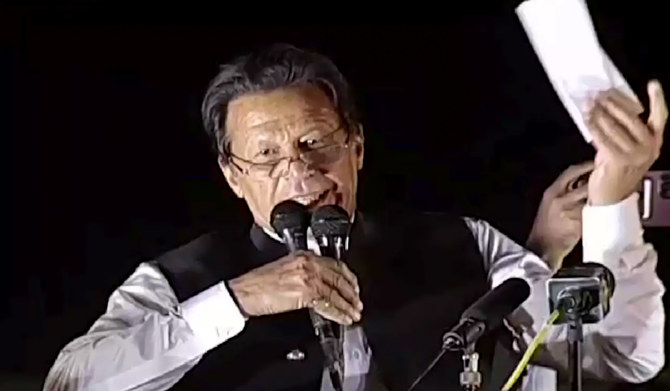
Pakistan's former prime minister Imran Khan holding what he says is a cipher which is a proof of a "foreign conspiracy" to oust him, during a political rally in Islamabad on March 30, 2022. (Photo courtesy: social media)
Short Url
Updated 10 August 2023
Follow

Pakistan ‘cipher case’ takes new turn as US outlet publishes document for first time

  • Alleged document reveals State Department pressured Islamabad in March 2020 to remove Imran Khan as PM
  • Former interior minister Rana Sanaullah calls for investigation to establish authenticity of the ‘source document’

ISLAMABAD: Pakistan’s former interior minister Rana Sanaullah, part of the outgoing cabinet of Prime Minister Shehbaz Sharif which was dissolved on Wednesday, has called for an investigation after a US news outlet published what it said was a classified Pakistani government document revealing that the US State Department pressured Islamabad in a March 2022 meeting to remove Imran Khan as prime minister.

Ex-PM Khan has since last year, in what has come to be known as the ‘cipher case,’ said there was diplomatic correspondence between Washington and Islamabad that proved a US conspiracy to topple his government. Washington has denied being involved.

The Intercept, an online American nonprofit news organization, on Thursday, published the text of the so-called Pakistani cable for the first time, saying it was produced by Islamabad’s ambassador to Washington after a meeting between him and two State Department officials.

One month after the meeting with US officials documented in the leaked document, a no-confidence vote was held in parliament, leading to Khan’s removal from power.

“Investigation needs to be held to establish the authenticity of the information or source document. Potentially, it is a very sinister, treacherous, and seditious act,” Rana Sanaullah, the outgoing interior minister and a senior leader in Sharif’s PMLN party, said on Twitter.

Sanaullah said Khan had a copy of the classified document, which he had not returned and had accepted he had misplaced.

“If proven guilty, Khan should be tried under the Official Secret Act,” the ex-minister said.

https://twitter.com/RanaSanaullahPK/status/1689354888004907008?s=20

Last month, on the recommendation of the Sharif cabinet, the Federal Investigation Agency had formed a joint investigation team against Khan for “prejudicing” national security and the interests of the state by exposing official secrets. The decision to probe Khan in the ‘cipher case’ was taken after the ex-premier’s former principal secretary Azam Khan reportedly recorded a court statement saying the letter was manipulated by Khan in March 2022 to serve his political goals.

Meanwhile, Khan’s Pakistan Tehreek-e-Insaf (PTI) party, in a statement issued Thursday, called out the Sharif cabinet for “denying the cipher’s existence” and demanded the debate around it should be put in the “right perspective” by acknowledging that Khan was removed from power through foreign intervention via a no-confidence vote.

“We reiterate our demand that a high-powered judicial commission should be constituted to investigate the issue comprehensively and make its findings public,” the PTI said.


Pakistan consumer confidence rises by 4 percentage points in two years, survey shows

Updated 6 sec ago
Follow

Pakistan consumer confidence rises by 4 percentage points in two years, survey shows

  • Four in 10 Pakistanis believed the country is on the right track, with optimism higher among men
  • Economic concerns remained most worrying, but their quantum fell drastically across all issues

ISLAMABAD: Consumer confidence in Pakistan has risen by 4 percentage points from 31.5 to 35.5 over the last two years, which highlights improving public optimism under the government’s tenure, Ipsos market research firm said in a recent survey.

The survey was conducted through computer-assisted telephonic interviews (CATI) and included more than a thousand participants from all provinces and Azad Kashmir and Gilgit Baltistan regions on Feb. 2-14.

It comes at a time when Pakistan has undergone a difficult period of stabilization, though international rating agencies have acknowledged improvements after Islamabad began implementing structural reforms as part of its $7 billion International Monetary Fund (IMF) program.

The Ipsos survey revealed a “measurable” improvement in Pakistan’s economic sentiment, marked by a decline in inflation alongside notable reductions in poverty and unemployment, since the current government took charge two years ago.

“These findings point to a clear two-year transformation in the Consumer Confidence Index, demonstrating the perceived impact of consistent governance and policy measures,” read the key takeout in the survey.

“Sustained performance, coupled with transparent communication of achievements, will be essential to maintain momentum, reinforce optimism, and support further improvements in economic confidence.”

Four in 10 Pakistanis believed the country is on the right track, with optimism higher among men, while confidence in the country’s direction being right increased more than three times, from 12 percent to 40 percent, since the government came to power, according to the survey.

Economic concerns remained most worrying, but their quantum fell drastically across all issues since the first quarter of 2024. Inflation has dropped by 23 percent, unemployment by 10 percent, poverty by 20 percent, electricity prices by 34 percent and the burden of additional taxes was reduced by 18 percent in Q1 2026 as compared to Q1 2024.

“One in 3 Pakistanis expect the economy to strengthen,” the survey read. “Confidence to invest has grown steadily over two years, rising from 11 percent to 16 percent, with even stronger optimism among urban residents.”