

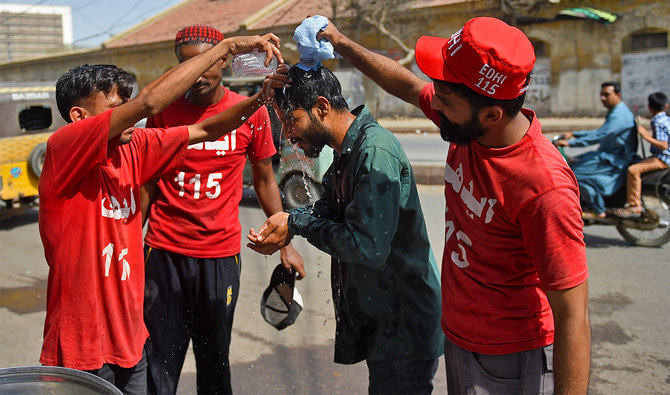

LONDON: A dangerous combination of heat and humidity is sweeping the Gulf region this week, hitting cities from Dubai to Doha.
Dubai, for example, is forecast to see air temperatures hover around 43 degrees Celsius (109 degrees Fahrenheit). But climate experts say air temperature alone can be misleading.
Meteorologists are particularly worried about the "wet-bulb" temperature — a more holistic measurement that accounts not just for air temperature but also how much moisture it holds. In Dubai, humidity this week is expected to be between 35% and 45%.
At the upper end, wet-bulb temperatures can cause serious health effects if people can't find a way to quickly cool down.
Dubai could this week briefly touch wet-bulb temperatures nearing 30C (86F) - roughly the point at which serious health effects could occur - but would need to sustain that temperature for several hours, which isn't yet expected.
HOW IS WET-BULB TEMPERATURE MEASURED?
A wet-bulb measurement is taken by covering a thermometer with a water-soaked cloth. The process of the water evaporating from the cloth, thus lowering the temperature, mirrors how the human body cools down with sweat.
At 100% relative humidity, wet-bulb temperature will be the same as the dry air temperature, but with less humidity it is lower.
HOW DO HIGH WET-BULB TEMPERATURES AFFECT THE HUMAN BODY?
High wet-bulb temperatures are dangerous because humans lose around 80% of heat through sweating, so when both humidity and air temperature are high it becomes harder to shed excess heat.
Sweat evaporates very slowly, if at all, in very humid conditions.
Internal body temperature is around 37C (98F). But humans also generate more heat through exercise.
"You have to lose that - if you don't lose the heat, you just slowly heat up and that can't be good," said Matthew Huber, a global expert on heat stress at Purdue University in the U.S.
If the body cannot cool down it will eventually overheat, triggering respiratory and cardiovascular issues, and even death.
WHAT'S THE THRESHOLD?
This is an area of ongoing research among scientists.
A landmark study co-authored by Huber in 2010 found that a wet-bulb temperature of 35C (95F) persisting beyond six hours could induce hyperthermia in people and cause serious health consequences or death.
While Huber's study assumed more of an ideal scenario —perhaps a person in the shade drinking water — real people might be out exercising in direct sunlight.
Research published in the Journal of Applied Physiology in 2022 suggested that limit could be lower. Scientists placed young, healthy adults in chambers that mimicked high wet-bulb temperatures and had them perform tasks that mirrored those of daily life. They found the limit could be much lower — between 30C (86F) and 31C (88F).
"That's kind of a game changer if that's right," said Huber.
HOW DOES CLIMATE CHANGE AFFECT WET-BULB TEMPERATURES?
Climate change is predicted to affect not just how high wet-bulb temperatures get but also how long they persist. The upper range of wet-bulb temperatures scales directly with the climbing global average temperature.
"If you warm the world by about 1C, then the maximum wet-bulb temperature that might be experienced over much of the world increases by about one degree," said Huber.
The world is on track for 2.7C (4.9F) of global warming by 2100 under current government policies, the United Nations says.
"All of a sudden you have large parts of the world in terms of population that reach the threshold, even with moderate warming," said Huber.
Climate change may also cause dangerous wet-bulb temperatures to last longer. A 2020 study in the Journal of Scientific Advances found that, rather than lasting for only an hour, dangerous wet-bulb temperatures could persist for six or more hours by 2060 — killing anyone who can't take cover.
Overall, extreme humid heat worldwide has doubled in frequency since 1979, the study found.
WHAT AREAS ARE AT HIGHEST RISK?
Tropical regions with a lot of humidity, especially those along the monsoon belt, are generally at greatest risk of experiencing lethal wet-bulb temperatures.
China, India, Bangladesh, Pakistan and Africa's Sahel region are all considered key risk zones.
HAVE WE ALREADY SEEN DEADLY WET-BULB TEMPERATURES?
Small slivers of the world have flirted with lethal wet bulb temperatures. But these punishing conditions only lasted one to two hours at a time, avoiding deadly consequences.
Jacobabad in Pakistan — dubbed the hottest city on Earth — has surpassed a wet-bulb temperature of 35C on at least four occasions.
But many other cities have briefly seen maximum wet-bulb temperatures exceeding 32C, said the Scientific Advances study, which assessed global weather station data. These include La Paz, Mexico; Port Hedland, Australia; and Abu Dhabi, UAE.


