

Pakistani parliament dissolved, setting the stage for general elections

1 / 2
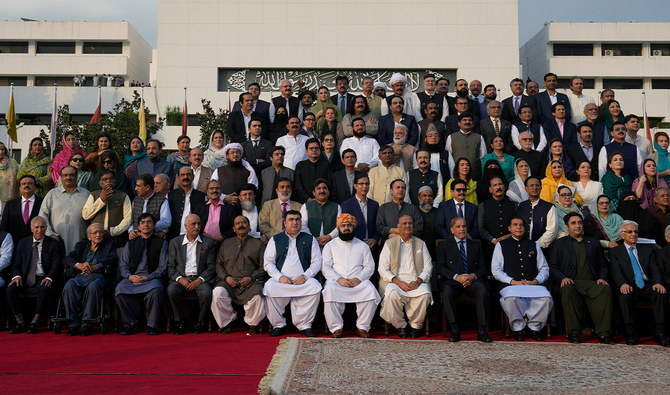
Pakistan's Prime Minister Shehbaz Sharif in a group photo with the members of the National Assembly in Islamabad, Pakistan August 9, 2023. (REUTERS)
2 / 2
The picture posted by the Pakistani president's office shows President Dr. Arif Alvi signing a summary sent by Prime Minister Shehbaz Sharif for the dissolution of the National Assembly in Islamabad, Pakistan on August 9, 2023. (President's Office)
Short Url
Updated 09 August 2023
Follow

Pakistani parliament dissolved, setting the stage for general elections

  • Sharif’s tenure technically expires on August 12, caretaker setup now has up to 90 days to hold general elections
  • Elections likely to be delayed beyond November as fresh constituency boundaries required after new census

ISLAMABAD: Pakistan’s National Assembly stood dissolved on Thursday after President Dr. Arif Alvi signed a summary sent by Prime Minister Shehbaz Sharif, sending the South Asian country into election mode.

The parliament’s five-year term was due to expire on August 12, but this move dissolved it three days earlier, meaning the caretaker government has 90 days to organize general elections, as against 60 days if the assembly had been dissolved when the government’s term expired, as per the constitution.

“The prime minister’s advice at para 6 of the summary is approved,” a notification released by the President House and signed by Alvi said.

Following the president’s decision, the National Assembly and the federal cabinet stand dissolved.

“The president dissolved the National Assembly on the advice of the prime minister under Article 58-1 of the Constitution,” said an official statement issued by the President’s Office.
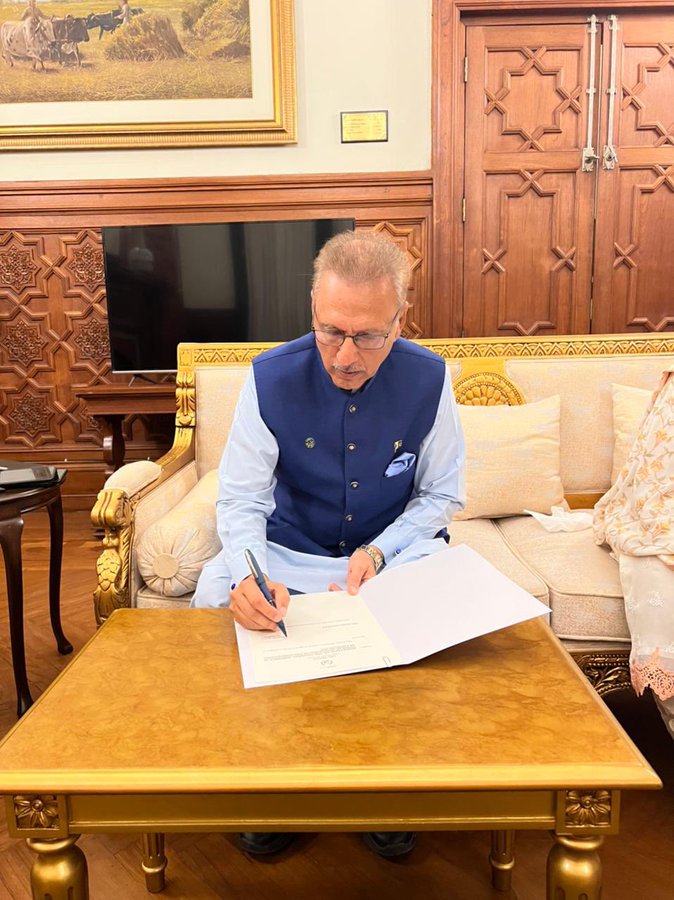


The picture posted by the Pakistani president's office shows President Dr. Arif Alvi signing a summary sent by Prime Minister Shehbaz Sharif for the dissolution of the National Assembly in Islamabad, Pakistan on August 9, 2023. (President's Office)

With parliament dissolved ahead of schedule, general elections would be due by November. But the government’s move last week to approve the results of a fresh digital census has thrown polls into uncertainty, as the Election Commission is now bound under the constitution to draw new constituency boundaries as per the results of the latest population count. That process could take up to six months and would mean polling day is pushed back by months.

The ECP has already said it cannot hold general elections on the basis of the new population count within the stipulated three-month deadline if it has to finalize fresh delimitations of constituencies.

Meanwhile, Pakistan’s myriad economic and political troubles continue.
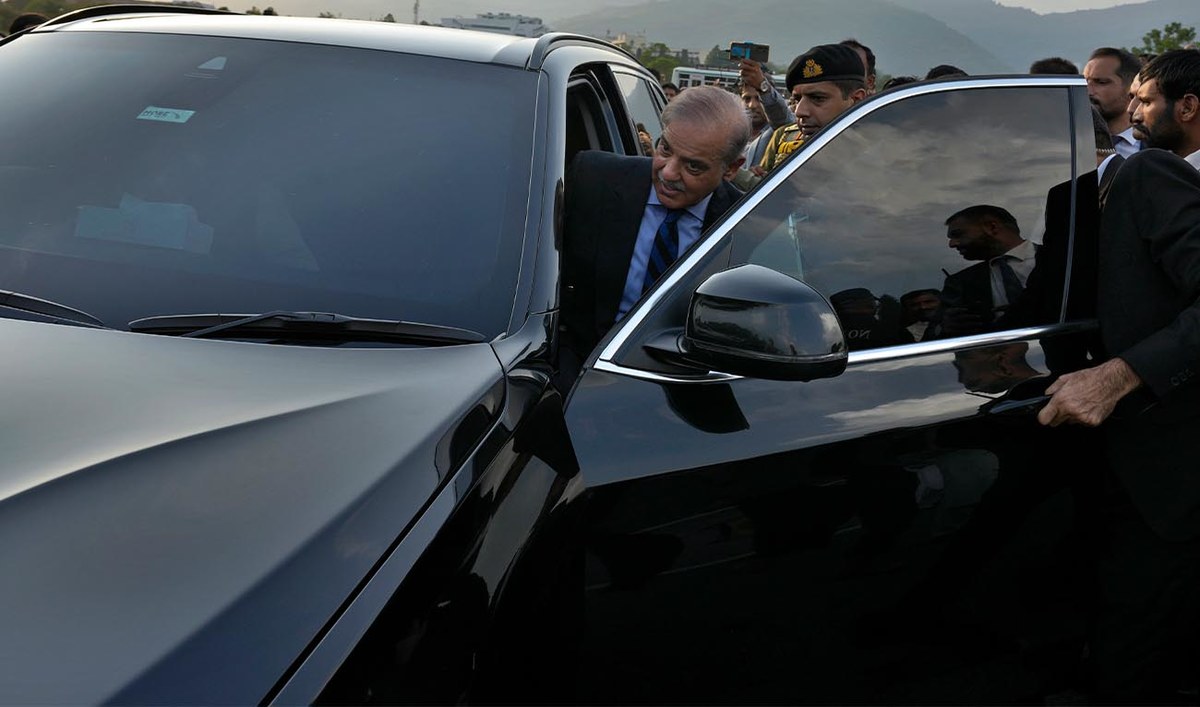


Pakistan's Prime Minister Shehbaz Sharif leaves after a group photo with lawmakers of the National Assembly at the end of the last session of the current parliament, in Islamabad, Pakistan, on August 9, 2023. (AP)

At the heart of the political crisis is former Prime Minister Imran Khan, whose ouster last year plunged the country into months of unrest and violent street protests. The ex-premier, the country’s most popular politician by far, was convicted and jailed on graft charges last week and on Tuesday the election regulator barred him from politics for five years, for all practical purposes ending his chances of running in upcoming elections.

His legal team has appealed the conviction and the disqualification though Khan also faces over 100 other cases, with charges ranging from terrorism to corruption and murder. Khan says the cases are part of the crackdown against him and his Pakistan Tehreek-e-Insaf party, orchestrated by the powerful military establishment and his political opponents. Both deny the charge.

Meanwhile, inflation remains at a record high and millions of ordinary Pakistanis are grappling with a cost-of-living crisis. The country’s Consumer Price Index rose to 28.3 percent in July, year-on-year, with prices up 3.5 percent in July from the previous month. In June, the CPI rise was 29.4 percent year-on-year, coming off a record 38 percent in May. On August 1, Pakistan announced an increase in petrol and diesel prices to meet fiscal objectives laid down in a deal with the International Monetary Fund (IMF), adding further fuel to its sky-high inflation.

Pakistan secured the last-gasp $3 billion deal with the IMF on June 30. Islamabad has committed to a petroleum levy of up to 50 rupees a liter, alongside a string of painful measures, including raising extra revenues, increasing energy prices and a market-based exchange rate, which has already fueled inflation.


Pakistan says responding to Afghan ‘offensive operations’ after border fire as tensions escalate

Updated 26 February 2026
Follow

Pakistan says responding to Afghan ‘offensive operations’ after border fire as tensions escalate

  • Afghan Taliban spokesperson says “large-scale offensive operations” launched against Pakistani military bases
  • Pakistan says Afghan forces opened “unprovoked” fire across multiple sectors along shared border

ISLAMABAD: Afghanistan’s Taliban authorities said on Thursday they had launched “large-scale offensive operations” against Pakistani military bases and installations, prompting Pakistan to say its forces were responding to what it described as unprovoked fire along the shared border.

The escalation follows Islamabad’s weekend airstrikes targeting what it said were Tehreek-e-Taliban Pakistan (TTP) and Daesh militant camps inside Afghanistan in response to a wave of recent bombings and attacks in Pakistan. Islamabad said the strikes killed over 100 militants, while Kabul said dozens of civilians were killed and condemned the attacks as a violation of its sovereignty.

In a post on social media platform X, Afghan government spokesperson Zabihullah Mujahid said Afghanistan had launched “large-scale offensive operations” in response to repeated violations by the Pakistani military.


Pakistan’s Ministry of Information said Afghan forces had initiated hostilities along multiple points of the frontier.

“Afghan Taliban regime unprovoked action along the Pakistan–Afghanistan border given an immediate, and effective response,” the ministry said in a statement.

The statement said Pakistani forces were targeting Taliban positions in the Chitral, Khyber, Mohmand, Kurram and Bajaur sectors, claiming heavy Afghan casualties and the destruction of multiple posts and equipment. It added that Pakistan would take all necessary measures to safeguard its territorial integrity and the security of its citizens.


Separately, security officials said Pakistani forces had carried out counterattacks in several border sectors.

“Pakistan’s security forces are giving a befitting reply to the unprovoked Afghan aggression with full force,” a security official said, declining to be named. 

“The Pakistani security forces’ counter-attack destroyed Taliban’s hideouts and the Khawarij fled,” they added, referring to TTP militants. 

The claims from both sides could not be independently verified.

Cross-border violence has intensified in recent weeks, with Pakistan blaming a surge in suicide bombings and militant attacks on militants it says are based in Afghanistan. Kabul denies providing safe havens to anti-Pakistan militant groups.

The clashes mark the third major escalation between the neighbors in less than a year. Similar Pakistani strikes last year triggered weeklong clashes before Qatar, Türkiye and other regional actors mediated a ceasefire in October.

The 2,600-kilometer (1,600-mile) frontier, a key trade and transit corridor linking Pakistan to landlocked Afghanistan and onward to Central Asia, has faced repeated closures amid tensions, disrupting commerce and humanitarian movement. Trade between the two nations has remained closed since October 2025.