

Saudi Arabia issues 32 new mining licenses in June  

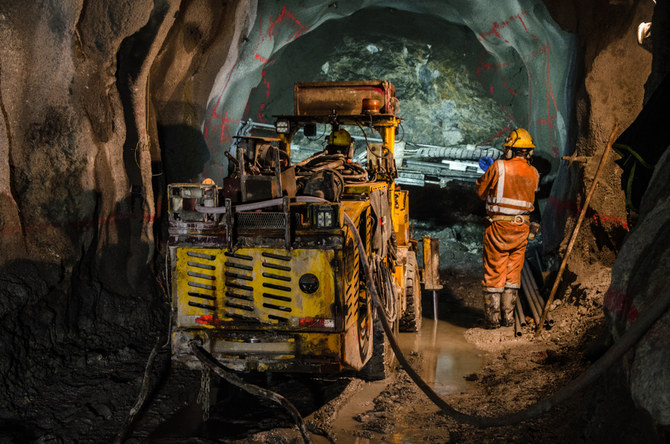
This allocation follows the ministry’s issuance of 34 permits in May, 55 in April and 27 in March. (Shutterstock)
Short Url
Updated 09 August 2023
Follow

Saudi Arabia issues 32 new mining licenses in June  

RIYADH: As the mining industry continues to expand in line with Saudi Arabia’s Vision 2030 economic diversification plan, the Kingdom issued 32 licenses in June. 

According to the Ministry of Industry and Mineral Resources, the new permits included 17 for exploration and 11 for quarrying building materials. 

The ministry also issued two licenses for mining and small mine exploitation, followed by one each for exploration and surplus mineral ores. 

This allocation follows the ministry’s issuance of 34 permits in May, 55 in April and 27 in March.   

The report stated that the total number of mining licenses valid in the sector until the end of June 2023 reached 2,363, led by 1,466 for quarrying building materials, followed by 657 explorations. 

There were also 182 mining and small mines exploitation licenses issued, and 37 for reconnaissance.

Some 21 were handed out for surplus mineral ores.   

Furthermore, the ministry noted that Riyadh acquired the largest number of the total mining licenses with 596 permits, followed by Makkah with 387 licenses. 

The Eastern province received 373 licenses, and Madinah acquired 264 permits. Additionally, Asir benefited from 212 licenses, Tabuk received 150 permits, Qassim was awarded 88, followed by Jizan with 76. 

Furthermore, Hail issued 68 licenses, while Najran received 56, Al-Baha took 40 licenses, followed by the Northern Borders and Al-Jawf receiving 27 and 26, respectively.  

The ministry has been actively exploring opportunities to protect the mining industry and raise its value in line with the goals of the Kingdom's Vision 2030 and the National Industry Development and Logistics Program.      

Furthermore, Saudi Arabia is on track to make mining the third pillar of its economy, and it is working to fully use the approximately 5,300 mineral resource sites, which are valued at SR5 trillion ($1.33 trillion).   

Saudi Arabia, which is rich in natural resources, has implemented a number of regulations in recent years to make its mining sector enticing to private investors.     

The strategic position and robust infrastructure of the Kingdom also provide chances for companies to expand their global supply chain.     


Kuwait forecasts 54.7% rise in fiscal deficit as oil revenues weaken 

Updated 11 sec ago
Follow

Kuwait forecasts 54.7% rise in fiscal deficit as oil revenues weaken 

JEDDAH: Kuwait expects its fiscal deficit to widen sharply in the 2026–2027 budget year as lower oil income weighs on public finances, with the shortfall projected to rise 54.7 percent to 9.8 billion dinars ($31.9 billion). 

Announcing the draft budget, Finance Minister Yaqoub Al-Refaei estimated total expected revenues at 16.3 billion dinars, marking a 10.5 percent decline compared with the previous fiscal year. 

Kuwait is pushing Vision 2035 reforms to diversify its economy and boost non-oil growth but remains exposed to oil price volatility despite moderate inflation and strong non-oil expansion. 

“The minister disclosed that oil revenues were budgeted at 12.8 billion dinars, a 16.3 percent contraction compared to the current budget ending March 31, 2026,” the Kuwait News Agency, known as KUNA, reported. 

Highlighting a positive trend for fiscal diversification, non-oil revenues are projected to rise 19.6 percent to 3.5 billion dinars. 

He noted that total expenditure is expected to reach 26.1 billion dinars, with salaries and subsidies accounting for 76 percent, capital spending 11.8 percent, and other expenditures 12.2 percent. The FY 2026–2027 budget is based on a conservative oil price estimate of $57 per barrel. 

The minister, however, stressed that Kuwait’s fiscal break-even price — the price needed to balance the budget — is significantly higher, at $90.5 per barrel. 

The draft budget, covering April 1, 2026, to March 31, 2027, includes capital spending of 3.1 billion dinars, with significant allocations for infrastructure and strategic projects, according to a release by the Ministry of Finance. 

Of this, 318 million dinars will fund the Ministry of Public Works for developments such as Mubarak Al-Kabeer Port, the Umm Al-Hayman plant expansion, the North Kabd station, and the expansion of Kuwait International Airport’s Terminal 2. 

Additional allocations support the health ministry’s cancer control center, as well as the Defense and Interior ministries for military equipment. 

Higher spending is also driven by a 741.2 million-dinar increase in the public treasury’s contribution to social insurance to cover pension fund deficits. 

Conversely, support for fuel used in power generation and refined products declined by 449.2 million dinars due to falling global oil prices. 

The ministry highlighted that the budget would create 14,518 new positions, reflecting efforts to boost employment while continuing to diversify revenue sources.