

41 dead in new migrant shipwreck off Tunisia

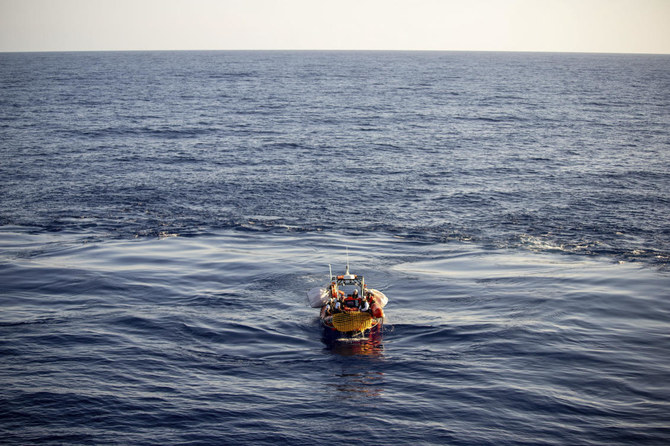
The boat, which departed from Sfax, Tunisia, capsized and sank after a few hours. (File/AP)
Short Url
Updated 10 August 2023
Follow

41 dead in new migrant shipwreck off Tunisia

  • Four survivors were adrift for days

JEDDAH: Forty-one migrants drowned after their flimsy metal boat overturned in the Mediterranean between Tunisia and the Italian island of Lampedusa, the four survivors of the shipwreck told authorities on Wednesday.

The vessel had set off on Aug. 3 from the port city of Sfax, but capsized and sank during the night after being hit by a large wave. The survivors — a 13-year-old boy, a woman and two men, from Ivory Coast and Guinea — clung on to life jackets and other inflatable devices until they found another empty boat at sea, on which they spent several days adrift without food or drinking water.

They were rescued by a merchant vessel on Tuesday before being transferred to an Italian coastguard vessel, and arrived in Lampedusa on Wednesday.

Flavio Di Giacomo of the International Organization for Migration said the migrants’ boat would have been ill-equipped for the bad weather in the Central Mediterranean in the past week.

“Sub-Saharan migrants leaving from Tunisia are forced to use these low-cost iron boats that break after 20 or 30 hours of navigation,” he said.

“With this kind of sea, these boats capsize easily. It is very likely that there are many more shipwrecks than those we know about — that is the real fear.”

People traffickers who sent migrants to sea in such conditions were “more criminal than usual ... totally without scruples,” he said.

Provincial chief of police Emanuele Ricifari said the traffickers would have known bad weather was forecast.“Whoever allowed or forced the migrants to leave with this sea is an unscrupulous criminal lunatic,” he said.

The central Mediterranean is one of the world’s most dangerous migration routes. More than 22,000 people have died or gone missing there since 2014 and more than 1,800 people have died attempting the route so far this year — more than double the number in the same period last year.

Nevertheless, the tiny island of Lampedusa, about 145 kilometers, from Tunisia, is still the first port of call for many migrants heading from North Africa to Europe. Almost 94,000 migrants have landed on Italy’s shores so far this year, up from almost 45,000 in the same period last year.

The latest tragedy is one of several recent deadly incidents during bad weather in the Mediterranean.Authorities said on Monday that 16 migrants had died in shipwrecks off the coasts of Tunisia and Western Sahara. On Sunday, the International Organization for Migration said at least 30 people were missing after two shipwrecks off Lampedusa.


Built on ancient design, Indian Navy’s first stitched ship sails to Oman

Updated 7 sec ago
Follow

Built on ancient design, Indian Navy’s first stitched ship sails to Oman

  • INSV Kaundinya is a 21-meter wooden ship modeled on painting from Ajanta Caves
  • It was constructed by artisans from Kerala and inducted into Indian Navy last year

NEW DELHI: Built using a fifth-century stitched-ship technique, the Indian Navy’s Kaundinya vessel is approaching Oman, navigating the historic Arabian Sea route once traveled by ancient seafarers.

The 21-meter ship is a type of wooden boat, in which planks are stitched together using cords or ropes, a technique popular in ancient India for constructing ocean-going vessels.

The vessel set sail on its first transoceanic voyage from Porbandar in Gujarat on Dec. 29 and is expected to reach Muscat in mid-January.

“The exact date obviously depends on how weather conditions pan out. It has been a great experience thus far and the crew remains in high spirits,” Sanjeev Sanyal, an Indian economist who initiated the Kaundinya project and is part of the expedition, told Arab News.

“This is a very ancient route going back to the Bronze Age, and very active from ancient to modern times. We are trying to re-create the voyage on INSV Kaundinya, a ‘stitched’ ship using designs as they would have existed in the fifth century A.D. — a hull from stitched planks, steering oars, square sails, and so on.”

The ship was built by artisans from Kerala based on a painting found in the Ajanta Caves, a UNESCO World Heritage Site in Maharashtra state, where rock-cut monuments feature exquisite murals dating from the second century B.C. to the fifth century.

INSV Kaundinya crew members pose for photo on the third day of their voyage from Gujarat to Oman, Dec. 31, 2025. (INSV Kaundinya)

Funded by the Indian Ministry of Culture in 2023, the vessel was completed in February last year and inducted into the Indian Navy in May.

The Indian Navy collaborated with the Department of Ocean Engineering at the Indian Institute of Technology-Madras to conduct model testing of the vessel’s hydrodynamic performance. The navy also tested the wooden mast system, which was built entirely without modern materials.

On its journey to Muscat, the ship is manned by an 18-member crew, which, besides Sanyal, consists of four officers, 12 sailors, and a medic.

“The voyage gives a good glimpse of how ancient mariners crossed the Indian Ocean — the changing winds and currents, the limitations of ancient technology,” Sanyal said.

“The square sail, for example, allows the ship to sail only up to a limited angle to the wind compared to a modern sailing boat. It also does not have a deep keel, so it rolls a lot. “Nonetheless, in good winds, it can do up to five knots — a very respectable speed. One reads about these voyages in ancient texts and (they are also) depicted in paintings and sculpture, but this provides a real experience.”