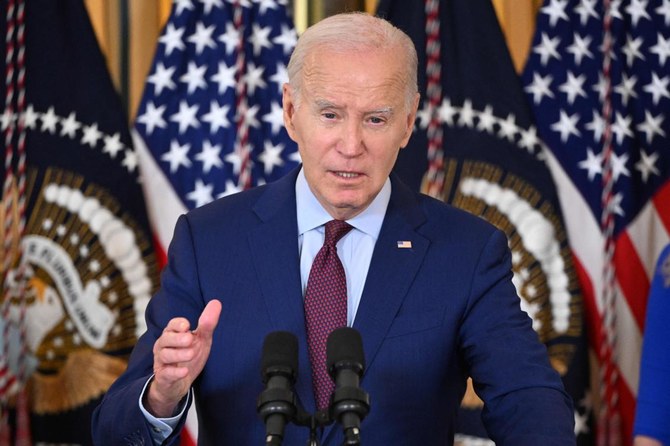
WASHINGTON: US President Joe Biden said Tuesday he would travel to Vietnam “shortly” as part of an effort to improve ties with Hanoi, as Washington seeks to counter China’s influence in the region.
“I’m going to be going to Vietnam shortly because Vietnam wants to change our relationship and become a partner,” Biden said during remarks in New Mexico.
“We find ourselves in a situation where all these changes around the world are taking place at a time we have an opportunity ... to change the dynamic,” he added.
The United States and Vietnam have increasingly close trade links, while both share concern over China’s growing strength in the region.
Friction has been increasing for years between Beijing and Southeast Asian nations, particularly Vietnam and the Philippines, over China’s sweeping maritime claims in the South China Sea.
Washington and Hanoi pledged in April to upgrade diplomatic ties when US Secretary of State Antony Blinken stopped over on his way to a Group of Seven (G7) foreign ministers’ meeting in Japan.
“We think this is an auspicious time to elevate our existing partnership,” Blinken told reporters during the visit with Vietnamese leaders.
“We’ve had for the last 10 years this comprehensive partnership that has created an incredibly strong foundation of cooperation across many different areas. As a result, we think this is a good moment to go even further.”
Blinken also attended a ground-breaking opening for a new US embassy in Hanoi.
And in March, Biden spoke with the head of Vietnam’s ruling Communist party, Nguyen Phu Trong.
Washington has, however, bristled over human rights concerns in Vietnam, with Blinken saying he continued “to underscore how future progress on human rights is essential to unleashing the full potential of the Vietnamese people.”
The South China Sea, the longtime center of tensions between China and Vietnam, is seen as a powder keg, and many fear a miscalculation or accident could ignite a military conflict.
Analysts say Hanoi may be more reluctant to elevate relations with Washington, wary of upsetting Beijing — an important economic partner — despite rival claims in the South China Sea.
The United States has no territorial claim over the waters, but has persisted in conducting its own patrols there, angering Beijing.
Washington says this is to ensure what it terms “freedom of navigation” in the sea, through which trillions of dollars in trade passes annually.
The United States has also sought to improve relations with China in recent months, with Blinken visiting in June after a previous trip was canceled when an alleged Chinese spy balloon was shot down by a US warplane after traversing the country earlier this year.


Biden to visit Vietnam ‘shortly’ amid China tensions
https://arab.news/n5fxp
Biden to visit Vietnam ‘shortly’ amid China tensions

- United States and Vietnam have close trade links, while both share concern over China’s growing strength in the region
- US Secretary of State Antony Blinken attended ground-breaking opening for new US embassy in Hanoi


Pakistan rules out talks with Afghanistan, says more than 330 Afghan fighters killed in operations
- More than 330 Afghan fighters killed in operations
ISLAMABAD: Pakistan has ruled out talks with Afghanistan until there is an end to “terrorism” emanating from Afghan soil, officials said on Friday. The statement follows the killing of more than 330 Afghan fighters in cross-border skirmishes this week.
The latest clashes between the neighbors erupted after Pakistani airstrikes on Afghan territory last weekend triggered retaliatory attacks along the border on Thursday, escalating long‑simmering tensions over Pakistan’s claim that Afghanistan shelters Pakistani Taliban militants. Afghanistan denies this, saying Pakistan is deflecting blame for its own security failures.
Pakistani Information Minister Attaullah Tarar said his country had killed 331 Afghan fighters, destroyed over 100 posts and targeted 37 military locations across Afghanistan. Afghan officials have said more than 50 Pakistani soldiers have been killed and several Pakistan posts captured. Neither casualty figures nor battlefield claims by either side could be independently verified.
Meanwhile, Mosharraf Zaidi, Prime Minister Shehbaz Sharif’s spokesperson for foreign media, ruled out any talks with Afghanistan until Kabul addresses the issue, while the US expressed support for what it called Pakistan’s “right to defend itself” against attacks from Afghanistan’s Taliban rulers.
“There won’t be any talks, there is nothing to talk about ... Terrorism from Afghanistan has to end,” Zaidi told state-run Pakistan TV Digital, saying Islamabad would continue to target militant havens inside Afghanistan.
“Pakistan’s responsibility is to protect its citizens. If we know that there is a terrorist in point A and we know that there is a terrorist enabler at point A, we will find a weapon to land at point A and eliminate the threat.”
Zaidi said he did not expect Pakistan to deviate from this position: “We have clearly articulated what we are doing and what we plan on continuing to do and what it will take for us to stop doing what we are doing.”
He added: “And we will expect that both the international community and the regime in question, the Afghan Taliban, will come to their senses and will help reduce instability and disorder in this region.”
Pakistan is a major non-NATO ally of Washington, while the US considers the Afghan Taliban a “terrorist” group.
“The United States supports Pakistan’s right to defend itself against attacks from the Taliban, a Specially Designated Global Terrorist group,” Reuters quoted a State Department spokesperson as saying.
US diplomat Allison Hooker said on X she had spoken with Pakistan Foreign Secretary Amna Baloch on Friday.
The State Department spokesperson said Washington was aware of the escalation in tensions and “outbreak of fighting between Pakistan and the Afghan Taliban,” adding the US was “saddened by the loss of life.”
“The Taliban have consistently failed to uphold their counterterrorism commitments,” it said. “Terrorist groups use Afghanistan as a launching pad for their heinous attacks.”
Meanwhile, Afghan Taliban spokesperson Zabihullah Mujahid called for talks to resolve the crisis.
“We have always emphasized peaceful resolution, and now too we want the issue to be resolved through dialogue,” he said on Friday afternoon.
Asked what Pakistan desired, Tarar said: “Neutralizing the threat and ensuring that Pakistan is safe. Because for us, we’ve been good neighbors, we’ve been very friendly neighbors, we’ve been very, very generous neighbors. Our generosity, unfortunately, has often been seen as our weakness. So the objective, aim is to neutralize the threat and make Pakistan safe.”
He added it was too early to comment on a ceasefire as it was an evolving situation.


