

2023 is not election year in Pakistan — interior minister

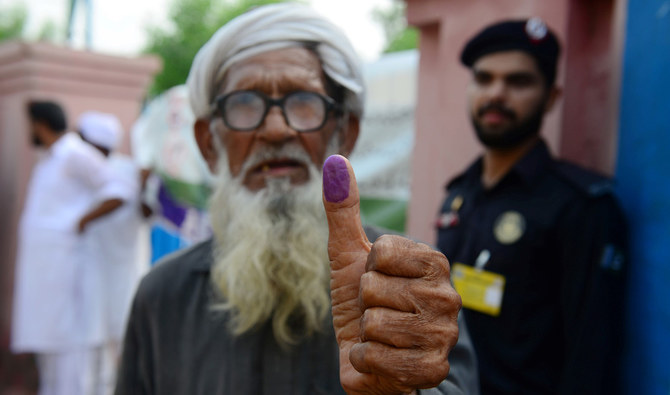
An elderly Pakistani man shows his inked thump after casting his vote outside a polling station during general election in Lahore, Pakistan, on July 25, 2018. (AFP/File)
Short Url
Updated 08 August 2023
Follow

2023 is not election year in Pakistan — interior minister

  • Interior Minister Rana Sanaullah says delimitation of constituencies under new census can take up to 120 days
  • Sanaullah says prime minister, opposition leader have not yet finalized candidate for caretaker premier

ISLAMABAD: Pakistani Interior Minister Rana Sanaullah said on Tuesday general elections would not be held this year, as a new census approved by the government last week required fresh constituency boundaries to be drawn across the country, a process that could take months.

Prime Minister Shehbaz Sharif’s tenure expires on August 12, after which a caretaker government will take over with the constitutional mandate to organize general elections within a maximum of 90 days if the assembly is dissolved before the expiry of its term, and 60 days if it is dissolved when the term ends. Sharif has said he will dissolve the assembly on August 9 ahead of the expiry of its term, meaning general elections would be due by November.

However, last week Sharif’s government approved the results of a digital census carried out this year. The Election Commission of Pakistan is now bound under the constitution to draw new constituency boundaries as per the results of the new population count, a process that can take up to six months and would mean polling day is pushed back by months.

The ECP has already said it cannot hold general elections on the basis of the new population count within the stipulated three-month deadline if it has to conduct fresh delimitations of constituencies.

“The straight answer is no,” Sanaullah said in an interview with a local TV channel when asked if 2023 was the year in which general elections would be held in Pakistan.

“The constitution states that when the census is notified, then it is necessary to conduct delimitation of the constituencies,” Sanaullah said. “So, the caretaker setup will fulfill these legal requirements which takes around 120 days.”


Pakistan's Interior Minister Rana Sanaulah (left) addresses a media conference in Islamabad, Pakistan, on August 8, 2023. (PID/File)

Sanaullah said polls would be held as soon as the delimitation of the constituencies was complete. The new census shows the population has risen to 241.49 million.

With only a day left before August 9 when the government plans to dissolve its term, both the leader of the opposition and the prime minister have not yet finalized a name for the caretaker prime minister’s post. According to the constitution, a caretaker prime minister is appointed by the president in consultation with the PM and leader of the opposition in the outgoing National Assembly, the lower house of parliament. 

Sanaullah said though many names for the post were being discussed by Pakistani media, a candidate had not yet been finalized.

“No name has been locked till now,” the minister said.

The opposition in Pakistan, particularly the party led by now jailed former premier Imran Khan, says the ruling coalition of Sharif is seeking to avoid facing an election as Khan’s popularity grows. The government denies it is dragging its feet. 


Pakistan refineries urge regulator to curb fuel imports, citing supply chain risks

Updated 5 sec ago
Follow

Pakistan refineries urge regulator to curb fuel imports, citing supply chain risks

  • Industry cites rules requiring priority use of locally refined fuel
  • Dispute highlights pressure on Pakistan’s energy security and refinery viability

ISLAMABAD: Pakistan’s major oil refineries this week jointly urged the country’s energy regulator to step in and limit fuel imports, warning that excessive reliance on overseas supplies is undermining domestic refining operations and threatening the stability of the national oil supply chain.

In a letter sent to the Oil and Gas Regulatory Authority (OGRA), the chief executives of Attock Refinery Limited, Pakistan Refinery Limited, National Refinery Limited, Pak-Arab Refinery Limited and Cnergyico PK said current regulatory decisions were allowing imported petroleum products to displace locally refined fuel, despite rules requiring domestic output to be prioritized.

OGRA is Pakistan’s federal regulator responsible for overseeing oil and gas markets, including licensing, pricing frameworks and supply planning. The dispute comes as Pakistan, which imports most of its crude oil and refined fuel, seeks to balance energy security concerns with cost pressures and foreign exchange constraints.

“As clearly stipulated in Rule 35(g) of the Pakistan Oil (Refining, Blending, Transportation, Storage, and Marketing) Rules, 2016, the upliftment of locally produced refinery products must be prioritized before any imports are considered,” the refineries wrote in a letter dated Dec. 10. “Unfortunately, the excessive imports allowed by OGRA have worsened the situation on ground.”

Rule 35(g) requires that fuel produced by Pakistan’s refineries be taken up by oil marketing companies before additional imports are approved, a provision designed to protect local refining capacity and ensure steady utilization of plants that are critical to national supply.

The refineries warned that continued preference for imports could disrupt operations, reduce refinery utilization rates and weaken Pakistan’s ability to respond to supply shocks, particularly for products such as aviation fuel and diesel. They called on OGRA to take “urgent and proactive intervention” to ensure timely off-take of locally produced fuel.

Pakistan’s refining sector has long struggled with aging infrastructure, limited upgrading and thin margins, while imports are often seen as cheaper or more flexible in the short term. However, industry officials argue that over-reliance on imports increases exposure to global price volatility, shipping disruptions and foreign exchange pressure.

The letter was also copied to the federal minister for energy, the secretary of the petroleum division and the director general of oil, indicating the issue has been escalated beyond the regulator to senior policymakers.

Energy analysts say the dispute underscores broader tensions in Pakistan’s energy market, where policy decisions must balance consumer prices, refinery survival and long-term energy security. Any regulatory shift could affect fuel availability, refinery investment plans and the country’s import bill at a time when Pakistan remains under economic strain.

OGRA has not yet commented on the letter.