

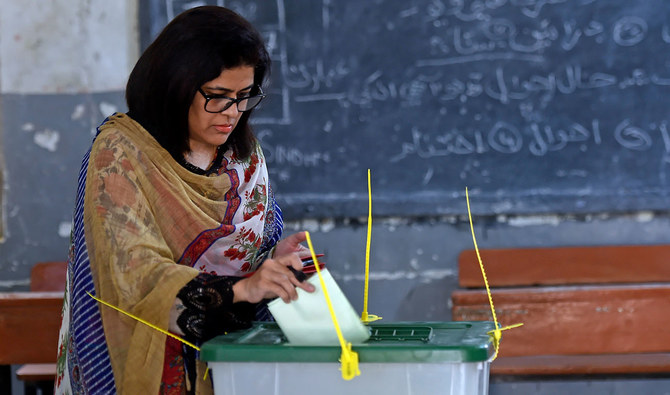

ISLAMABAD: A leading network of Pakistan’s civil society organizations resumed its election monitoring work by scrutinizing voter lists, informed one of its officials this week, though it encountered challenges while recruiting impartial election observers in a charged environment where people have been quite vocal about their political affiliations.
The Free and Fair Election Network (FAFEN) has been in the field since 2008 with the primary mandate to observe the polls and critically watch legislative work along with other significant government and parliamentary actions.
The organization has also used its findings in the past to convince the election commission and parliament to effect necessary adjustments to the legal framework governing electoral contests to make them more transparent.
“We have already conducted voter list audit to look at the quality of electoral rolls that are going to be used in the next elections,” FAFEN’s Director Programs Muddassir Rizvi told Arab News. “The findings are going to be shared after the elections as part of our election reporting.”
He said that his organization’s long-term election observers would be looking at candidates and their nomination process in the next stage and see if all political parties get equal opportunity to contest the polls and connect with the voters.
FAFEN plans to send 6,000 election observers in the field this time, a number far lower than in the past.
“This is one election where people have not only taken their sides on all sides of the political divide but they are also declaring their political affiliations,” he said. “Thanks to the social media, many people who would otherwise say they are non-partisan now inadvertently say something or the other which shows their political affiliation. So, it is very difficult to find people who are non-partisan in Pakistan to be trained as election observers.”
Rizvi, however, noted this was not going to compromise the quality of election monitoring.
“We are going with a smaller number but with a more sound statistical sample which we will be using on election day,” he explained. “Roughly, there will be 100,000 polling stations on the election day and we are targeting to observe around 25 percent.”
Asked about the politically tense environment of Pakistan, the FAFEN official said it was a good thing that people were aware of their choices.
“We may disagree with them,” he maintained, “but they have a political choice which is good. This is how we will be developing a democratic critical mass in Pakistan.”
Rizvi added, however, he was not trying to turn a blind eye to the political polarization in Pakistan on a level where lawmakers were required to interact with each other.
“At that level, people need to grow up and start talking,” he said. “The entire issue that we have seen for the last one-and-a-half years, or even the last four-and-a-half years, was political disengagement. The previous government didn’t want to engage with the opposition and the new government doesn’t want to engage with the opposition [either].”
Responding to a question about recent amendments to empower caretaker setups in Pakistan, he said it was not a bad move, though interim administrations should not be allowed to take decisions with long-term consequences.
“They cannot be just there because we need to have a government,” he argued. “[Only] the symbolism of the government should not be there. They should be functioning governments. They should be able to make decisions.”


