Track, BMX, road, mountain biking all in the mix at cycling’s world championships

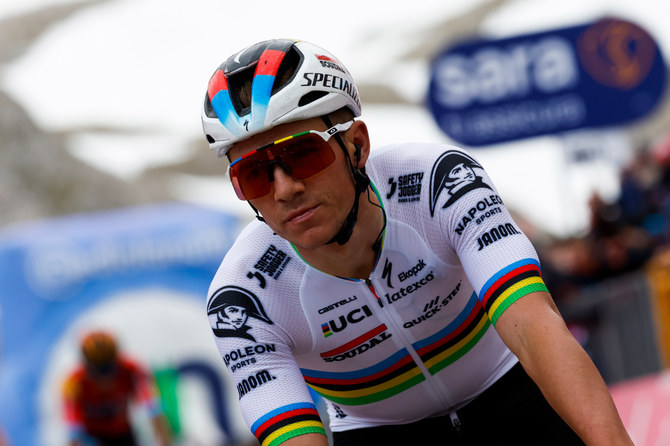
Defending men's world road race champion Remco Evenepoel arrives in good shape at the world cycling championships after landing his third San Sebastian classic. (File/AFP)
Short Url
Updated 02 August 2023
Follow

Track, BMX, road, mountain biking all in the mix at cycling’s world championships

  • Remco Evenepoel: It’s super-good for the head and for the motivation to start the second part of the season and to go to Glasgow next week
  • Tour de France winner Jonas Vingegaard is absent having chosen to race the Vuelta a Espana in late August

GLASGOW: Remco Evenepoel is among the stars assembling for the world cycling championships in Scotland with 13 disciplines including road races, BMX, mountain biking and track racing on the menu from Thursday.

Over 200 of the eye-catching rainbow jerseys will be handed out over the 11 days of action to the various world champions.

The men’s world road race champion Evenepoel arrives in good shape after landing his third San Sebastian classic.

“It’s super-good for the head and for the motivation to start the second part of the season and to go to Glasgow next week,” he said after Saturday’s win.

The 23-year-old Belgian is unlikely to have to contend with swooping parrots in Scotland as he did at the 2022 championships in Wollongong. He forms part of a powerful Belgian team aided by Wout Van Aert.

Van Aert was last in action as ‘sherpa’ to Tour de France winner Jonas Vingegaard but left the race in the final week to attend the birth of his second child.

The epic 271km course from Edinburgh to Glasgow will weed out any bluffers and Evenepoel’s endurance will lend him an edge.

Another to consider is Mathieu van der Poel, who is targeting the men’s road race before switching to cyclo-cross.

Vingegaard himself is absent having chosen to race the Vuelta a Espana in late August, but Denmark can call upon 2019 champion Mads Pedersen, who won in a deluge in Yorkshire.

France’s Julian Alaphilippe, who won the 2020 and 2021 titles, is also there but somewhat struggling for form since a bad fall a year ago.

The elite women’s road race takes top billing on the closing day on Sunday week with 40-year-old Annemiek van Vleuten ending her career in the 154km race from the banks of Loch Lomond into downtown Glasgow.

Standing in her way are a new generation of cyclists including Lotte Kopecky, Marianne Voss and Demi Vollering, who succeeded Van Vleuten as winner of the women’s Tour de France in Pau last Sunday — this trio are all capable of their own tilt at the title in the fast-growing women’s sport.

The two elite time trials both run to Stirling and culminate with a sharp climb to the city’s landmark castle.

There are also events for the juniors and the under-23s for the men and women plus a mixed team time trial.

Three women and three men race a 20.15km road circuit in turn with the men first down the ramp in central Glasgow.

Ben Nevis, the highest peak in the British Isles, provides the backdrop for the mountain biking while the BMX events all take place in Glasgow.

The Sir Chris Hoy Velodrome stages the track racing with British riders bent on garnering 2024 Paris Olympic Games spots by doing well here.

The velodrome will be one of the hubs of the entire carnival — built for the 2014 Commonwealth Games it is doted with a 250m Siberian timber track and is named after 11-time world champion Hoy, the greatest Scottish cyclist of all time.


Morocco banish any doubts about ability to host World Cup 2030

Updated 19 January 2026
Follow

Morocco banish any doubts about ability to host World Cup 2030

  • Impressive stadiums, easy transportation links and a well-established tourism infrastructure ensured the 24-team tournament went off without any major hitch and will assuage any doubters about the World Cup in four years’ time

RABAT: Morocco’s successful staging of the Africa Cup of Nations means there should be no skepticism about its ability to co-host the World Cup with Portugal and Spain in 2030, even if Sunday’s final was clouded by a walk-off and defeat for the home team.

Impressive stadiums, easy transportation links and a well-established tourism infrastructure ensured the

24-team tournament went off without any major hitch and will assuage any doubters about the World Cup in four years’ time.

Morocco plans to use six venues in 2030 and five of them were used for the Cup of Nations, providing world-class playing surfaces and a spectacular backdrop.

The Grande Stade in Tangier with a 75,000 capacity is an impressive facility in the northern coastal city, less than an hour’s ferry ride from Spain.

Meanwhile, FIFA President Gianni Infantino condemned "some Senegal players" for the "unacceptable scenes" which overshadowed their victory in the final when they left the pitch in protest at a penalty awarded to Morocco.

African football's showpiece event was marred by most of the Senegal team walking off when, deep into injury time of normal play and with the match locked at 0-0, Morocco were awarded a spot-kick following a VAR check by referee Jean-Jacques Ndala for a challenge on Brahim Diaz.

security personnel at the other end of the stadium, Senegal's players eventually returned to the pitch to see Diaz shoot a soft penalty into the arms of their goalkeeper Edouard Mendy.

The match was played at the Stade Moulay Abdellah in the capital Rabat, which has a capacity of 69,500. The attendance for the final was 66,526.

Stadiums in Agadir, Fes and Marrakech were also more than adequate and will now be renovated over the next few years.

But the crowning glory is the proposed 115,000-capacity Stade Hassan II on ⁠the outskirts of Casablanca which Morocco hope will be chosen to host the final over Madrid’s Santiago Bernabeu Stadium.

In all, Morocco will spend $1.4 billion on the six stadiums. Also planned is extensive investment in airports, with some 10 Moroccan cities already running direct air links to Europe and many budget airlines offering flights to the country.

An extension of Africa’s only high-speed rail service, which already provides a comfortable three-hour ride from Tangier to Casablanca, further south to Agadir and Marrakech is also planned. Morocco hopes all of this will modernize its cities and boost the economy.

On the field, Morocco will hope to launch a credible challenge for a first African World Cup success, although on Sunday they continued their poor return in the Cup of Nations, where their only triumph came 50 years ago.

They surprised with a thrilling run to the last four at the Qatar 2022 World Cup as the first African nation to get that far and will hope for a similar impact at this year’s finals in North America. They are in Group C with Brazil, Scotland and Haiti.