

Pakistan hosts first minerals summit as leaders call for emulating Middle Eastern example

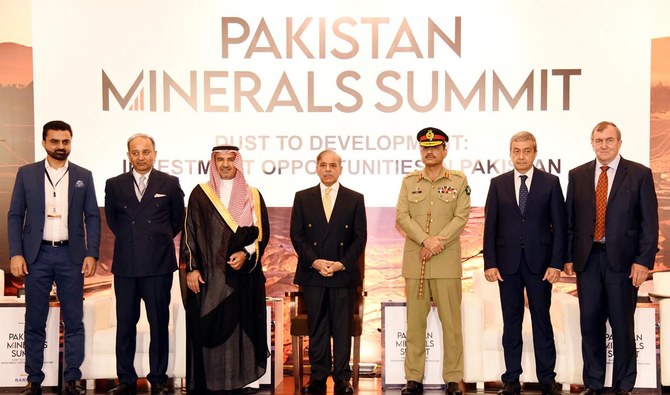
Pakistan's prime minister Shehbaz Sharif, center, along with army chief General Syed Asim Munir, third right, and foreign dignitaries attend Pakistan Mineral Summit in Islamabad on August 1, 2023. (PID)
Short Url
Updated 01 August 2023
Follow

Pakistan hosts first minerals summit as leaders call for emulating Middle Eastern example

  • Foreign investors, dignitaries attend summit aimed at tapping Pakistan's $6 trillion worth of natural deposits
  • Army chief says government and military on the “same page” to provide security to foreign investments

ISLAMABAD: Army chief General Syed Asim Munir said on Tuesday foreign investors would be an "integral part" of realizing the potential of Pakistan’s estimated $6 trillion worth of natural deposits, while Prime Minister Shehbaz Sharif called for following the example of Middle Eastern states in tapping and developing mineral wealth.

Both leaders were addressing Pakistan's first dedicated summit on minerals, which was widely attended in Islamabad by foreign investors, diplomats, and international dignitaries.

The summit was organized under the umbrella of the Special Investment Facilitation Council (SIFC) that Pakistan set up in June to attract foreign investment. The army has been given a key role in the body and will be involved in all projects under the new framework.

“Our vision for the mining industry goes beyond financial gains,” Munir said, assuring foreign investors that the federal and provincial governments and Pakistan's security forces were on the “same page” to provide secure investment opportunities.

“Foreign investors will be an integral part of the mines and mineral projects and their investment will be secure under the Special Investment Facilitation Council … We will establish an investor-friendly system that avoids unnecessary complications and provides favorable conditions.”

“There are vast opportunities for exploration in our country, and we will make sure that these opportunities are realized through joint efforts,” Munir added.

In the past, a joint venture was blocked by Pakistan’s Supreme Court from developing Reko Diq - one of the world’s biggest untapped deposits of copper and gold - following a court case over how the contract had been awarded. Pakistan’s government was later ordered by a global arbitration body to pay $5.8 billion in damages after Tethyan Copper took it to court. The dispute was only resolved after Barrick Gold ended the conflict last year and said it would start to develop the gold and copper mining projects under a new agreement.

Pakistan's mineral-rich province of Balochistan and the country's northwestern regions are also home to both militants and separatist insurgents, who have engaged in insurgency against the government for decades and made exploration difficult for the government and undesirable for foreign investors. 
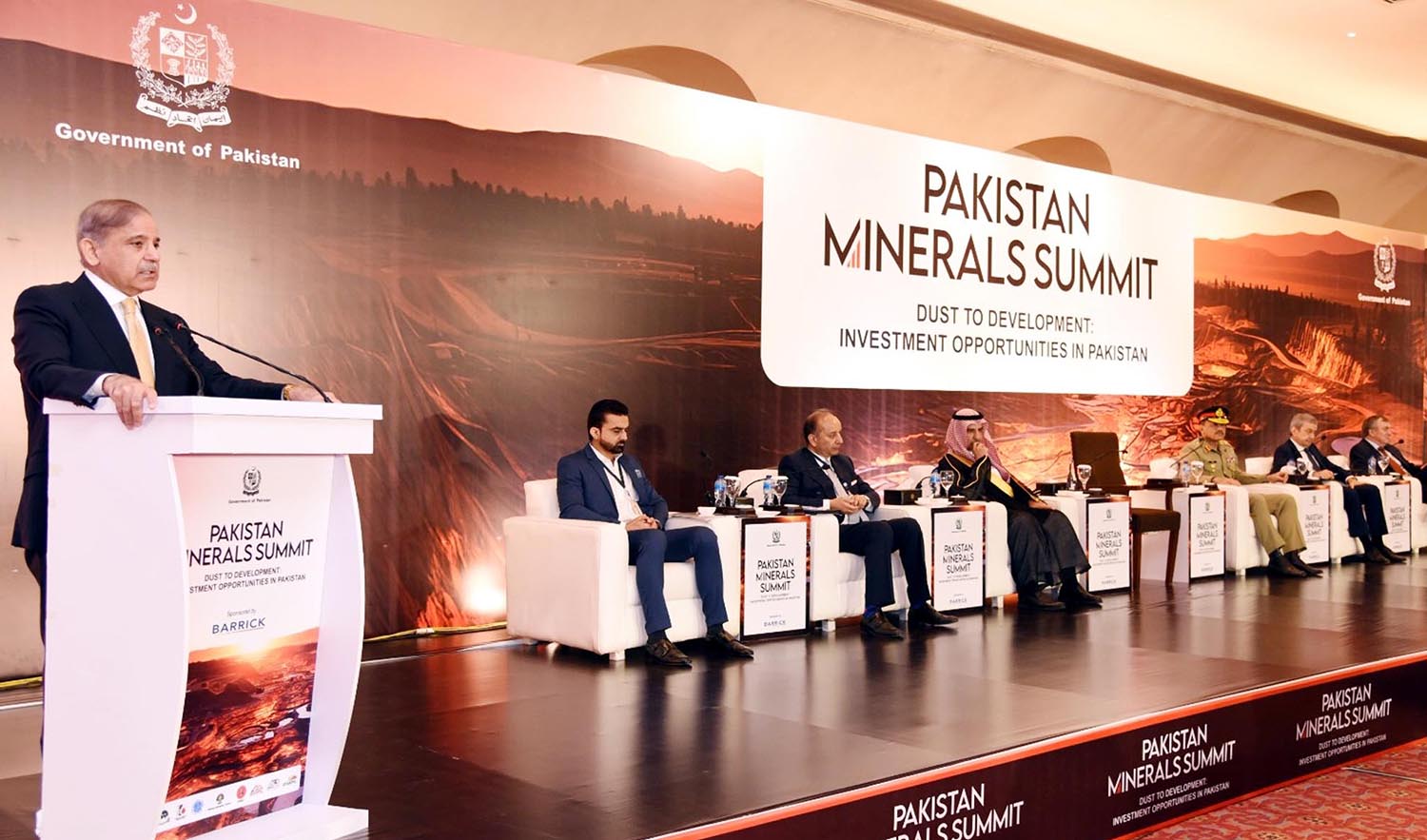


Pakistan Prime Minister Shehbaz Sharif addressing Pakistan Mineral Summit in Islamabad on August 1, 2023. (PID)

Addressing Tuesday’s ceremony, Prime Minister Shehbaz Sharif said Pakistan should learn from its "bitter experiences" of the past and follow the example of Middle Eastern states who had built and strengthened their economies by tapping mineral wealth.

States like Saudi Arabia and the United Arab Emirates had set an example for other countries, including Pakistan, by building on oil and gas resources, Sharif said.

“If sand dunes could be converted into great models of progress and prosperity by our brothers, why can’t we convert our dust into gold,” he asked.

Saudi vice minister for mining affairs, Engineer Khalid Bin Saleh Al-Mudafiq, who was also present at the summit, said the Kingdom wanted to enable the development of a responsible mineral value chain in Pakistan.

“Let us unite our efforts to harness the full potential of Pakistan’s, Saudi Arabia’s, and the region’s mineral sector,” the minister said. 

“Together, we can pave the way from dust to development, transforming our nations into thriving hubs of mineral resources, economic prosperity, and sustainable growth …I look forward to celebrating soon the eminent success of the Pakistan mining sector.”


Sindh assembly passes resolution rejecting move to separate Karachi

Updated 21 February 2026
Follow

Sindh assembly passes resolution rejecting move to separate Karachi

  • Chief Minister Shah cites constitutional safeguards against altering provincial boundaries
  • Calls to separate Karachi intensified amid governance concerns after a mall fire last month

ISLAMABAD: The provincial assembly of Pakistan’s southern Sindh province on Saturday passed a resolution rejecting any move to separate Karachi, declaring its territorial integrity “non-negotiable” amid political calls to carve the city out as a separate administrative unit.

The resolution comes after fresh demands by the Muttahida Qaumi Movement (MQM) and other voices to grant Karachi provincial or federal status following governance challenges highlighted by the deadly Gul Plaza fire earlier this year that killed 80 people.

Karachi, Pakistan’s largest and most densely populated city, is the country’s main commercial hub and contributes a significant share to the national economy.

Chief Minister Syed Murad Ali Shah tabled the resolution in the assembly, condemning what he described as “divisive statements” about breaking up Sindh or detaching Karachi.

“The province that played a foundational role in the creation of Pakistan cannot allow the fragmentation of its own historic homeland,” Shah told lawmakers, adding that any attempt to divide Sindh or separate Karachi was contrary to the constitution and democratic norms.

Citing Article 239 of Pakistan’s 1973 Constitution, which requires the consent of not less than two-thirds of a provincial assembly to alter provincial boundaries, Shah said any such move could not proceed without the assembly’s approval.

“If any such move is attempted, it is this Assembly — by a two-thirds majority — that will decide,” he said.

The resolution reaffirmed that Karachi would “forever remain” an integral part of Sindh and directed the provincial government to forward the motion to the president, prime minister and parliamentary leadership for record.

Shah said the resolution was not aimed at anyone but referred to the shifting stance of MQM in the debate while warning that opposing the resolution would amount to supporting the division of Sindh.

The party has been a major political force in Karachi with a significant vote bank in the city and has frequently criticized Shah’s provincial administration over its governance of Pakistan’s largest metropolis.

Taha Ahmed Khan, a senior MQM leader, acknowledged that his party had “presented its demand openly on television channels with clear and logical arguments” to separate Karachi from Sindh.

“It is a purely constitutional debate,” he told Arab News by phone. “We are aware that the Pakistan Peoples Party, which rules the province, holds a two-thirds majority and that a new province cannot be created at this stage. But that does not mean new provinces can never be formed.”

Calls to alter Karachi’s status have periodically surfaced amid longstanding complaints over governance, infrastructure and administrative control in the megacity, though no formal proposal to redraw provincial boundaries has been introduced at the federal level.