UNESCO recommends adding Venice to list of world heritage sites in danger

1 / 4
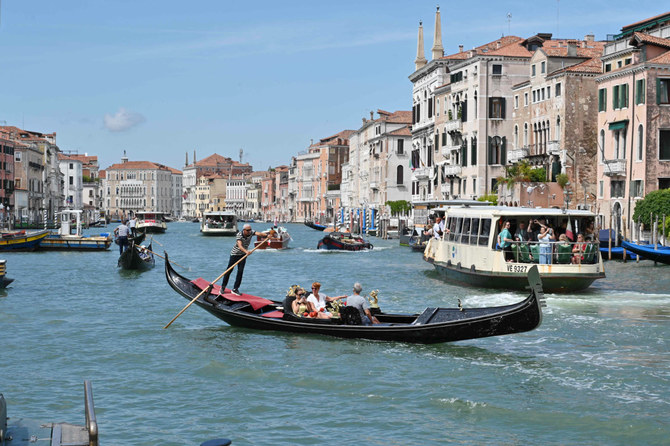
A view taken on July 31, 2023 shows tourists taking a Gondola ride across the Grand Canal in Venice. (AFP)
2 / 4
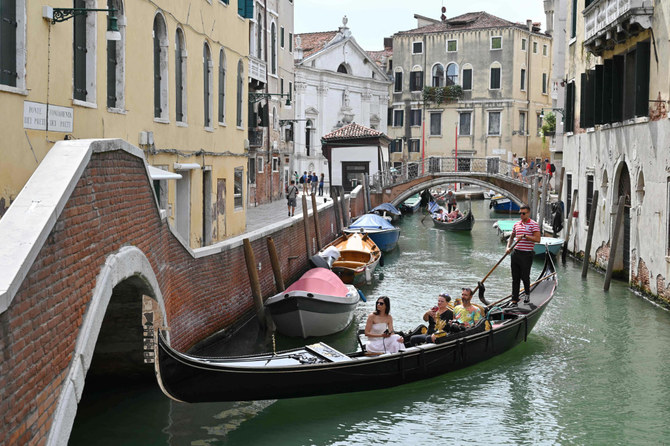
A view taken on July 31, 2023 shows tourists taking a Gondola ride across a canal in Venice. (AFP)
3 / 4
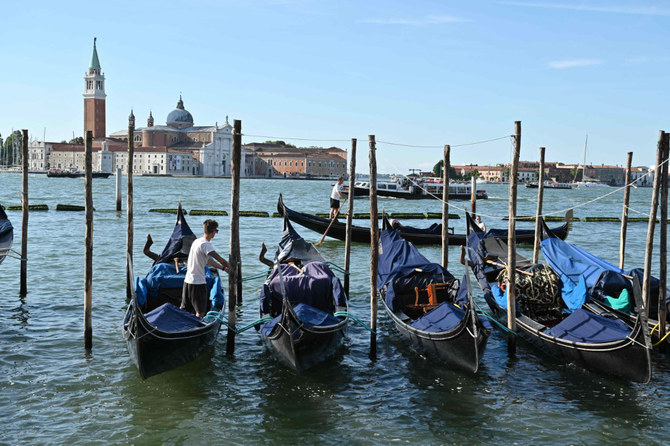
A general view taken on July 31, 2023 shows a Gondolier preparing for a ride in the Venice basin. (AFP)
4 / 4
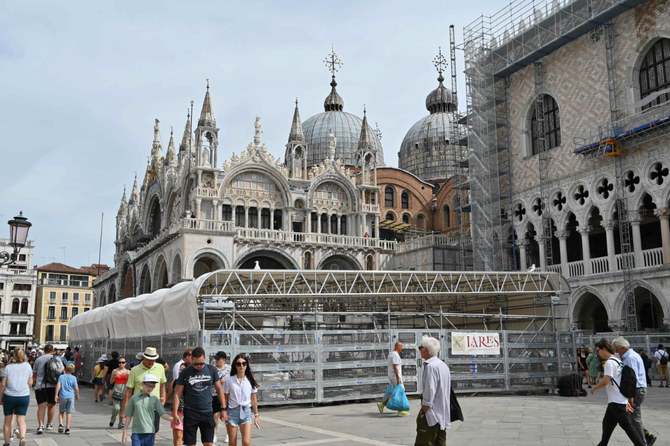
A view taken fon July 31, 2023 shows the construction site of the elevation of St. Mark's square against high water, expected to be completed by 2026, in Venice. (AFP)
Short Url
Updated 01 August 2023
Follow

UNESCO recommends adding Venice to list of world heritage sites in danger

ROME: UNESCO experts have recommended that Venice and its lagoon be added to its list of World Heritage in Danger as Italy is not doing enough to protect the city from the impact of climate change and mass tourism.
UNESCO World Heritage Center experts regularly review the state of the UN cultural agency’s 1,157 World Heritage sites, and at a meeting in Riyadh in September, a committee of 21 UNESCO member states will review more than 200 sites and decide which to add to the danger list.
For nearly 10 of these sites, the experts recommend that member states put them on the danger list, among which already are the historic center of Odessa, Ukraine, the town of Timbuktu in Mali, and several sites in Syria, Iraq and Libya.
Other sites recommended to be put on the danger list this year are the cities of Kyiv and Lviv in Ukraine.
“Resolution of long-standing but urgent issues is hindered by a lack of overall joint strategic vision for the longterm preservation of the property and low effectiveness of integrated coordinated management at all stakeholder levels,” UNESCO said.
UNESCO said corrective measures proposed by the Italian state are “currently insufficient and not detailed enough.” It added that Italy “has not been communicating in a sustained and substantive manner since its last Committee session in 2021, when UNESCO had already threatened to blacklist Venice.
The agency said it hoped that “such inscription will result in greater dedication and mobilization” of local and national stakeholders to address long-standing issues.
A spokesperson for the Venice municipality told Reuters the city “will carefully read the proposed decision published today by the Center for UNESCO’s World Heritage Committee and will discuss it with the government.”
Venice, known for its canals and cultural sites, has been struggling with mass tourism for years. On a single day during the 2019 Carnival, some 193,000 people squeezed into the historic center. Venice has been preparing to introduce a fee for day-trippers to control visitor numbers, but has been delayed by objections.


Filipinos master disaster readiness, one roll of the dice at a time

Updated 29 December 2025
Follow

Filipinos master disaster readiness, one roll of the dice at a time

  • In a library in the Philippines, a dice rattles on the surface of a board before coming to a stop, putting one of its players straight into the path of a powerful typhoon

MANILA: In a library in the Philippines, a dice rattles on the surface of a board before coming to a stop, putting one of its players straight into the path of a powerful typhoon.
The teenagers huddled around the table leap into action, shouting instructions and acting out the correct strategies for just one of the potential catastrophes laid out in the board game called Master of Disaster.
With fewer than half of Filipinos estimated to have undertaken disaster drills or to own a first-aid kit, the game aims to boost lagging preparedness in a country ranked the most disaster-prone on earth for four years running.
“(It) features disasters we’ve been experiencing in real life for the past few months and years,” 17-year-old Ansherina Agasen told AFP, noting that flooding routinely upends life in her hometown of Valenzuela, north of Manila.
Sitting in the arc of intense seismic activity called the “Pacific Ring of Fire,” the Philippines endures daily earthquakes and is hit by an average of 20 typhoons each year.
In November, back-to-back typhoons drove flooding that killed nearly 300 people in the archipelago nation, while a 6.9-magnitude quake in late September toppled buildings and killed 79 people around the city of Cebu.
“We realized that a lot of loss of lives and destruction of property could have been avoided if people knew about basic concepts related to disaster preparedness,” Francis Macatulad, one of the game’s developers, told AFP of its inception.
The Asia Society for Social Improvement and Sustainable Transformation (ASSIST), where Macatulad heads business development, first dreamt up the game in 2013, after Super Typhoon Haiyan ravaged the central Philippines and left thousands dead.
Launched six years later, Master of Disaster has been updated this year to address more events exacerbated by human-driven climate change, such as landslides, drought and heatwaves.
More than 10,000 editions of the game, aimed at players as young as nine years old, have been distributed across the archipelago nation.
“The youth are very essential in creating this disaster resiliency mindset,” Macatulad said.
‘Keeps on getting worse’ 
While the Philippines has introduced disaster readiness training into its K-12 curriculum, Master of Disaster is providing a jolt of innovation, Bianca Canlas of the Department of Science and Technology (DOST) told AFP.
“It’s important that it’s tactile, something that can be touched and can be seen by the eyes of the youth so they can have engagement with each other,” she said of the game.
Players roll a dice to move their pawns across the board, with each landing spot corresponding to cards containing questions or instructions to act out disaster-specific responses.
When a player is unable to fulfil a task, another can “save” them and receive a “hero token” — tallied at the end to determine a winner.
At least 27,500 deaths and economic losses of $35 billion have been attributed to extreme weather events in the past two decades, according to the 2026 Climate Risk Index.
“It just keeps on getting worse,” Canlas said, noting the lives lost in recent months.
The government is now determining if it will throw its weight behind the distribution of the game, with the sessions in Valenzuela City serving as a pilot to assess whether players find it engaging and informative.
While conceding the evidence was so far anecdotal, ASSIST’s Macatulad said he believed the game was bringing a “significant” improvement in its players’ disaster preparedness knowledge.
“Disaster is not picky. It affects from north to south. So we would like to expand this further,” Macatulad said, adding that poor communities “most vulnerable to the effects of climate change” were the priority.
“Disasters can happen to anyone,” Agasen, the teen, told AFP as the game broke up.
“As a young person, I can share the knowledge I’ve gained... with my classmates at school, with people at home, and those I’ll meet in the future.”