



KHAR, Pakistan: The death toll from a massive suicide bombing that targeted an election rally for a pro-Taliban cleric rose to 54 Monday, as Pakistan held funerals and the government vowed to hunt down those behind the attack.
No one immediately claimed responsibility for Sunday’s bombing, which also wounded nearly 200 people. Police said their initial investigation suggested that the Daesh group’s regional affiliate could be responsible.
The victims were attending a rally organized by the Jamiat Ulema Islam party, headed by hard-line cleric and politician Fazlur Rehman. He did not attend the rally, held under a large tent close to a market in Bajur, a district in Khyber Pakhtunkhwa province that borders Afghanistan.
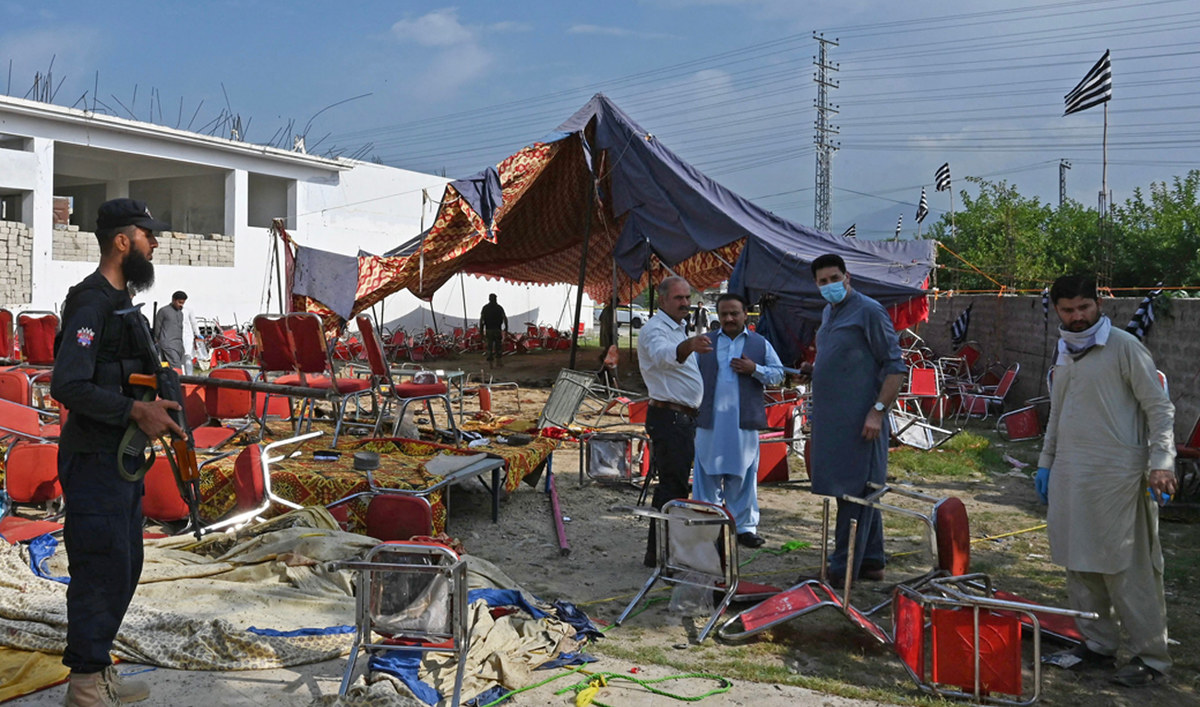
Security personnel examine the site of a bomb blast in Bajaur district of Khyber-Pakhtunkhwa province on July 31, 2023. (AFP)
Rehman, who has long supported Afghanistan’s Taliban government, escaped at least two known bomb attacks in 2011 and 2014, when bombings damaged his car at rallies.
Victims of the bombing were buried in Bajur on Monday.
As condolences continued to pour in from across the country, dozens of people who received minor injuries were discharged from hospital while the critically wounded were taken to the provincial capital of Peshawar by army helicopters. The death toll continued to rise as critically wounded people died in hospital, physician Gul Naseeb said.
On Monday, police recorded statements from some of the wounded at a hospital in Khar, Bajur’s largest town. Feroz Jamal, the provincial information minister, said police were “investigating this attack in all aspects.”
At least 1,000 people were gathered under a large tent Sunday as their party prepared for parliamentary elections, expected in October or November.
“People were chanting God is Great on the arrival of senior leaders, when I heard the deafening sound of the bomb,” said Khan Mohammad, a local resident who said he was standing outside the tent.
Mohammad said he heard people crying for help, and minutes later ambulances started arriving and taking the wounded away.
Abdul Rasheed, a senior leader in Rehman’s party said the bombing was aimed at weakening the party but that “such attacks cannot deter our resolve.”
Islamist groups have long had a presence in Bajur. The district was formerly a base for Al Qaida and a stronghold of the outlawed Pakistani Taliban, known as Tehreek-e-Taliban Pakistan, or TTP. The army declared the district clear of the group in 2016 following a series of offensives.
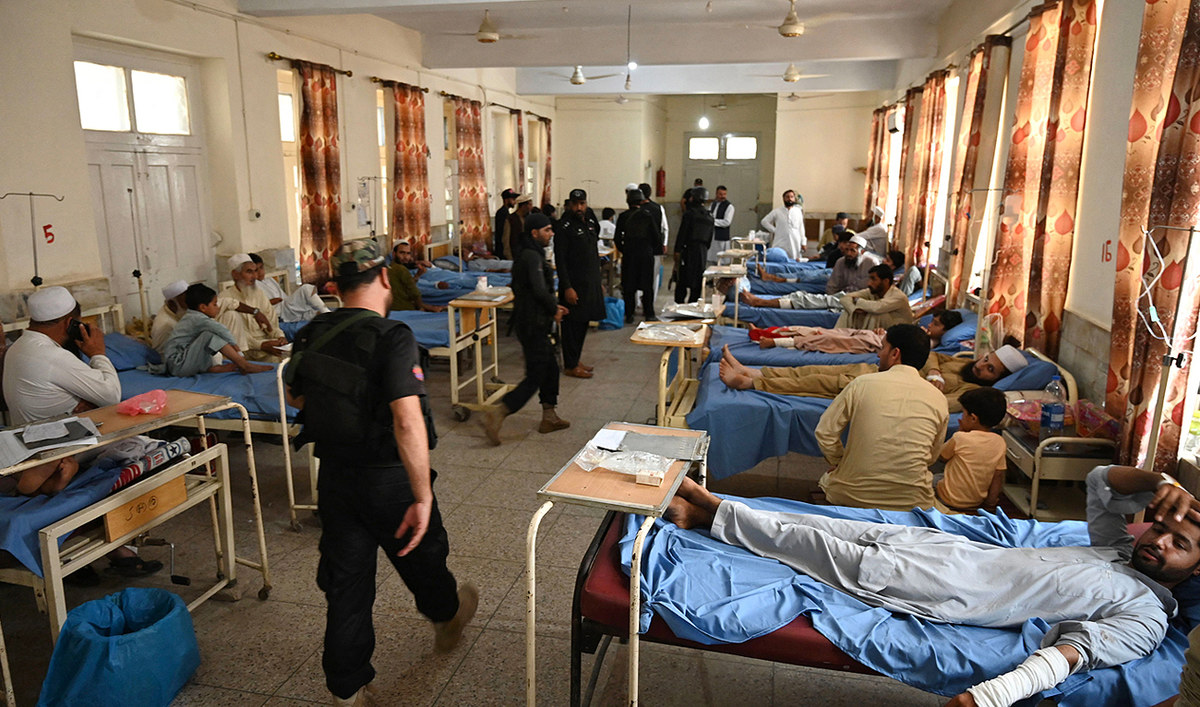
Security personnel walk past bomb blast victims at a hospital in Bajaur district of Khyber-Pakhtunkhwa province on July 31, 2023. (AFP)
The IS regional affiliate, known as the Islamic State in Khorasan Province, is based in neighboring Afghanistan’s Nangarhar province and is a rival of the Afghan Taliban and Al Qaida.
Shaukat Abbas, a senior police officer, said that police have made progress in their investigation, but did not provide details.
Pakistani security analyst Mahmood Shah told The Associated Press that breakaway factions of the TTP could also be behind the attack. He said some TTP members have been known to disobey their top leadership to carry out attacks, as have breakaway factions of the group.
Shah said such factions could have perpetrated the attack to cause “confusion, instability and unrest ahead of the elections.”
Prime Minister Shehbaz Sharif is expected to dissolve Pakistan’s parliament in August.
Rehman’s party is part of Sharif’s coalition government, which came to power in April 2022 by ousting former Prime Minister Imran Khan through a no-confidence vote in the legislature.
Sharif called Rehman to express his condolences and assure the cleric that those who orchestrated the attack would be punished. The bombing has also drawn nationwide condemnation, with ruling and opposition parties offering condolences to the families of the victims. The US and Russian embassies in Islamabad also condemned the attack.
Khan condemned the bombing Sunday.
The Pakistani Taliban condemned the attack, while the Afghan Taliban spokesman, Zabiullah Mujahid, said on Twitter that “such crimes cannot be justified in any way.
The bombing came hours before the arrival of Chinese Vice Premier He Lifeng in Islamabad, where on Monday he was to participate in an event to mark a decade of the China-Pakistan Economic Corridor, a sprawling package under which Beijing has invested billions of dollars in Pakistan.
In recent months, China has helped Pakistan avoid a default on sovereign payments. Some Chinese nationals have also been targeted by militants in northwestern Pakistan and elsewhere.
Sunday’s bombing was one of the four worst attacks in northwestern Pakistan since 2014, when 147 people, mostly schoolchildren, were killed in a Taliban attack on an army-run school in Peshawar.
In January, 74 people were killed in a bombing at a mosque in Peshawar. And in February, more than 100 people, mostly policemen, died in a bombing at a mosque inside a high-security compound housing Peshawar police headquarters.


