

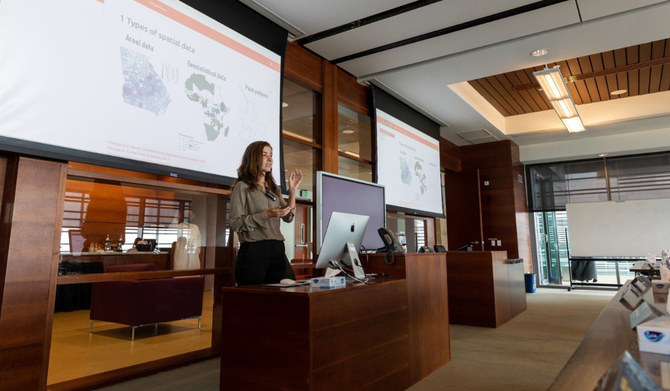

RIYADH: In a world that’s more connected and globalized than ever, the potential for spreading diseases is increasing, along with the risk of outbreaks escalating into pandemics.
Paula Moraga is an assistant professor of statistics at King Abdullah University of Science and Technology, and the principal investigator of the GeoHealth research group. She has come up with a timely action strategy with her groundbreaking work in developing data technology for disease surveillance to detect outbreaks of infectious diseases.
Moraga’s surveillance system recently won the Letten Prize 2023 for Young Researchers. The prize was established in 2018 in a collaboration between the Letten Foundation, which was founded in 1986 by Prof. Letten F. Saugstad, and the Young Academy of Norway, to highlight the contributions of young researchers working to address pressing global issues.
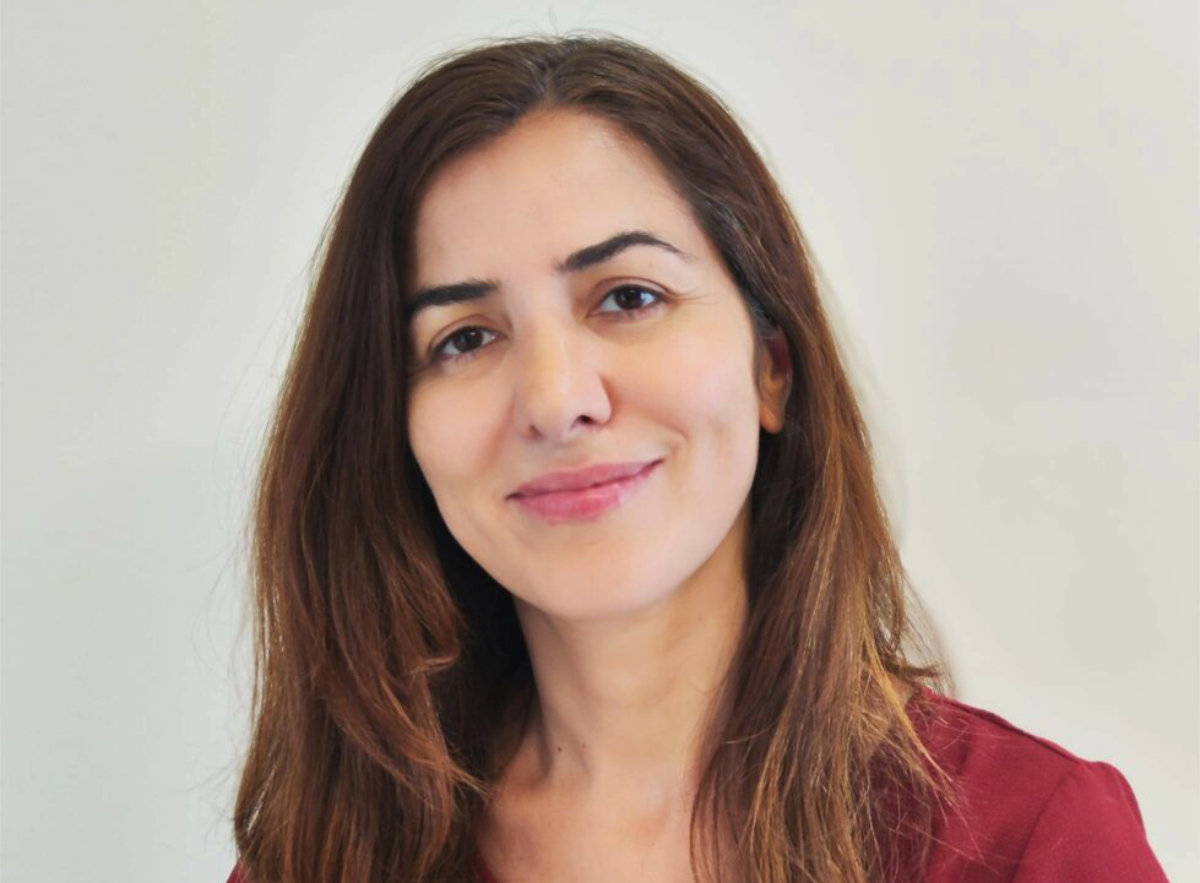
Paula Moraga, Assistant professor & researcher
Moraga said: “Professor Latten from Norway believes that health, environment, and equality are key to a better future for all, and to be honored in his name is a wonderful privilege.”
People became more interested in disease surveillance and advocating for a worldwide improvement in public health following the COVID-19 pandemic.
Moraga added: “We live in an interactive world. Human health is interconnected with animal health and with the environment, and human activities and development are causing the emergence of new infectious diseases.
(KAUST) is one of the best universities in the world as it provides a lot of resources and support to reach your full potential and make an impact, and it is a very stimulating environment.
Paula Moraga, Assistant professor & researcher
“Diseases that usually occur in tropical and subtropical regions of the world are now occurring in new areas.”
Moraga is developing a disease surveillance system to help in the early detection of outbreaks and to help improve public health decision-making.
Traditional surveillance systems have limitations. Moraga explained that information is delayed from the time a person becomes sick to when they decide to visit a health practitioner and do a laboratory test, and to the time information is added to the system.
Moraga’s system has access to social media data, such as when people chat about how they feel, or search Google for treatments for their conditions.
She explained: “This information is not produced for epidemiological research, but we can use it to understand the activity levels in real time.”
The system also has access to temperature, humidity, and precipitation, which are useful for the early detection of outbreaks.
It combines data from multiple sources, including official disease-related data, environmental and digital, to produce local probabilistic forecasts.
She said that the system includes software with interactive visualization reports to alert public health officials when elevated disease levels are anticipated, help policymakers allocate resources in areas of greatest need, and design strategies to help control diseases.
Moraga has been working at KAUST for three years, and said: “I am very happy. It is one of the best universities in the world as it provides a lot of resources and support to reach your full potential and make an impact, and it is a very stimulating environment.”
Her work as the principal investigator involves leading a group of students and postdocs, working on statistical methodology, and the development of open-source software to solve problems in public health.
Moraga has worked on methods to understand the spatial and spatio-temporal patterns of diseases, such as malaria in Africa, and has worked on packages for disease mapping, detection of clusters, and risk assessment of travel related to the spread of illnesses.
She said: “The software packages that we developed are used by many researchers worldwide, including public health officials in Canada for the mapping of cancer.”
Like most young graduates, Moraga was unsure of the career path to follow when she was younger, but her passion and interest in mathematics led her to where she is today.
She said: “When I started studying mathematics at university, I wasn’t enjoying it as I did in high school because it was very theoretical, and I wanted to do something more applied.
“Then I discovered other courses such as statistics programming, and I realized that through statistics you could analyze data and get insights from data that could be useful to make decisions and improve society.”
After finishing her mathematics degree, Moraga worked in developing algorithms for a while before deciding to further her studies in statistics by gaining a doctorate.
Moraga then worked with the cancer registry in Spain to create maps of different types of the disease. She enjoyed applying mathematics to problems but believed she needed further qualifications.
She added: “When I was at the registry of cancer, I realized that I didn’t have enough knowledge of epidemiological concepts and biostatistics so I applied for a master’s in biostatistics at Harvard.”
Since then, Moraga has been involved in several projects related to cancer and infectious diseases, and has been an influential figure in disease surveillance.


