

Steve Smith leads Australia revival in fifth Ashes Test

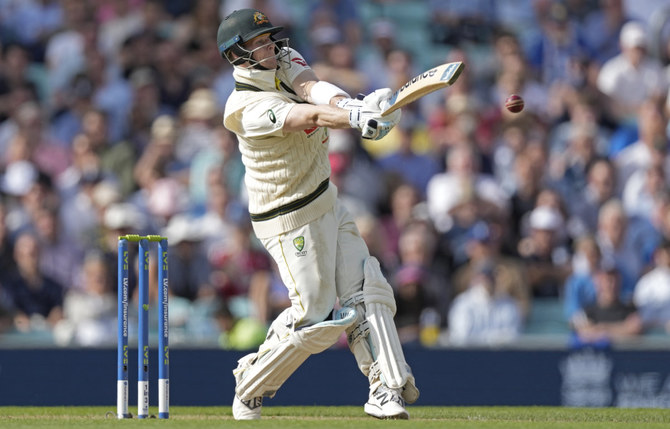
Australia's Steven Smith plays a shot during the second day of the fifth Ashes Test match between England and Australia at The Oval cricket ground in London Friday. (AP)
Short Url
Updated 29 July 2023
Follow

Steve Smith leads Australia revival in fifth Ashes Test

  • Smith and Australia captain Pat Cummins (36) kept England at bay during an eighth-wicket stand of 54
  • Australia, as the holders, are assured of retaining the Ashes at 2-1 up, and only need to avoid defeat at The Oval to secure their first Test series win away to England in 22 years

LONDON: Steve Smith’s 71 helped Australia recover from a batting collapse as the tourists frustrated England by battling to a first-innings lead in the fifth and final Ashes Test at The Oval on Friday.

Australia were eventually bowled out for 295 on the second day, 12 runs ahead of England’s 283.

It looked as if England would enjoy a sizeable advantage as veteran seamer Stuart Broad sparked a slump that left Australia 185-7 from a comfortable 115-2 at lunch.

But Smith and Australia captain Pat Cummins (36) kept England at bay during an eighth-wicket stand of 54. Cummins then added 49 for the ninth wicket with Todd Murphy.

Off-spinner Murphy — recalled following last week’s rain-marred drawn fourth Test at Old Trafford — added to England’s woes with a sparkling 34 off just 39 balls.

Cummins eventually holed out off part-time spinner Joe Root, with rival skipper Ben Stokes throwing the ball back in over the rope at long-on to complete a fine catch.

Australia, as the holders, are assured of retaining the Ashes at 2-1 up, and only need to avoid defeat at The Oval to secure their first Test series win away to England in 22 years.

“It’s ebbed and flowed the whole way, we’re pretty disappointed,” Smith told the BBC. “A few of us got good starts but couldn’t go and get a big score. Twelve runs in front, it’s a one-innings game from here pretty much.”

Australia resumed on Friday on 61-1, with Usman Khawaja 26 not out and Marnus Labuschagne, fresh from his hundred at Old Trafford, unbeaten on two.

Their position in the series means they have no need to replicate England’s risky ‘Bazball’ batting approach.

But they arguably veered too much in the opposite direction during an attritional morning session, scoring just 54 runs in 26 overs for the loss of Labuschagne, who edged express fast bowler Mark Wood to Root in the slips, who took a brilliant one-handed catch.

But Broad, whose 167-Test career has been notable for dramatic wicket-taking bursts, soon reduced them to 127-4.

He had Khawaja, the leading run-scorer in the series, lbw for 47 with a full-length delivery.

Broad, who made his name in Ashes cricket with a return of 5-37 at The Oval in 2009, became the first Englishman to take 150 Test wickets against Australia.

That rose to 151 wickets when Travis Head was caught behind off an excellent delivery that nipped away off the seam.

James Anderson, Test cricket’s most successful pace bowler, then took just his fifth wicket of the series when Mitchell Marsh played on.

“It’s a very level game,” said Anderson. “Getting into the position we did, we’re a little disappointed they got past us. Pat and Murphy batted really well in the end.”

England were a bowler light on Friday as Moeen Ali remained off the field with the groin injury the off-spinner suffered while batting on Thursday.

But Root filled the gap when inducing an ugly swipe from Alex Carey that went straight to Stokes at short cover.

Australia were 185-7 when Mitchell Starc holed out to backward square leg off Wood.

Smith had made 43 when, going for a needless second run, it appeared he had been beaten by a throw from substitute fielder George Ealham to wicketkeeper Jonny Bairstow.

But third umpire Niton Menon, after several minutes’ study, ruled in the batsman’s favor.

England took the new ball but Smith completed a 98-ball fifty when he drove Broad for a fine boundary.

It looked as if the former Australia captain, whose four previous Tests at The Oval had yielded three hundreds, might go on to three figures again until he carelessly skied a catch off Chris Woakes to Bairstow.

Murphy, however, pulled Wood for three fine sixes, with the left-handed batsman also square-driving Woakes for a stylish four.

Woakes eventually had the 22-year-old, in only his 14th first-class match, lbw but the damage had been done.


Round-arm bowling challenges cricket’s norm

Updated 19 February 2026
Follow

Round-arm bowling challenges cricket’s norm

  • The action is defined as the hand being between shoulder and waist height and is different to the delivery mode adopted by most bowlers

Following last week’s consideration of the most significant of the 73 recently announced changes to the Laws of Cricket, a new challenge to an old law has surfaced.

This focuses on what constitutes a fair delivery and the spotlight has fallen on Pakistan’s spinner, Usman Tariq. At first sight, one might assume Tariq’s 1.93-meter height would make it likely he would be a fast bowler. He used to be, but an injury restricted his movement and he turned to spin. After some success he decided to stick with it, although now aged 28, it has taken him at least six years to hit the heights.

There is little doubt Tariq has a distinctive action. He starts with a shuffle, takes a skip, then three short steps to arrive alongside the crease. He enters with a sideways step on one foot, pausing in his delivery stride, knee raised, looking at the batter, before delivering the ball in a slinging, round-arm action. This is defined as the hand being between shoulder and waist height and is different to the delivery mode long adopted by most bowlers, who have a high arm action.

Attempts to introduce round-arm bowling in the first quarter of the 19th century met with fierce resistance to the point where the Marylebone Cricket Club introduced a law in 1816 to prohibit its practice. Gradually, however, attitudes changed and by 1835 its use was legitimized. It was not long before bowlers raised their hands above the shoulder during delivery. This led to years of confrontation between bowlers, umpires and law makers, which ended when the MCC changed Law 10 in 1864. Bowlers were allowed to bring their arm through at any height providing it was straight and the ball was not thrown.

Under the current code, Law 21, No Ball, defines a fair delivery. It states that “a ball is fairly delivered in respect of the arm if, once the bowler’s arm has reached the level of the shoulder in the delivery swing, the elbow joint is not straightened partially or completely from that instant until the ball has left the hand.”

The International Cricket Council has underpinned this definition by stating: “An illegal bowling action is a bowling action where the player's elbow extension exceeds 15 degrees between their arm reaching the horizontal and the ball being released.” The precision of this specification cannot be measured accurately by the human eye. If an umpire has a suspicion that the action is illegal, the bowler can be reported and sent for testing at an ICC bowling action testing center.

In March 2024, Tariq was reported by the umpires when bowling for Quetta Gladiators in the Pakistan Super League. Five days later, his action was cleared by the ICC-accredited biomechanics laboratory at the National Cricket Academy in Lahore.

In April 2025, he was reported again when playing in the PSL and was cleared for a second time. Most observers support this judgement, agreeing that Tariq’s arm does not straighten anywhere near the 15-degree threshold required for an action to be ruled illegal.

Buoyed by this second clearance, Tariq played with distinction in the Caribbean Premier League in September 2025, claiming 20 wickets, forming close bonds with senior West Indian players. A month later, Tariq made his T20 debut for Pakistan against South Africa in Lahore.

My first sighting of Tariq was during the latter stages of the DP World ILT20 in December 2025/January 2026, when he played a key role in the Desert Vipers’ success. In the first qualifier against the MI Emirates, one batter, Tom Banton of England, made a throwing motion when Tariq dismissed him. This served to further raise Tariq’s profile and gain the attention of a wider cricket world.

In franchise leagues, he has claimed 37 wickets in 22 matches, conceding around seven runs per over. When Pakistan hosted Australia in January prior to the T20 World Cup, more controversy erupted. In the second of three T20Is, Tariq dismissed Cameron Green, who made a throwing gesture as he walked off the field. Green later apologized, but his action fueled social media hysteria in the build up to the World Cup and Pakistan’s match against India, with exaggerated imitations appearing on-line.

Several ex-players have been outspoken in condemning Tariq’s action. One suggested that his act of stopping in his delivery swing was in breach of the laws, claiming it is not allowed to stop and look at the position of the batter before delivering the ball. In practice, it is not unusual for finger spinners to pause slightly at the crease, as their braced front leg is important in the act of imparting spin to the ball. There appears to be nothing in the laws which prohibits this pause.

The fallback position for those who do not approve of it is Law 41, Unfair Play, and clause 41.5, which covers the “deliberate distraction or deception of the batter.” It states: “It is unfair for any fielder willfully to attempt, by word or action, to distract, deceive or obstruct either batter after the striker has received the ball.” Clearly, this discounts before the striker receives the ball, although this should be considered equally important.

There is another part of Law 41 that gives umpires power. In 41.2.1, the umpires “shall be the sole judges of fair and unfair play. If an umpire considers that any action by a player, not covered in the Laws, is unfair, he/she shall call and signal Dead ball.”

In this T20 World Cup, another bowler has adopted a round-arm action. Gerhard Erasmus, the captain of Namibia, fell foul of umpire Rod Tucker in a match against India. As part of his bowling repertoire, Erasmus has developed a delivery from behind the crease. Tucker objected to this, calling “dead ball,” presumably invoking Law 41.2.1. An altercation ensued, after which Erasmus was allowed to continue bowling in the same way. He claimed four key wickets, conceding only 20 runs. It may be assumed that the Indian batters were not best pleased.

In an era of T20 cricket where everyone agrees that the balance of power lies with batters, it is understandable that bowlers will try and introduce ways to alter the balance. Tariq and Erasmus are attempting to do this with actions out of the norm.

Batters and their supporters are seeking to negate their impact by questioning their legitimacy. Reasoned voices within the game point out that Tariq’s pause is a part of his regular action, delivered consistently. He does not throw the ball, and his action should be considered legal.

In a fascinating interview with Brain Murgatroyd for the Desert Vipers, Tariq revealed that he has “two corners” in his elbow, whilst the pause came about because one coach told him his run up was too fast.

Batters may feel that the pause is off-putting, but they cannot say they do not have an opportunity to prepare, since Tariq is now a known quantity. On Wednesday, Pakistan played Namibia in Colombo, where both Erasmus and Tariq were on show. I watched Tariq’s bowling very closely in the warm-ups and the match, in which he claimed four wickets. His action never varied, but his speed and type of delivery did in a guileful manner. This is where his real deception exists. It is up to batters to deal with it rather than question the legalities.