


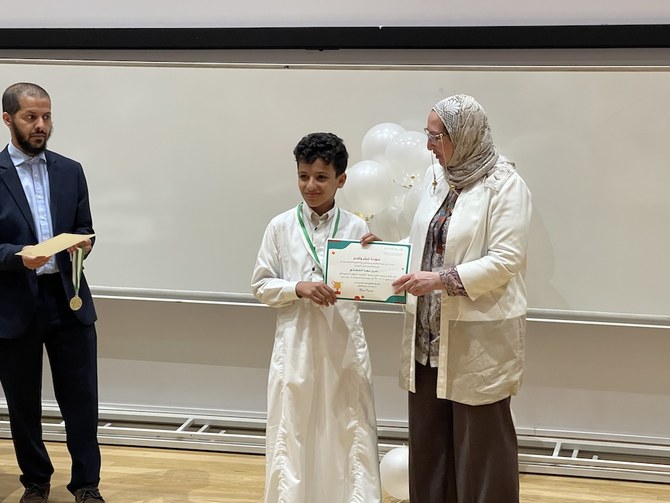


LONDON: The Saudi Students Club in London recently concluded a public speaking competition organized for the children of the Kingdom’s scholarship students residing in the UK.
The “Little Speaker” contest, which was sponsored by the Saudi cultural attache in the UK, saw around 40 children aged 8 to 12 take part. They had the option to deliver the same speech on the Kingdom’s development and Vision 2030 plan, in either English or Arabic.
The children had one month to prepare for the competition via weekly sessions that trained them in different aspects of public speaking, with the deadline for submissions on June 20, said Reem Kharji, president of the Saudi Students Club in London.

The contestants from across the UK were shortlisted to 15 at the end of June. They passed through to the final stage and delivered their speeches at a ceremony in the capital last week, where the five winners were also announced. The first-place winner received £200 ($258), the second received £150, while winners three to five received £100 each.
“Saudi students in the UK are the ambassadors of Saudi Arabia in the UK, so we are trying to raise this in the younger generation to be proud of our country,” Kharji told Arab News.
She added that there are around 30 Saudi student clubs across Britain which hold regular events at universities, where members can talk about their country and its culture.

“One of these events is starting to prepare the younger generation to be speakers in the future, because we know the importance of these kinds of events to raise the confidence of these children to be representatives in the future,” Kharji said.
The Saudi cultural attache in the UK, Dr. Amal bint Jameel Fatani, said: “I’m responsible for all our scholarship recipients, which are about 12,000 students, but they all come with their families and it’s very important to the government and to myself that we not only help them to get their degrees but support them while they’re away from their families, support their children, and help their elderly.”
Fatani said it was important for Saudi students to get the “utmost experiences” from their presence in the UK, so they are “experiencing both the knowledge that they have gained while abroad and also the experience of their family as a unit.”

Fatani said they hold multiple events for children, including one in Newcastle that taught them how to code, and are looking to hold more in the future. There would soon be a symposium held with sessions and workshops organized by children for children, she added.
“I just want them to feel that whether they win today or not, they still have something to look forward to because with that age, it’s not easy to face that I did not win and you really don’t want to break their spirits,” Fatani said.
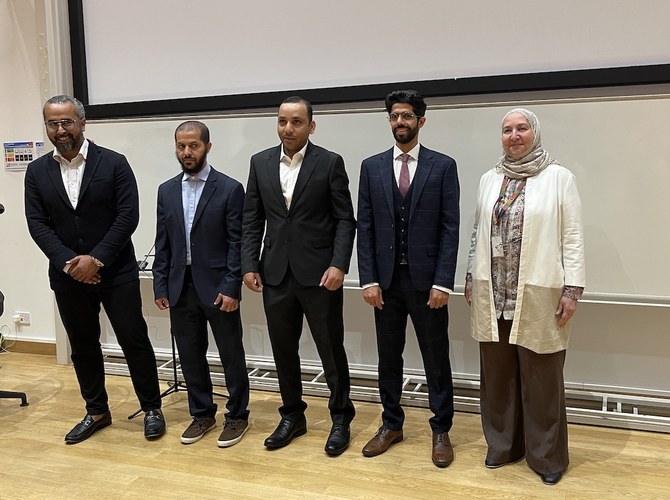
The children were evaluated by a specialized judging committee, according to five criteria — diversity of tone of voice, hand movement, use of pauses, looking at the camera, and soundness of language. The committee was made up of five students studying different subjects at various UK universities.

“It’s not an easy job to decide who can win the first or the second position in this competition, but we are proud of all of them and they are doing a great job,” said Abdulaziz Alothman, one of the judges.
“We hope and wish to see them in the near future also doing something amazing for Saudi Arabia around the world,” added Alothman, who is president of the Saudi Students Club in Leeds and studying medical education at Leeds University.
He added that one of the key advantages of holding such events is that it brings together children and members of the Saudi student community from across the UK, which allows them to network and learn from each other.

Twelve-year-old Yazeed Alharbi, who moved to Nottingham from Madinah in 2016, won third place for his performance and strong elocution.
“I talked about Saudi Arabia in general and all the projects which aim to make Saudi Arabia richer, more popular, and make people want to go and see Saudi Arabia,” he said.
Alharbi, who has previously taken part in drawing and Qur’an competitions in the UK, also highlighted the Kingdom’s Vision 2030 plan, which he said has been set up by the Saudi government and aims to promote tourism and “improve the economy globally.”

He added: “I’d like my country to become very popular (and) in school I always talk about Saudi Arabia and my teacher is like, OK, I really want to go there.”
The first prize went to 9-year-old Jumanah Alharbi, who moved from Riyadh to the Welsh capital, Cardiff, four years ago.
“I feel really (overjoyed) because I’ve won first place and I needed to practice a lot to win first place. And I needed to work hard and make sure that I pronounced the words correctly,” she said.

Alharbi, who aspires to be a space scientist because she wants to know if life exists beyond Earth, said that in her first presentation she spoke about how the government has set up Vision 2030 which will make her country “better and smarter.”
In her second presentation, she spoke about imagination, friendship, kindness and that anything is possible, she said.

“They tell you that dreams don’t just come true on their own and it takes hard work and it takes the importance of friendship as well.
“Just dream big and let your curiosity guide you, but don’t let anyone stop you and believe in yourself.”


