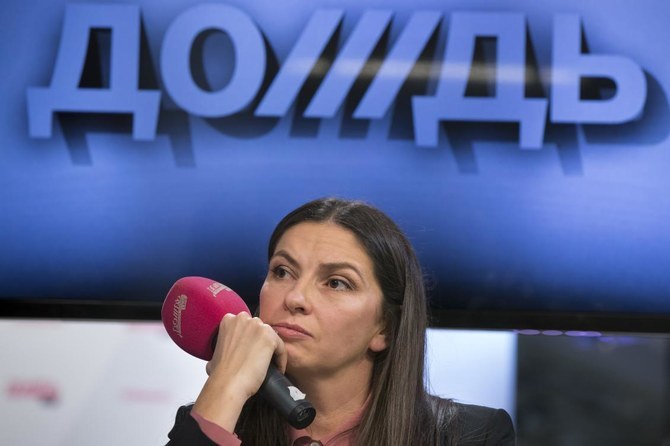
MOSCOW: The Russian prosecutor-general’s office on Tuesday declared independent TV channel Dozhd to be an undesirable organization, continuing the country’s wide crackdown on news media and groups regarded as threats to Russia’s security.
The designation outlaws Dozhd from operating in Russia and exposes its journalists, staff and donors to potential criminal charges.
Dozhd, which is often critical of the Kremlin, closed its operations in Russia soon after the beginning of the Ukraine conflict, moving first to Latvia and then to the Netherlands. The prosecutor-general’s office said Dozhd had spread extremist material and discredited authorities.
The channel frequently offended authorities with its coverage of Russia’s political opposition and criticism of the Kremlin. It was removed from Russian cable TV systems in 2014 after conducting a controversial poll of whether viewers thought the Soviet Union should have surrendered in the World War II siege of Leningrad in order to save civilian lives.
It then transmitted programs on a subscription Internet site and through YouTube.
In recent years, Russia has methodically targeted people and organizations critical of the Kremlin, branding many as “foreign agents” and declaring some “undesirable” under a 2015 law that made membership in “undesirable” organizations a criminal offense.
This year it declared the European edition of the newspaper Novaya Gazeta, whose editor is a Nobel Peace Prize laureate, as undesirable and also applied the label to the World Wide Fund for Nature, Greenpeace and the US-based Wild Salmon Center.


Russia declares independent TV channel ‘undesirable,’ banning it from country
https://arab.news/8sju6
Russia declares independent TV channel ‘undesirable,’ banning it from country

- The designation outlaws Dozhd from operating in Russia and exposes its journalists, staff and donors to potential criminal charges
- Dozhd, which is often critical of the Kremlin, closed its operations in Russia soon after the beginning of the Ukraine conflict


BBC slammed for ‘shameful’ cut to ‘free Palestine’ comment at BAFTA Awards
- Broadcaster removes from broadcast part of filmmaker Akinola Davies Jr.’s acceptance speech at the British Academy Film Awards
- Amnesty UK praises filmmaker for speaking up for those ‘facing and fleeing from persecution and mass atrocities’
LONDON: The BBC was accused on Monday of a “shameful” decision after it cut part of an acceptance speech at the previous night’s British Academy Film Awards in which a filmmaker uttered the phrase “free Palestine.”
British-Nigerian director and co-writer Akinola Davies Jr. and his brother, co-writer Wale Davies were collecting the award for outstanding debut by a British writer, director or producer for their film “My Father’s Shadow” when the former made the comment.
The BBC chose not to include the final part of his speech when it broadcast the BAFTAs ceremony later in the evening. However, the corporation did broadcast an inadvertent racist slur shouted by a person with Tourette syndrome while Black actors Michael B. Jordan and Delroy Lindo were presenting an award.
Akinola thanked industry figures and family for their support as he accepted the award, before dedicating it to “all those whose parents migrated to obtain a better life for their children.”
In the final part of his speech, cut by the BBC, he said: “To the economic migrant, the conflict migrant, those under occupation, dictatorship, persecution and those experiencing genocide, you matter and your stories matter more than ever.
“Your dreams are an act of resistance. To those watching at home, archive your loved ones, archive your stories yesterday, today and forever. For Nigeria, for London, Congo, Sudan, free Palestine. Thank you.”
The BBC, which broadcast the ceremony with a two-hour time delay, said the cut was made for timing reasons.
A spokesperson told Deadline: “The live event is three hours, and it has to be reduced to two hours for its on-air slot. The same happened to other speeches made during the night, and all edits were made to ensure the program was delivered to time. All winners’ speeches will be available to watch via BAFTA’s YouTube Channel.”
Human rights campaign group Amnesty UK described the decision by the BBC to cut part of the speech as “shameful.”
It added: “Thank you Akinola Davies Jr. for using your platform to speak out for the rights of migrants and people facing and fleeing from persecution and mass atrocities, from the Congo to Sudan to Palestine.”
In June last year, the BBC was at the center of a row after it broadcast a Glastonbury Festival performance by the duo Bob Vylan, during which the lead singer chanted “death to the IDF” in protest against the Israeli Defense Forces’ assault on Gaza.


