

Pakistan urges EU to find solution to ‘grain deal’ crisis, raises alarm over possible food inflation

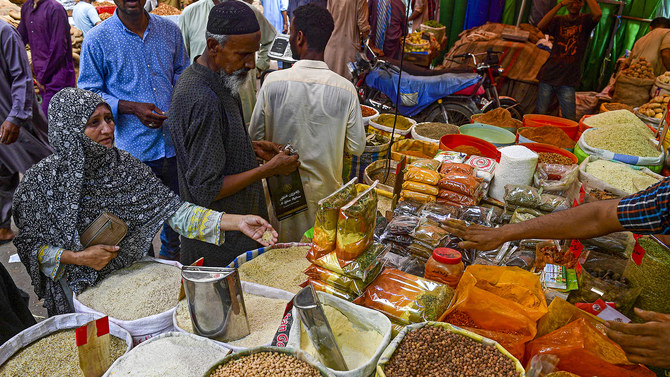
Customers bargain as they buy cereals and legumes at a shop in Karachi on June 8, 2023. (AFP/File)
Short Url
Updated 25 July 2023
Follow

Pakistan urges EU to find solution to ‘grain deal’ crisis, raises alarm over possible food inflation

  • Russia last week pulled out of the ‘grain deal’ which allowed safe exports of Ukrainian grains to developing countries
  • Foreign Minister Bilawal Bhutto Zardari says Pakistan ready to contribute to renewal of Black Sea Grain Initiative

ISLAMABAD: Pakistan’s Foreign Minister Bilawal Bhutto Zardari on Monday requested European Union envoy Josep Burrell to reinstate an international agreement that permitted the safe exports of Ukrainian grains to mostly developing countries, conveying Islamabad’s concerns about possible food inflation if the deal is not reinstated.

Negotiated by Turkiye and the United Nations in July 2022, the Black Sea Grain Initiative (BSGI), also known as the “grain deal” allowed ships carrying agricultural and fertilizer products to leave three Ukrainian exports, traveling carefully through mapped routes to snake past Russian warships to Turkiye’s Bosporous trait. Much of the 38.2 million tons of wheat, grains and corn that were exported since last year went to developing countries, particularly in Africa.

The deal, which helped alleviate global food shortages and help cut food costs by about 23 percent since March 2022, suffered a setback when last Monday Russia announced it was pulling out of the agreement. Russian President Vladimir Putin alleged the West had “emasculated and perverted” the deal and used it for political blackmail. Fearing a surge in food prices and resulting shortages of food grains, developing countries, including Pakistan, have called for the deal to be urgently reinstated.

“Expressing Pakistan’s concerns over the expiry of the Black Sea Grain Initiative (BSGI), the Foreign Minister said that the resulting food inflation and food security-related challenges would adversely impact developing countries like Pakistan which were already under economic pressure,” Pakistan’s Ministry of Foreign Affairs (MoFA) said in a press release.

These remarks were made by Bhutto Zardari during a telephonic conversation with EU’s High Representative for Foreign Affairs and Security Policy Josep Borrell. MoFA said he spoke to his Ukrainian and Turkish counterparts regarding the deal, hoping efforts to revive it would come to fruition through “dialogue and constructive engagement accommodating the concerns of all parties.”

“The Foreign Minister requested the EU High Representative to play his role to help find a solution that would allow the renewal of BSGI, and conveyed Pakistan’s readiness to contribute to collective efforts in that regard,” MoFA said.

Both representatives agreed to remain engaged on the issue and other matters of mutual interest.

To revive a standby $3 billion bailout package with the International Monetary Fund (IMF), Pakistan scrapped fuel subsidies last year, resulting in a massive hike in fuel and food prices. Pakistan’s poverty rate is expected to reach 37.2 percent this year, according to a World Bank report released in April, as the South Asian country reels from an economic crisis that has seen its foreign exchange reserves decline to historic lows and its currency plummet against the US dollar over the past year.


Pakistan army chief says future warfare will rely on technology over battlefield maneuvers

Updated 8 sec ago
Follow

Pakistan army chief says future warfare will rely on technology over battlefield maneuvers

  • Asim Munir cites drones, electronic warfare and surveillance as central to future war operations
  • Remarks follow Pakistan’s 2025 military conflict with India that highlighted role of technology

ISLAMABAD: Pakistan’s army chief said on Thursday future conflicts would be shaped more by technology than traditional battlefield maneuvers, as the military accelerates its shift toward drone warfare, electronic systems and networked command structures, according to a statement issued by the Pakistan military.

Field Marshal Syed Asim Munir, who also serves as Chief of Defense Forces, made the remarks while visiting the Bahawalpur Garrison in southern Punjab, where he observed a high-intensity field exercise focused on integrating new technologies into conventional military operations, the Inter-Services Public Relations (ISPR) said.

The exercise, titled Steadfast Resolve, involved unmanned aerial systems, advanced surveillance assets, electronic warfare capabilities and modern command-and-control mechanisms, reflecting what the military described as a move toward “technology-enabled multi-domain operations.”

“Character of war has evolved massively, with technological advancements driving the evolution, dictating huge mental transformation at all tiers,” Munir said while addressing troops, according to the ISPR statement.

“In future, technological maneuvers will replace physical maneuvers and will fundamentally alter the way offensive and defensive operations are undertaken,” he added.

Militaries worldwide are reassessing combat doctrine as drones, electronic warfare and real-time data increasingly shape outcomes on modern battlefields. In South Asia, those shifts gained renewed attention following military exchanges between Pakistan and India in May 2025, when both sides employed surveillance, electronic countermeasures and precision capabilities alongside conventional forces, underscoring the growing role of non-kinetic domains.

Munir said the Pakistan army was “embracing and absorbing technology at a rapid pace,” adding that “innovation, indigenization and adaptation shall remain fundamental” as the military prepares for future battlefield and security challenges.

The army chief also reiterated that Pakistan’s armed forces remained prepared to defend the country’s sovereignty and territorial integrity, while emphasizing the need to maintain readiness as warfare increasingly expands across physical, cyber and electronic domains.