

Pakistan warns of floods, landslides as next monsoon spell due from July 31 to August 6

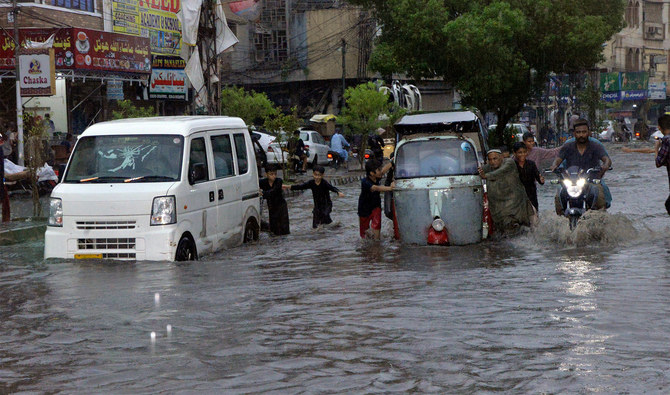
Motorcyclists and cars drive through a flooded road caused by heavy monsoon rainfall in Hyderabad, Pakistan, on July 23, 2023. (AP)
Short Url
Updated 24 July 2023
Follow

Pakistan warns of floods, landslides as next monsoon spell due from July 31 to August 6

  • At least 133 people have died across Pakistan since June 24 when monsoon rains began
  • Monsoon season, which officially began on July 1, will continue until September in Pakistan

ISLAMABAD: Pakistan’s National Disaster Management Authority said on Monday the country’s next monsoon spell was expected from July 31 to August 6, warning of fresh risks of flash and urban flooding as well as landslides.

At least 133 people have died in weather-related incidents across Pakistan since June 24 when monsoon rains began. In one incident, at least 11 construction workers were killed when a wall collapsed on them during heavy monsoon rains on the outskirts of Islamabad last week. The workers, from a nearby construction site, were inside a makeshift tent set up under the wall to take shelter from the rain when the wall fell on them.

Landslides caused by rain hit several roads in the northern districts of Chitral, Dir and Battagram in the northwestern Khyber Pakhtunkhwa province on Sunday. Authorities were trying to clear roads to restore traffic in the mountainous areas well into Monday. 

Heavy rains have swollen three main rivers — the Jhelum, Sutlej and Chenab in eastern Punjab province — prompting the disaster management agency to be on high alert for more flash floods, which have already affected at least 15,000 people in the past three weeks.

“According to the Meteorological Department, the next monsoon spell will continue from July 31 to August 6, due to which the risk of flash and urban flooding, landslides is likely to remain,” NDMA said on Twitter. “Due to heavy rains, there is a risk of increasing water flow in rivers, flooding in rivers and inundation of low-lying areas.”

Monsoon rains have returned to Pakistan a year after devastating floods killed 1,739 people across the country and affected over 30 million people.

The monsoon season, which officially began on July 1, will continue until September in the South Asian country.


Pakistan’s deputy PM discusses ways to boost economic, trade ties with Iran

Updated 8 sec ago
Follow

Pakistan’s deputy PM discusses ways to boost economic, trade ties with Iran

  • Both countries agreed in August to increase bilateral trade to $10 billion by 2028
  • Pakistan and Iran have been working to stabilize relations after strained security ties

ISLAMABAD: Pakistan’s Deputy Prime Minister Ishaq Dar presided over a meeting to discuss economic and trade cooperation with Iran, the foreign office said on Friday, as the neighboring countries seek to expand ties.

The development took place during an inter-ministerial meeting on Pakistan-Iran bilateral relations chaired by Dar in Islamabad. Pakistan and Iran have been working to stabilize ties following a period of strained security relations.

Both countries have been working to enhance bilateral trade, setting up border markets and exploring barter trade to circumvent banking and currency restrictions. Sanctions and foreign exchange shortages remain key hurdles for Iran, making these alternative systems central to its trade strategy with Pakistan.

“The meeting reviewed ongoing cooperation across a range of sectors and discussed ways to further enhance economic and trade ties,” the foreign office said in a statement.

“The DPM/FM reaffirmed Pakistan’s commitment to deepening engagement with Iran in key priority areas.”

In December, the foreign ministers of Iran and Pakistan vowed to strengthen bilateral cooperation in trade and connectivity while working for regional peace.

Iranian President Dr. Masoud Pezeshkian also visited Pakistan in August, during which both countries signed agreements to increase bilateral trade to $10 billion by 2028.