

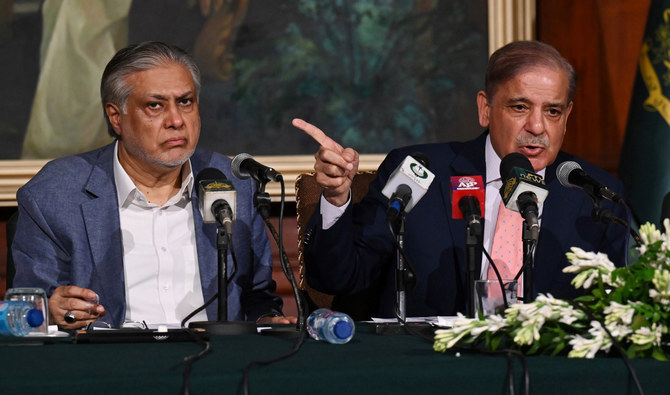

ISLAMABAD: Finance Minister Ishaq Dar could be among the candidates to lead the incoming caretaker government, a spokesperson for Prime Minister Shehbaz Sharif’s Pakistan Muslim League-Nawaz party said on Monday, a move aimed at helping with continuity of economic reforms under a $3 billion International Monetary Fund bailout program.
The current legislature is set to complete its five-year term on August 12, paving the way for the next general elections in October. Under the constitution, the caretaker PM is to be appointed by the president in consultation with the PM and leader of the opposition in the outgoing National Assembly.
“He [Dar] could be one of the candidates, as an economist he could help implement IMF conditions and ensure fiscal discipline,” Muhammad Zubair, a spokesperson for PMLN chief Nawaz Sharif, told Arab News.
Dar is a chartered accountant by training and has, since the 1990s, served in several governments, most notably as chairman of the Pakistan Board of Investment, minister of commerce and three times as finance minister. He is regarded as the most trusted aide of the Sharif family, particularly supremo Nawaz Sharif, and his eldest son is married to Sharif’s daughter.
Zubair said the PMLN wanted an economist as caretaker premier to ensure implementation of a badly-needed $3 billion short-term financial package from the International Monetary Fund that the South Asian nation clinched earlier this month, giving its economy a much-awaited respite as it teeters on the brink of default.
“The agreement with the IMF is an economic prescription which requires continuity of the economic policies and necessary actions during the interim setup to keep the loan program on track,” Zubair said, explaining why it would be “practical” for the caretaker prime ministerial candidate to have prior experience running economic policy.
“We need fiscal discipline during the interim setup as the IMF will be releasing one of the tranches of the $3billion loan after the economic review in the caretaker government,” he said.
Zubair said that his party would consult other coalition partners to develop consensus over the name of the caretaker prime minister: “The caretaker prime minister should be a consensus candidate for free and fair polls.”
Economists welcomed the idea of appointing someone with economic knowhow as caretaker PM but suggested that the candidate be “independent and neutral.”
“If an economist is appointed as the interim prime minister, he can ensure to implement IMF conditions like currency exchange rate, monetary policy tightening and energy prices,” Syed Atif Zafar, a chief economist at Topline Securities, told Arab News.
If an “independent and neutral” economist was appointed with the consensus of all stakeholders, he would have the support to undertake required economic decisions and reforms during his or her three-month tenure, Zafar added.
Imran Khan’s Pakistan Tehreek-e-Insaf (PTI), arguably the most popular party in Pakistan, has said having Dar helm the caretaker government would mean it could not be impartial.
“If Ishaq Dar is to be made a caretaker prime minister, then there will be no elections but only a selection,” PTI spokesman Farrukh Habib told media.
“The IMF approved this stand-by arrangement for Pakistan after completion of all the prior actions including external financing, increase in energy prices and taxes, so there is no logic to appoint Ishaq Dar as caretaker prime minister,” Muzammil Aslam, PTI’s spokesperson on finance and economy, told Arab News.
“The caretaker government is not required to take any major economic decisions for implementation of the IMF program, so an independent and neutral person should be appointed instead of Dar. Ishaq Dar just wants to cling to the position to serve political interests of his party during the elections which is not acceptable to PTI.”


