

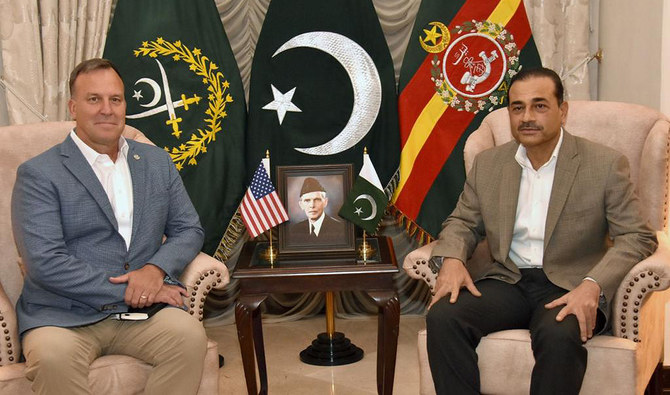
US CENTCOM commander, Pakistan’s army chief discuss regional security, agree to bolster ties

In this handout picture, released and taken by Pakistan's Inter Service Public Relation (ISPR) shows United States CENTCOM Commander General Michael Erik Kurilla (left) and Pakistan Army Chief General Syed Asim Munir (right) in Rawalpindi on July 24, 2023. (Photo courtesy: ISPR)
Short Url
Updated 24 July 2023
Follow

US CENTCOM commander, Pakistan’s army chief discuss regional security, agree to bolster ties

  • The meeting comes at a time when Pakistan is witnessing a surge in militant attacks in areas that border Afghanistan
  • Last week, US said it retained ability to conduct operations against militants and did not depend on Taliban promises

ISLAMABAD: General Michael Erik Kurilla, commander of the United States Central Command (CENTCOM), called on Pakistan’s Army Chief General Asim Munir, the Pakistani military said on Monday, adding the two figures discussed the regional security situation among other affairs of mutual interest.

The meeting comes at a time when Pakistan is witnessing a surge in militant attacks in its northwestern and southwestern parts that border Afghanistan.

The attacks particularly increased after the Pakistani Taliban ended their fragile truce with the government in Islamabad in November last year. The militant group, which maintains sanctuaries in neighboring Afghanistan, is separate from but a close ally of the Afghan Taliban.

“During the meeting matters of mutual interest, regional security situation and defense cooperation were discussed,” the Inter-Services Public Relations (ISPR), the Pakistani military’s media wing, said in a statement.

“Both reiterated the desire to further enhance bilateral relations in all fields.”

Last week, Pakistan’s special representative to Afghanistan, Ambassadors Asif Durrani, also visited Kabul where he raised the issue of militant attacks with the Afghan Taliban authorities, a Pakistani Foreign Office spokesperson said.

The meeting came days after militants attacked a military installation in Pakistan’s Balochistan province and killed nine soldiers, with Pakistan expressing concerns over the presence of militant “safe havens” in Afghanistan and asked Kabul not to allow the use of its territory for attacks inside Pakistan.

Last week, the US State Department said it retained the ability to conduct its own operations against militants in the Pakistan-Afghanistan region and did not depend on the Taliban’s promises. The comments came in response to a question about recent attacks in Pakistan from militant hideouts in Afghanistan.

“I will say that we will hold them to their commitments. But as we have said before, we retain the ability to conduct our own operations in the region to ensure that, regardless of any promises that the Taliban make and regardless of their relative ability or willingness to uphold them,” State Department’s spokesperson Matthew Miller said.

Islamabad says it has time and again raised the matter of the Pakistani Taliban sanctuaries with the Afghan Taliban authorities, but there has been a lukewarm response from Kabul. Afghanistan denies the claims it has any militant sanctuaries on its soil.


Pakistan and Kazakhstan sign 37 MoUs to deepen cooperation, set $1 billion trade target

Updated 6 sec ago
Follow

Pakistan and Kazakhstan sign 37 MoUs to deepen cooperation, set $1 billion trade target

  • Both sides agree to form strategic partnership and discuss enhanced physical connectivity
  • PM Sharif says the two sides should turn these MoUs into implementable agreements

ISLAMABAD: Pakistan and Kazakhstan on Wednesday agreed to establish a strategic partnership, signed 37 memoranda of understanding (MoUs) and set a target of raising bilateral trade to $1 billion within a year, as the two sides agreed to strengthen bilateral cooperation and physical connectivity amid a push for greater regional integration.

The MoUs were signed in the presence of Prime Minister Shehbaz Sharif and President Kassym-Jomart Tokayev, who arrived in Islamabad a day earlier on an official visit.

Landlocked Kazakhstan is seeking access to global maritime trade through Pakistan’s ports on the Arabian Sea, while Islamabad has been positioning itself as a regional transit hub linking Central Asia with South Asia, the Middle East and beyond.

“We had very useful and productive meetings since morning, and just now we have had this signing ceremony of 37 MOUs,” Sharif said while addressing the gathering at the PM House, expressing hope that the understandings would soon be converted into binding agreements and implemented.

The two countries agreed to expand cooperation across transport and logistics, including rail, road and multimodal corridors, with Sharif offering Kazakhstan access to Pakistan’s transit infrastructure and seaports as part of broader efforts to enhance regional connectivity through Central Asia and Afghanistan.

Sharif acknowledged that current bilateral trade levels remained well below potential.

“Unfortunately, our trade volume is just meager $250 million during the last year,” he said. “This does not reflect not only the strength of our friendship, but also the potential of the two countries ... Let us make a commitment that we will take up our trade volume to $1 billion in the next one year.”

Speaking at the ceremony, Tokayev described Pakistan as a key partner for Kazakhstan.

“Pakistan is a reliable and important partner of Kazakhstan in South Asia and beyond,” he said. “Our peoples are united by centuries-old ties rooted in the legacy of the Great Silk Road, as well as by deep cultural and spiritual affinity.”

Beyond connectivity, the MOUs cover cooperation in energy, agriculture, mining and minerals, pharmaceuticals, defense production, digital technologies and artificial intelligence.

The two sides also agreed to promote joint ventures, particularly in food processing, agriculture value chains and industrial production.

Investment cooperation featured prominently, including the launch of a joint investment platform involving Kazakhstan’s sovereign wealth entities and Pakistani partners to identify bankable projects in mining, energy and infrastructure.

The talks also addressed collaboration in education, science and culture, with both sides agreeing to expand academic exchanges, institutional linkages between universities and people-to-people contacts through cultural and sporting initiatives.

This is the first visit of a Kazakhstan president to Pakistan in 23 years.

The two countries are also scheduled to hold the joint business forum in which more than 250 companies from both sides will come together and are expected to sign commercial agreements.