

17 killed in Pakistan as monsoon rains lash Punjab, KP and Gilgit-Baltistan

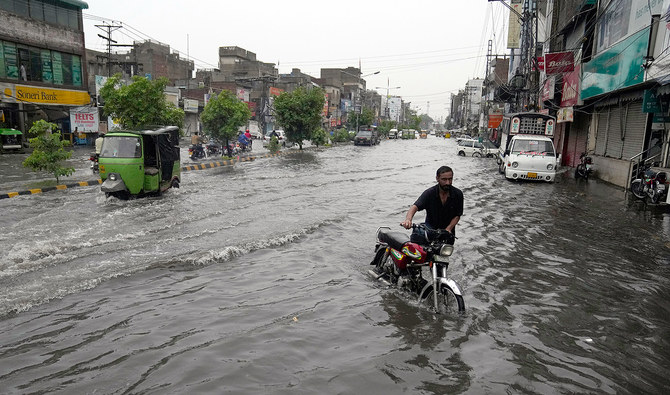
A motorcyclist drives through a flooded road caused by heavy monsoon rainfall in Lahore, Pakistan, Saturday, July 22, 2023. (AP)
Short Url
Updated 23 July 2023
Follow

17 killed in Pakistan as monsoon rains lash Punjab, KP and Gilgit-Baltistan

  • Pakistan’s Khyber Pakhtunkhwa, Punjab, and Gilgit-Baltistan areas report 9, 4, and 4 deaths respectively in 24 hours
  • As monsoon currents penetrate Pakistan, rain is expected to continue for the next few days in northern regions of country

ISLAMABAD: The fresh spell of heavy monsoon rains has killed 17 in Pakistan’s northwestern Khyber Pakhtunkhwa (KP), Punjab, and northern Gilgit-Baltistan areas over the past 24 hours, according to official data, as authorities remain concerned over the risk of floods as water levels in Punjab’s rivers rise.

Monsoon currents are continuously penetrating the country from the Bay of Bengal, according to the Pakistan Meteorological Department (PMD), and a westerly trough is expected to persist in the northern regions over the next few days. As a result, several parts of KP and Punjab are at risk of flash floods and landslides, while rains or thundershowers will also hit the southern and southwestern parts of the country.

Official data from the provincial KP government states nine people were killed while seven were injured in rain-related incidents over the past 24 hours. Incidents of land sliding partially and completely damaged 68 and 7 houses in the province respectively.

“All affected families in the province have been provided food and all other necessary items,” KP’s Provincial Disaster Management Authority (PDMA) said in a statement, declaring an emergency in lower and upper Chitral following the heavy rains.

Separately, four people of the same family were killed while one was injured due to a land sliding incident in Gilgit-Baltistan’s Skardu district, Arif Hussain, a Rescue 1122 official, said.

He said all major roads in the city were closed due to mudflow and landsliding, adding that machinery had been deployed to clear debris from the roads. “The rain has stopped now here, but almost all major roads are blocked due to landsliding,” Hussain told Arab News.

Assistant commissioner of the mountainous Hunza valley in GB said the Karakorum Highway at Hassanabad will remain closed for traffic on July 24, 2023, from 7:00 a.m. to 2:00 p.m. during which authorities would blast heavy boulders to clear the road and the adjacent public irrigation water channel.

People, transporters, drivers, and tourists are advised to use the SAS valley Nagar route to avoid any inconvenience, he said in a statement.

Meanwhile, four people were killed and eight were injured in rain-related incidents across Punjab over the last 24 hours, as per official Among those killed were three women and children.

Mazhar, a PDMA Punjab spokesperson, said the roofs of five houses have been damaged due to intense rainfall, adding that showers are expected to continue in the province till July 29.

“The water inflows in the rivers in Punjab have been constantly rising due to rains which may cause flash floods in some areas,” Mazhar told Arab News. “We have put all provincial administration on high alert to protect citizens’ lives and properties.”

He said authorities have been directed to relocate people living in close proximity to rivers and low-lying areas in Punjab, urging citizens to avoid unnecessary travel this week.


Pakistan’s deputy PM says country will not send forces to Gaza to disarm Hamas

Updated 27 December 2025
Follow

Pakistan’s deputy PM says country will not send forces to Gaza to disarm Hamas

  • Ishaq Dar says Pakistan open to peacekeeping but Gaza’s internal security is Palestinian responsibility
  • Pakistan’s top religious clerics from different schools have warned against sending forces to Palestine

ISLAMABAD: Deputy Prime Minister Ishaq Dar said on Saturday Pakistan was willing to contribute to an international peacekeeping force in Gaza, though it would not deploy troops to disarm or de-weaponize Hamas.

The statement follows media reports saying Washington views Pakistan as a potentially significant contributor given its battle-hardened military and wants it to be part of International Stabilization Force (ISF), which is part of United States President Donald Trump’s 20-point framework for a Gaza peace plan.

The plan announced by Trump at the White House on September 29 was formally adopted at the Sharm El-Sheikh Peace Summit in October. Co-chaired by Trump and Egyptian President Abdel Fattah El-Sisi, the summit brought together leaders from 27 countries to sign the “Trump Declaration for Enduring Peace and Prosperity.”

Deployment of troops from Muslim-majority countries during a transitional stabilization phase is a key part of the plan before the war-ravaged Palestinian territory moves toward reconstruction and a longer-term political settlement.

“If they say that we should go and start fighting, disarm Hamas, de-weaponize them, and go and destroy the tunnels that Hamas has built until now, that is not our job,” Dar, who is also the country’s foreign minister, told reporters during a year-end briefing in Islamabad.

He emphasized there was clarity between Pakistan’s civil and military leadership over the matter.

“We have a very complete understanding on this matter that we cannot do that kind of work,” he added.

The deputy prime minister said Pakistan had been using the term “peacekeeping” and had never used the phrase “peace enforcement” while discussing the force.

“I have been very clear: Pakistan will be happy to join if the mandate is not peace enforcement and disarming and de-weaponizing Hamas.”

The government’s stance comes amid growing domestic pressure over the issue.

On Monday, a group of Pakistan’s top religious leaders, chaired by prominent scholar Mufti Taqi Usmani, warned the government against yielding to what they described as international pressure to send forces to Gaza.

In a joint statement from Karachi, the clerics — representing Deobandi, Barelvi, Ahl-e-Hadees and Shia schools of thought — said that Washington wanted Muslim countries to send their forces to Gaza to disarm Hamas.

“Several Muslim governments have already refused this, and pressure is being increased on Pakistan,” it added.

Addressing such concerns, Dar said Pakistan would not land its forces in Palestine to “fight Muslims.”

Israel has repeatedly called for the disarmament of Hamas as a precondition for any long-term settlement, and the United Nations Security Council has also endorsed the ISF framework in November.

However, Dar maintained during the media briefing the internal security of Gaza was the Palestinian responsibility.

“The Palestinian Authority, their government, it is their job, it is the job of their law enforcement agency,” he said

The deputy prime minister also highlighted Pakistan’s involvement in the “Arab Islamic Group of Eight,” including Saudi Arabia, Jordan, Egypt, the United Arab Emirates, Qatar, Turkiye and Indonesia, which has been coordinating on the crisis.

He said the efforts of these countries had brought some peace to Palestine and reduced bloodshed.

“Our declared policy is that there should be an independent two-state solution,” he continued while calling for pre-1967 borders.