

Pakistan fuel pump operators defer nationwide strike call scheduled for Saturday

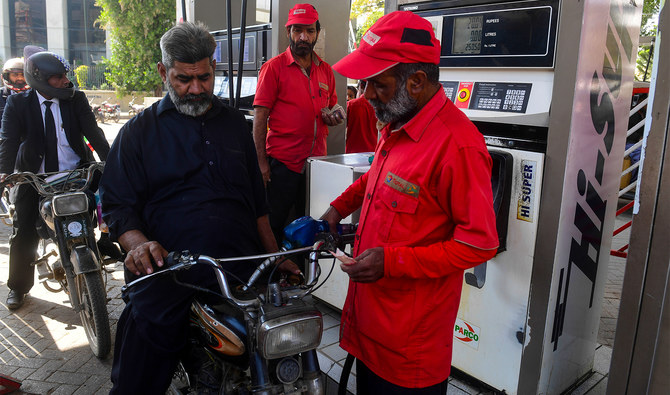
This picture taken on January 30, 2023, shows a man filling petrol in his motorcycle at a gasoline station in Pakistan's port city of Karachi. (AFP/File)
Short Url
Updated 21 July 2023
Follow

Pakistan fuel pump operators defer nationwide strike call scheduled for Saturday

  • The decision was reached after the government agreed to implement reasonable increase in their profit margin
  • The government will conduct survey of petrol stations before announcing its decision over the issue on Monday

KARACHI: Pakistan’s fuel pump operators on Friday decided to provisionally call off their previously planned indefinite nationwide strike, which was supposed to begin on Saturday evening, after the government responded to their concerns by promising to address the issues and agreeing to implement a reasonable increase in their profit margin.

Chairman of the Pakistan Petroleum Dealers Association (PPDA) Abdul Sami Khan announced the strike a day earlier, seeking an increase in the profit margin and raising concerns over the influx of smuggled fuel from neighboring Iran.

He highlighted that increasing utility prices, interest rates, and labor costs had been progressively eroding the income and profitability of fuel pump operators, rendering it unsustainable for them to carry on with their business operations.

Khan also emphasized that the smuggling of Iranian diesel had caused a significant 30 percent decline in the sales of petroleum dealers, as the availability of illegal fuel from the neighboring country had spread across Pakistan.

A written statement, jointly signed by the petroleum minister Dr. Musadik Malik and the PPDA chairman, said the strike had been deferred until Monday.

“It is agreed that there should be an upward reasonable revision in dealers’ margin,” it continued. “The increased margins will be ascertained based on actual data acceptable to all concerned stakeholders.”

“The revised margin number will be announced within the next ‘Forty Eight’ hours, i.e. Monday July 24th 2023,” added the statement.

Earlier, the petroleum minister told the media the government would make evidence-based policy over the issue by surveying petrol pumps on Monday.

However, the two sides agreed that fuel smuggling from Iran was damaging the local market.

The government also clarified it did not independently set the prices of petroleum products, stating that the rates were determined on a fortnightly basis, taking into consideration the volatility in the international oil market and the value of the US dollar.


Rating firm S&P says it won’t rush Iran war downgrades, sees risks for countries like Pakistan

Updated 12 March 2026
Follow

Rating firm S&P says it won’t rush Iran war downgrades, sees risks for countries like Pakistan

  • Agency says it is monitoring indebted energy importers as higher oil prices strain finances
  • Gulf economies seen better placed to weather shock, though Bahrain flagged as vulnerable

LONDON: S&P Global ‌said it would not make any knee-jerk sovereign rating cuts following the outbreak of war in the ​Middle East, but warned on Thursday that soaring oil and gas prices were putting a number of already cash-strapped countries at risk.

The firm’s top analysts said in a webinar that the conflict, which has involved US and Israeli strikes ‌against Iran and Iranian ‌strikes against Israel, ​US ‌bases ⁠and Gulf ​states, ⁠was now moving from a low- to moderate-risk scenario.

Most Gulf countries had enough fiscal buffers, however, to weather the crisis for a while, with more lowly rated Bahrain the only clear exception.

Qatar’s banking sector could ⁠also struggle if there were significant ‌deposit outflows in ‌reaction to the conflict, although there ​was no evidence ‌of such strains at the moment, they ‌said.

“We don’t want to jump the gun and just say things are bad,” S&P’s head global sovereign analyst, Roberto Sifon-Arevalo, said.

The longer the crisis ‌was prolonged, though, “the more difficult it is going to be,” he ⁠added.

Sifon-Arevalo ⁠said Asia was the second-most exposed region, due to many of its countries being significant Gulf oil and gas importers.

India, Thailand and Indonesia have relatively lower reserves of oil, while the region also had already heavily indebted countries such as Pakistan, Bangladesh and Sri Lanka whose finances would be further hurt by rising energy prices.

“We ​are closely monitoring ​these (countries) to see how the credit stories evolve,” Sifon-Arevalo said.