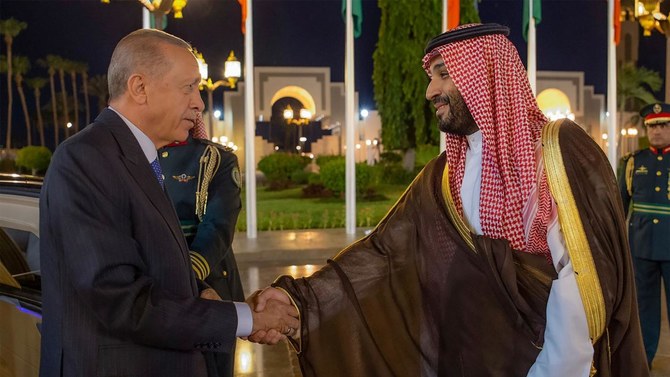

ANKARA: Ties between Ankara and Riyadh are improving as the bilateral relationship continues to warm following the signing of a significant defense export deal, analysts say.
During his official tour of the Gulf this week, Turkish President Recep Tayyip Erdogan signed a number of agreements with Saudi Arabia late on Monday, which many experts viewed as sending a signal about the future of defense cooperation between the two countries.
They included a pivotal defense-cooperation deal, and an agreement between the Saudi Ministry of Defense and Turkish defense equipment manufacturer Baykar for the supply of drones.
Saudi Defense Minister Prince Khalid bin Salman emphasized the important nature of these agreements, stating that they aim to enhance the readiness of the Kingdom’s armed forces and bolster the country’s defense and manufacturing capabilities.
Haluk Bayraktar, the CEO of Baykar, said the agreement was largest defense and aviation export contract signed by a Turkish company to date. His brother Selcuk Bayraktar is the chairman of the board at the company and its chief technology officer, and is Erdogan’s son-in-law.
Baykar is renowned for its Bayraktar TB2 drones, unmanned aerial vehicles equipped with laser-guided missiles that cost about the same as American and Israeli drones. As part of the deal, Turkiye will also export an undisclosed number of Bayraktar Akinci medium-altitude, long-endurance armed drones for use by Saudi air and naval forces.
The agreement also includes technology transfers and joint-production projects to help enhance the advancement of high-tech development capacities in both countries. Another deal is expected to be signed for the purchase of Turkish smart munitions and other payloads, with plans for them to be produced locally in the Kingdom.
“This significant development is surely the start of a new era in Turkish-Saudi relations,” Sine Ozkarasahin, a defense analyst at the Center for Economics and Foreign Policy Studies (also known as EDAM), an independent think tank in Istanbul, told Arab News.
She believes that in future we can expect “more collaboration between Ankara and Riyadh in the defense industry, in segments such as air defense and missiles, but more prominently in smart weapons, such as autonomous and uncrewed systems and other (artificial intelligence-driven) technologies.”
She added: “Both countries are very invested in (research and development) in the military sector. As illustrated in their Vision 2030 document, the Saudis are currently one of the pioneering countries leading the AI breakthrough in the Middle East.
“Deals like this also demonstrate that they see the potential in Turkiye’s rapidly expanding defense-technological industrial base.”
In the past four years, Turkiye has been offering domestically developed and produced drones, particularly those manufactured by Baykar, for sale to friendly countries with which Ankara seeks to strengthen ties.
Armed Turkish drones, including the Bayraktar TB2, have proven effective in a number of conflict zones, including Syria, Iraq, Somalia, Libya and Nagorno-Karabakh.
The TB2 in particular has earned a deserved reputation as a highly capable and cost-effective platform, in the process playing a pivotal role in advancing and fueling the growth of the Turkish defense aeronautics industry.
Ukrainian forces used the flagship Turkish drone for strategic communication in the early stages of the conflict with Russia, and they were credited with helping to halt the Russian advance.
Between 2019 and 2023, Turkiye has signed agreements for the co-production of unmanned aerial vehicles with several countries, including Kazakhstan, Ukraine and now Saudi Arabia.
The Kingdom is the seventh nation to purchase Akinci drones from Baykar, and as the list of export clients grows, the latest agreement means that Turkiye has successfully expanded its drone sales to cover all of the wealthy Gulf monarchies. The deal with Riyadh also serves as a significant signal that relations between the two countries are improving.
Meanwhile, Baykar is developing an unmanned fighter jet, a project that highlights Turkiye’s continuing commitment to advancing its capabilities in the unmanned aviation sector.
Leo Peria-Peigne, a research fellow at the Security Studies Center of the French Institute of International Relations in Paris, said that after several years of chilly relations, ties between Riyadh and Ankara are warming, and Turkish authorities are actively seeking to use armaments agreements as part of this process, not only in dealings with the Kingdom but other countries such as the UAE and Egypt.
“Right after the end of the Kingdom’s blockade on Qatar, rumors emerged about a potential armaments contract between (Riyadh and Ankara), especially on UAVs (unmanned aerial vehicles), rumors that were used as a proof of an improvement in relations,” he told Arab News.
“Also, an armaments contract is also some kind of guarantee that both countries will keep good relations for a while, as most of the profit on these deals is made in training and maintenance services.”
As the Turkish economy struggles with hyperinflation, its defense industry provides an effective way to attract an influx of foreign currencies, Peria-Peigne said.
“Armament contracts are also used by Ankara to enhance its diplomatic attractivness and support its ‘seduction efforts,’ especially toward African and Central Asian countries,” he added.
Meanwhile, Peria-Peigne said, the knock-on industrial benefits to Saudi Arabia expected from such agreements will help the Kingdom diversify its economy in line with the aims of its Vision 2030 agenda, which calls for half of the nation’s military equipment to be manufactured locally by the end of the decade.