Moscow and Kiev in tit-for-tat threats to civilian ships

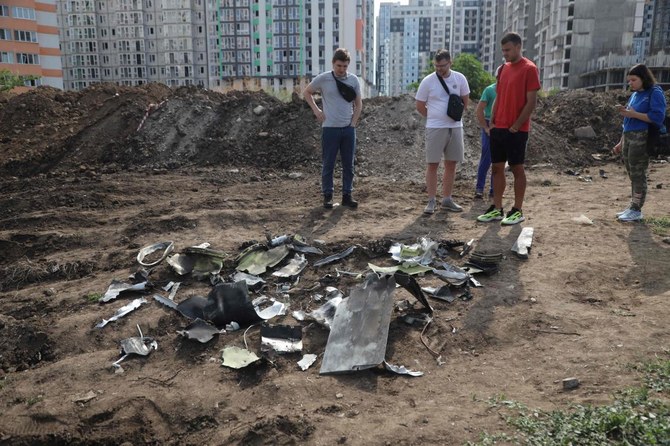
People look at fragments of a missile shot down during a night strike in Odesa on July 19, 2023. (AFP)
Short Url
Updated 20 July 2023
Follow

Moscow and Kiev in tit-for-tat threats to civilian ships

  • Warnings follow third straight night of massive Russian airstrikes on Ukraine’s Black Sea ports

JEDDAH: Moscow and Kiev issued tit-for-tat threats to shipping in the Black Sea on Thursday after Russia launched massive airstrikes against Ukrainian ports for a third straight night.

At least 27 civilians were injured in the port attacks, which set buildings ablaze and damaged China’s consulate in Odesa.
The latest confrontations came after Russia withdrew on Monday from a UN-brokered agreement guaranteeing safe passage to vessels exporting grain from the Black Sea ports.

Russia’s military said it would consider all ships heading for Ukrainian waters to be potentially carrying weapons, and Kyiv responded on Thursday with exactly the same threat.

The US said Russia’s warning suggested it could attack vessels at sea. “We believe this is a coordinated effort to justify any attacks against civilian ships in the Black Sea and lay blame on Ukraine,” national security council spokesman Adam Hodge said.
Since quitting the deal, Moscow has rained missiles down nightly on Ukraine’s two biggest port cities, Odesa and Mykolaiv. Thursday’s strikes were the heaviest so far.
“The aggressor is deliberately hitting the port infrastructure. Administrative and residential buildings nearby were damaged ... it shows the enemy does not pay attention to anything,” Odesa regional governor Oleh Kiper said.
The Chinese foreign ministry said the shock wave of the explosion “knocked down parts of the walls and window panes of the consulate. China is paying close attention to the relevant developments.”
In Mykolaiv, firefighters battled a huge blaze at a residential building blasted into a ruin. Several other residential buildings there were also damaged.


Venezuela aims to boost oil output but sanctions stand in the way, VP says

Updated 4 sec ago
Follow

Venezuela aims to boost oil output but sanctions stand in the way, VP says

  • Sanchez called the recent capture of Nicolas Maduro a “dark day” for the country

DUBAI: Venezuela’s Vice President for Economy Calixto Ortega Sanchez said on Wednesday that his country needed vast foreign investment and sanctions relief to tap its huge oil reserves and restart its ailing economy.

“We know that the reference for Venezuela is that (it is) the country with the biggest oil reserves, and we want to stop being known for this, and we want to be known as one of the countries with the highest production levels,” Sanchez said.

Responding to questions by American journalist Tucker Carlson, Sanchez called the recent capture of Nicolas Maduro a “dark day” for the country but said Venezuela was working to reestablish a relationship with the US, which he described as a “natural partner” for the country.

“The Venezuelan people and authorities have shown that they are ready to peacefully move forward and to build opportunities,” he said during a session at the World Government Summit.

Sanchez, who headed Venezuela’s central bank, said the most pertinent issue facing his country is continued US sanctions.

Despite failing to result in regime change, the sanctions had effectively stifled the economy from growing, he added.

He said the Venezuelan government was now working to reform its laws to allow foreign investment and hoped the US would ease sanctions to aid their work.

“The first decisions that interim President Rodriguez took was to go to the National Assembly and ask for reform to the hydrocarbon law … this law will allow international investors to go to Venezuela with favorable conditions, with legal assurance of their investments,” he added.

“The economy is ready for investment. The economy is ready for the private sector; it is ready to build up a better future for the Venezuelan people.”

Sanchez played down inferences by Carlson that his government had been taken over, insisting that the regime still held authority in the country. He said the country had set up two funds to receive money from oil production that would fund better welfare and social conditions for Venezuelans.

“Allow us to have access to our own assets … we don’t have access to our own money,” he added.

“If you allow us to function like a regular country, Venezuela will show extraordinary improvement and growth.”