Saudi SWCC, Japanese Shinshu University to explore new desalination technologies

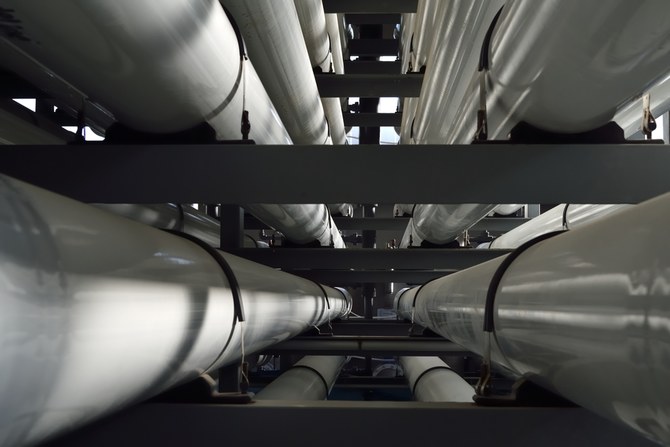
As part of the deal, both parties will work together to develop reverse osmosis technologies for seawater and other related processes in order to expel salts from washing processes for osmosis technologies. (Shutterstock)
Short Url
Updated 19 July 2023
Follow

Saudi SWCC, Japanese Shinshu University to explore new desalination technologies

RIYADH: Saudi Arabia and Japan have signed a deal to extend cooperation in the area of seawater desalination as both countries aim to explore new technologies to produce water using environmentally friendly renewable energy.   

The Saline Water Conversion Corp., a Saudi governmental institution responsible for seawater desalination and delivery, signed a memorandum of understanding with the Japanese Shinshu University to propel the growth in the sector, the Saudi Press Agency reported. 

As part of the deal, both parties will work together to develop reverse osmosis technologies for seawater and other related processes in order to expel salts from washing processes for osmosis technologies. 

In addition to this, they will also cooperate in developing innovative top-notch technologies such as zero-liquid discharge, micro membranes, and seawater mining technologies. 

Moreover, the two sides will also join forces in using advanced and innovative environmentally friendly green energy for water applications and any other field agreed upon by both parties. 

The signing of the MoU was attended by Minister of Investment Khalid Al-Falih as well as Japan’s Ambassador to the Kingdom Fumio Iwai, along with several officials from both sides. 

SWCC recently announced that it achieved a milestone in water security by increasing its water production capacity to 11.5 million cubic meters a day, making it the world’s largest producer of desalinated water.  

According to its second annual sustainability report released last week, the state-run institution accomplished this feat in line with its goal of reducing carbon emissions by 37 tons by the end of 2025.  

“We are proud of our contribution to the Saudi Green Initiative as we achieved high-performance levels while managing our costs, energy consumption and carbon emissions appropriately,” said SWCC Gov. Abdullah Ibrahim Al-Abdulkarim in the foreword of the sustainability report.  

The report also shed light on the innovative solutions, methods, and approaches the company pursued to achieve its established strategy, especially aspects related to governance structure, communication with stakeholders and environmental, economic and social sustainability.  

SWCC currently runs 30 desalination plants with a production capacity of around 7.5 million cubic meters per day and 139 purification stations with a total of about 4 million m3 per day, supported by a team of over 9,000 employees. 


Saudi banking sector outlook stable on higher non-oil growth: Moody’s 

Updated 11 February 2026
Follow

Saudi banking sector outlook stable on higher non-oil growth: Moody’s 

RIYADH: Saudi Arabia’s banking sector outlook remains stable as stronger non-oil economic growth and solid capital buffers support lending and profitability, Moody’s Ratings said, forecasting continued expansion despite liquidity constraints. 

In its latest report, credit rating agency Moody’s said the Kingdom’s non-oil gross domestic product is projected to expand by 4.2 percent this year, up from 3.7 percent recorded in 2025. 

In January, S&P Global echoed a similar view, saying banks operating in Saudi Arabia are expected to sustain strong lending growth in 2026, driven by financing demand tied to Vision 2030 projects. 

Fitch Ratings also underscored the healthy state of Saudi Arabia’s banking system last month, stating that credit growth and high net interest margins are supporting bank profitability in the Kingdom. 

Commenting on the latest report, Ashraf Madani, vice president and senior credit officer at Moody’s Ratings, said: “We expect credit demand to remain robust, but tight liquidity conditions will continue to limit the sector’s lending capacity.” 

Madani added that operating conditions in Saudi Arabia will continue to support banks’ strong asset quality and profitability. 

“The operating environment for banks remains buoyant, underpinned by a forecast increase in non-oil GDP growth, robust solvency and continued progress toward the government’s economic diversification goals,” he added.  

Moody’s said authorities in the Kingdom are introducing business-friendly reforms to bolster investment and private sector activity, while implementing key development projects and preparing for major global events. 

Saudi Arabia continues to advance reforms including full foreign ownership rights, simplified capital market registration procedures and improved investor protections, which could accelerate credit growth to 8 percent this year. 

Problem loans are expected to remain near historical lows at around 1.3 percent of total loans, supported by ongoing credit growth, favorable operating conditions and lower interest rates, which collectively strengthen borrowers’ repayment capacity. 

Retail credit risk remains controlled in Saudi Arabia because most borrowers are government employees with stable income streams. 

“Concentration of single borrowers and specific sectors remains high although the growing proportion of consumer loans — now nearing 50 percent of overall sector lending — continues to reduce aggregate concentration risk,” added Moody’s.  

The report said profitability is expected to remain solid among Saudi banks, supported by sustained loan growth and fee income. 

Margins are expected to remain stable despite lower asset yields as banks take advantage of credit demand to widen loan spreads on existing and new lending. 

Moody’s expects net income to tangible assets to remain stable at 1.8 percent to 1.9 percent this year. 

The report added that Saudi banks benefit from a very high likelihood of government support in the event of any failures. 

“We assume a very high likelihood of government support in the event of a bank failure. This is based on the government’s track record of timely intervention,” Moody’s said.  

It added that Saudi Arabia remains the only G-20 country that has not adopted a banking resolution framework. However, it is the only Gulf Cooperation Council member to have introduced a law for systemically important financial institutions.