Saudi Arabia and Turkiye sign energy cooperation agreement

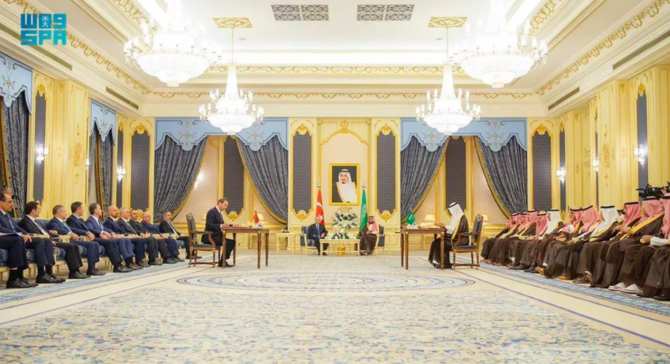
A Memorandum of Understanding was signed by Saudi Minister of Enregy Prince Abdulaziz bin Salman and his counterpart from Turkiye Alparslan Bayrakdar (SPA)
Short Url
Updated 18 July 2023
Follow

Saudi Arabia and Turkiye sign energy cooperation agreement

RIYADH: Saudi Arabia and Turkiye have signed an energy agreement aimed at boosting cooperation in oil and gas production during a high-level meeting.

The Kingdom’s Crown Prince Mohammed bin Salman held talks with President Recep Tayyip Erdogan at the gathering, which came as the Turkish leader undertakes a three-state Gulf tour.

A memorandum of understanding was signed by Saudi Minister of Enregy Prince Abdulaziz bin Salman and his counterpart from Turkiye Alparslan Bayrakdar.

According to the Saudi Press Agency, the MoU covers the production, marketing, distribution and trade of refined petroleum products, as well as the production of petrochemicals.

It also takes in cooperation in the field of renewable energy and electricity, as well as the exploration of investment opportunities between the two countries in that field.

There was also an agreement over investigating electrical interconnection between the Kingdom and Turkiye.

The SPA report added: “The memorandum also included strengthening cooperation in the field of hydrogen, through research and development to enhance its use, as well as cooperation in the field of the circular carbon economy, through exchanging knowledge about applications related to it, and cooperation in the field of energy supply chains, by encouraging bilateral investments, and working to access materials.”

The MoU is the latest sign of the growing relationship between Saudi Arabia and Turkiye, and comes as both countries try to promote links across their respective public and private sectors.

Trade between Turkiye and the Kingdom reached $6.5 billion in 2022, and hit $3.4 billion in the first half of this year. Turkiye’s trade with all the Gulf states has shot up from $1.6 billion to about $22 billion in the past 20 years.

On Monday, more than 400 business leaders and officials attended a special meeting of the Saudi-Turkish Business Forum in Jeddah in a further boost to economic ties between the two countries.

Amid discussions around further investment opportunities, a number of agreements were signed covering manufacturing, tourism, mining, food and agriculture, as well as defense and military industries. 

There were also deals covering energy, education, and digital technology, as well as agreements focused on media, construction, health and real estate. 


Oil prices rise sharply after attacks in Middle East disrupt global energy supply

Updated 53 min 42 sec ago
Follow

Oil prices rise sharply after attacks in Middle East disrupt global energy supply

  • Traders were betting the supply of oil from Iran and elsewhere in the Middle East would slow or grind to a halt.
  • Attacks throughout the region have restricted countries’ ability to export oil to the rest of the world

NEW YORK: Oil prices rose sharply Monday as US and Israeli attacks on Iran and retaliatory strikes against Israel and US military installations around the Gulf sent disruptions through the global energy supply chain.
Traders were betting the supply of oil from Iran and elsewhere in the Middle East would slow or grind to a halt. Attacks throughout the region, including on two vessels traveling through the Strait of Hormuz, the narrow mouth of the Arabian Gulf, have restricted countries’ ability to export oil to the rest of the world. Prolonged attacks would likely result in higher prices for crude oil and gasoline, according to energy experts.
West Texas Intermediate, the light, sweet crude oil produced in the United States, was selling for about $72 a barrel early Monday, up around 7.3 percent from its trading price of about $67 on Friday, according to data from CME group.
A barrel of Brent crude, the international standard, was trading at $78.55 per barrel early Monday, according to FactSet, up 7.8 percent from its trading price of $72.87 on Friday, which had been a seven-month high at the time.
Higher global energy prices could lead to consumers paying more for gasoline at the pump and shelling out more for groceries and other goods, at a time when many are already feeling the impacts of elevated inflation.
Roughly 15 million barrels of crude oil per day — about 20 percent of the world’s oil — are shipped through the Strait of Hormuz, making it the world’s most critical oil chokepoint, according to Rystad Energy. Tankers traveling through the strait, which is bordered in the north by Iran, carry oil and gas from Saudi Arabia, Kuwait, Iraq, Qatar, Bahrain, the UAE and Iran.
Iran had temporarily shut down parts of the strait in mid-February for what it said was a military drill, which led oil prices to jump about 6 percent higher in the days that followed.
Against that backdrop, eight countries that are part of the OPEC+ oil cartel announced they would boost production of crude Sunday. The Organization of Petroleum Exporting Countries, in a meeting planned before the war began, said it would increase production by 206,000 barrels per day in April, which was more than analysts had been expecting. The countries boosting output include Saudi Arabia, Russia, Iraq, the United Arab Emirates, Kuwait, Kazakhstan, Algeria and Oman.
“Roughly one-fifth of global oil supply passes through the Strait of Hormuz, a vital artery for world trade, meaning markets are more concerned with whether barrels can move than with spare capacity on paper,” said Jorge León, Rystad’s senior vice president and head of geopolitical analysis, in an email. “If flows through the Gulf are constrained, additional production will provide limited immediate relief, making access to export routes far more important than headline output targets.”
Iran exports roughly 1.6 million barrels of oil a day, mostly to China, which may need to look elsewhere for supply if Iran’s exports are disrupted, another factor that could increase energy prices.