

KSrelief to sponsor 5,000 surgeries to combat blindness, eye diseases in Pakistan 

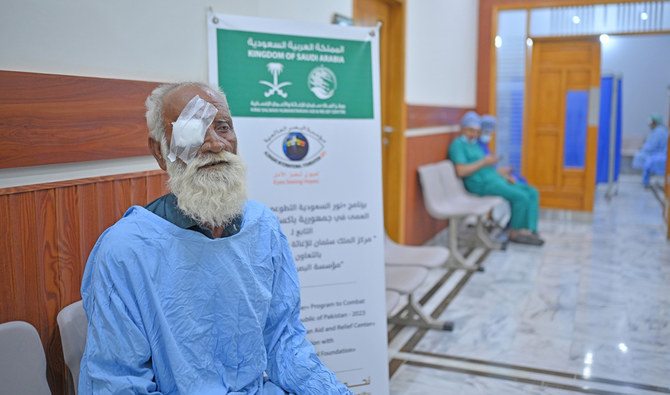
The undated photo shows a beneficiary of KSrelief's project to combat blindness in Pakistan after getting an eye surgery in a hospital in Pakistan. (Photo courtesy: KSrelief)
Short Url
Updated 18 July 2023
Follow

KSrelief to sponsor 5,000 surgeries to combat blindness, eye diseases in Pakistan 

  • Saudi aid agency KSrelief sets up 12 medical camps in rural and urban areas of Sindh, Balochistan
  • Program aims to provide advanced eye care facilities to individuals who lack access to treatment

ISLAMABAD: Saudi aid agency King Salman Humanitarian Aid and Relief Center (KSrelief) announced on Tuesday it has organized 12 relief camps in the rural and urban areas of Pakistan’s southern Sindh and Balochistan provinces where 5,000 surgeries would be conducted to combat eye diseases and blindness. 

KSrelief, with one of the largest humanitarian budgets for aid agencies across the world, has been undertaking humanitarian projects across 88 countries. Pakistan is the fifth largest beneficiary of the organization’s aid and humanitarian operations. According to the KSrelief data, the agency has completed 170 projects in Pakistan in education, health care, water, sanitation, hygiene, emergency camps, and community support. These collectively have cost roughly $163 million in the last 17 years.

The camps were held in Sindh’s cities of Karachi, Matli, Kundairo and Shikarpur while in Balochistan, they were organized in Kharan and Kalat. Residents from these areas were able to benefit from specialized eye care services and regain their vision, KSrelief said. The program was started in July and is slated to continue till the end of August while the medical camps are being organized in collaboration with Al-Basar International Foundation with the help of Al-Ibrahim Eye Hospital in Pakistan’s southern port city of Karachi.

“The primary objective of this outreach program is to detect and address eye-related issues at an early stage, thereby combating blindness and improving the quality of life for thousands of individuals,” KSrelief said in a press release. “Under this program, more than 50,000 medical examinations, and over 5,000 surgeries will be provided, along with 12,000 glasses for vision correction, using the medications prescribed by doctors.”

KSrelief said the initiative ensures individuals not only receive essential treatment but also have access to necessary eyewear to enhance their visual capabilities. 

“This campaign represents the Kingdom of Saudi Arabia’s commitment to humanitarian causes and their dedication to improving the lives of individuals affected by blindness,” KSrelief said. “Through these medical camps, KSrelief have made a significant difference in the lives of thousands of patients, restoring their sight and providing hope for a brighter future.”


Pakistan launches second indigenous EO-2 satellite from China, SUPARCO says

Updated 8 sec ago
Follow

Pakistan launches second indigenous EO-2 satellite from China, SUPARCO says

  • Earth observation satellite launched from Yangjiang Seashore Launch Center in China
  • EO-2 to enhance disaster response, governance, resource management capabilities

KARACHI: Pakistan has successfully launched its second indigenous Earth Observation satellite, EO-2, from China’s Yangjiang Seashore Launch Center, the national space agency SUPARCO said on Thursday.

The launch marks a significant step in Pakistan’s efforts to strengthen its domestic space and remote sensing capabilities, with the satellite expected to improve imaging continuity, disaster monitoring, agricultural planning and strategic resource management.

In a statement, Pakistan’s SUPARCO said the EO-2 satellite would enhance the country’s earth observation and imaging capabilities and support governance and planning functions across multiple sectors.

“Pakistan’s second indigenous EO-2 satellite has been successfully launched,” SUPARCO said, adding that the mission represents a “milestone” in the expansion of the country’s satellite fleet.

According to the agency, EO-2 will provide critical data for planning and resource management while improving the continuity and accuracy of national earth observation systems.

The satellite is expected to support disaster management, urban planning, environmental monitoring and infrastructure development by supplying updated geospatial imagery and data.

SUPARCO said the launch demonstrates growing indigenous capability in satellite development and reflects Pakistan’s broader objective of strengthening its national space program through locally developed platforms.

Pakistan has gradually expanded its space cooperation with China in recent years, including satellite launches and joint missions, as Islamabad seeks to build technical capacity and reduce reliance on external data sources.

The EO-2 satellite is expected to play a key role in improving data availability for federal and provincial authorities, particularly in areas vulnerable to floods, climate stress and rapid urbanization.