
RIYADH: Acclaimed director Abdulaziz Alshlahei’s upcoming Saudi feature film “Hobal” is set to begin shooting in NEOM, northwest Saudi Arabia, this September.
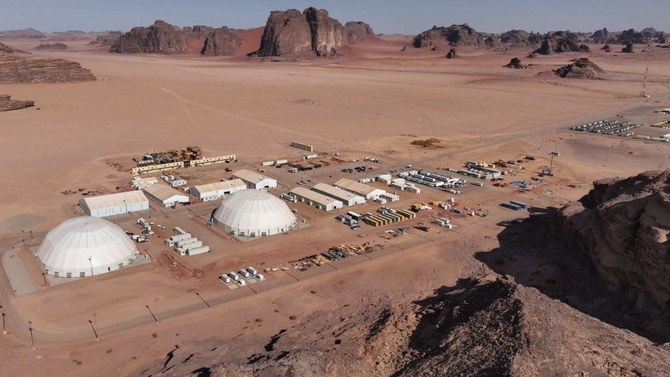
The film will utilize the picturesque Bajdah Studios and its vast landscapes to create an epic cinematic experience, the Saudi Press Agency reported on Monday.
“Hobal” focuses on a Saudi family living in isolation in the desert in the early 1990s. Following their grandfather’s strict instructions, the family are not allowed to leave the desert. However, a series of events shakes their foundations and pits them in a struggle between life and death. The film stars Mohammed Altoyan and Mishal Almutairi among an all-Saudi cast.
The motion picture marks Alshlahei’s third feature film, following the success of Saudi period drama “The Tambour of Retribution,” which received two awards at the Cairo Film Festival and was chosen as the Saudi Arabian entry for Best International Feature Film at the 94th Academy Awards in 2022.
The film’s scriptwriter, Mufarrej Al-Majfel, was one of the winners and recipient of a fund award at the Saudi Film Commission’s Daw Film Competition, an initiative launched by Saudi Arabia’s Ministry of Culture in September 2019 to support Saudi film production and champion the next generation of filmmakers by establishing a sustainable funding program to bring Saudi content to the screen and to wider audiences.
The film will benefit from production support provided by NEOM who are assisting with crew, location scouting, logistics, and on-the-ground production expertise.
The strategic location of Bajdah Studios offers producers the opportunity to shoot on location in the stunning landscapes of NEOM while being in close proximity to the state-of-the-art sound stages, complete with back-of-house facilities comprising of make-up rooms, green rooms and production offices.
Alshlahei said: “Since 2018, we have been thinking about unique locations to shoot our film. We decided on NEOM, and specifically Bajdah, where the captivating landscapes will be an influential and integral part of the narrative.
“Our director of photography will use anamorphic lenses to do justice to this extraordinary and majestic destination and set a beautiful atmosphere for the film. I’m excited about shooting and would like to take this opportunity to thank the NEOM Media Industries team for welcoming us and supporting the film.”
Wayne Borg, managing director of media industries, entertainment, and culture at NEOM, said: “We are thrilled to be the location of choice for Abdulaziz Alshlahei’s latest homegrown feature ‘Hobal.’ We are looking forward to supporting him in every step of the way to bring his vision to the screen, in what is a very exciting time for the local industry.
“There is a huge appetite for compelling authentic stories from the region across a range of genres that are now transcending borders which we are proud to be a part of. Supporting the new generation of trailblazing filmmakers and talent is of strategic significance to our industry and is central to creating a film ecosystem as we cement our position as the regional gateway to the industry.”
NEOM has supported and provided the backdrop for over 30 local projects spanning film and television across documentary and fiction in the last 18 months including Rupert Wyatt’s “Desert Warrior,” starring Anthony Mackie and Sir Ben Kingsley, “Dunki” directed by Rajkumar Hirani and starring Shah Rukh Khan, the first regional reality TV show “Million Dollar Island” and “Rise of The Witches,” the region’s biggest-ever budget TV show.
In addition, MBC’s “Exceptional,” a 200-episode-a-year TV drama series, is set to begin shooting in July.